



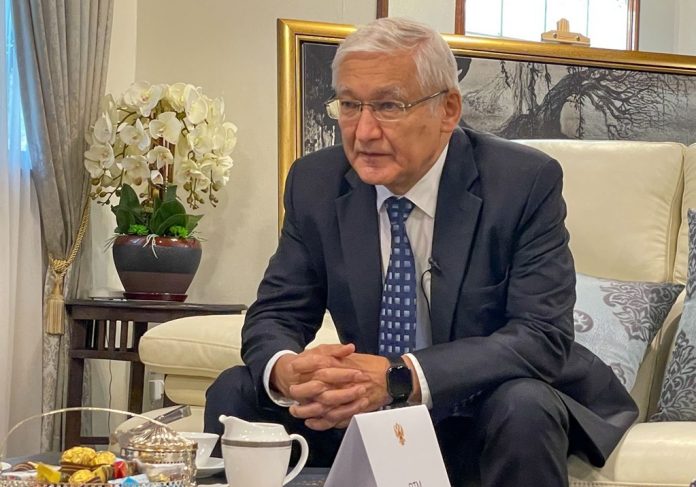
KUALA LUMPUR: Russia is seeking deeper economic engagement with Malaysia across energy, trade and nuclear technology as both countries position themselves to expand commercial cooperation following a year of intensified high-level interaction.
Russia’s ambassador to Malaysia, Naiyl Latypov, said Russia remains economically stable despite global headwinds.
He noted that while gross domestic product (GDP) growth slowed from 4% last year to between 1% and 2% this year, the country continues to pursue its domestic and international economic targets.
Latypov said 2025 marked a notable year for Malaysia-Russia relations, driven largely by Prime Minister Datuk Seri Anwar Ibrahim’s official visit to Moscow and Kazan in May, followed by the first-ever state visit of His Majesty Sultan Ibrahim King of Malaysia in August.
Although the visits did not result in formal agreements, Latypov said, they established a strong foundation for commercial expansion.
“Both of these visits were very fruitful for our relations. No agreements or MoUs were signed, but they laid a very solid base for further development. Now we have very good opportunities to develop our relations and to sign MoUs in different spheres,” he told the media at the Russian Embassy today.
Russia’s emphasis this year is on trade and energy, with Moscow identifying Malaysia as a priority partner for collaboration in oil and gas, liquefied natural gas (LNG) and emerging power technologies.
“This year our trade increased by 30%, to about US$3.2 billion (RM13.2 billion). To be honest, I am not satisfied with these figures because from our point of view we have many possibilities in this sphere,” Latypov said.
He acknowledged that Western sanctions have created structural barriers and uncertainty for some Malaysian companies.
“There are obstacles created for Russia by Western countries, and we do not want to cause any trouble for our Malaysian partners. If some projects are mutually beneficial, business will find a way to work in these conditions,” he said, adding that about 11 Malaysian companies are currently listed under Western sanctions.
Energy remains the core pillar of bilateral cooperation. Latypov said Russian energy firms have held multiple rounds of “productive and promising” discussions with Malaysian oil and gas players on potential LNG and petroleum-related supply arrangements.
“Russia is very rich in natural resources, especially energy. We are ready to continue increasing our supplies of oil products and LNG. There were productive talks between Malaysian companies and Russian producers, and we hope we will have very good results,” he said.
Beyond hydrocarbons, Russia is also offering cooperation in electrical infrastructure and renewable energy technologies, particularly solar and hydroelectric equipment, where several Russian companies are industry leaders.
“We have very good companies producing different kinds of electrical equipment and are ready to cooperate in developing green energy in Malaysia. Some Russian companies are leaders in producing solar panels and have strong experience in equipment for hydroelectric stations,” he said.
A major new proposal now under discussion is nuclear energy, following Malaysia’s stated intention to study long-term atomic energy development. Russia is pushing to position itself as a key partner in civilian nuclear power.
Latypov said discussions cover the full range of nuclear options, from large-scale plants to small modular reactors and floating nuclear platforms.
“We appreciate the Malaysian government’s decision to develop a national atomic energy programme. We are ready to conclude all necessary MoUs or agreements. We are discussing construction of a nuclear power station, whether a big station or a medium or small one. Russia has very good experience.”
Latypov said nuclear cooperation would also create opportunities for Malaysian shipyards, legislation development, regulatory capacity building and local technical employment.
“There are possibilities to use Malaysian industry, especially shipbuilding yards in Sabah and Sarawak.
“We are ready to work on legislation, education and public communication because anti-nuclear sentiments are strong in some countries. We are confident nuclear energy is the cheapest and safest.”



