




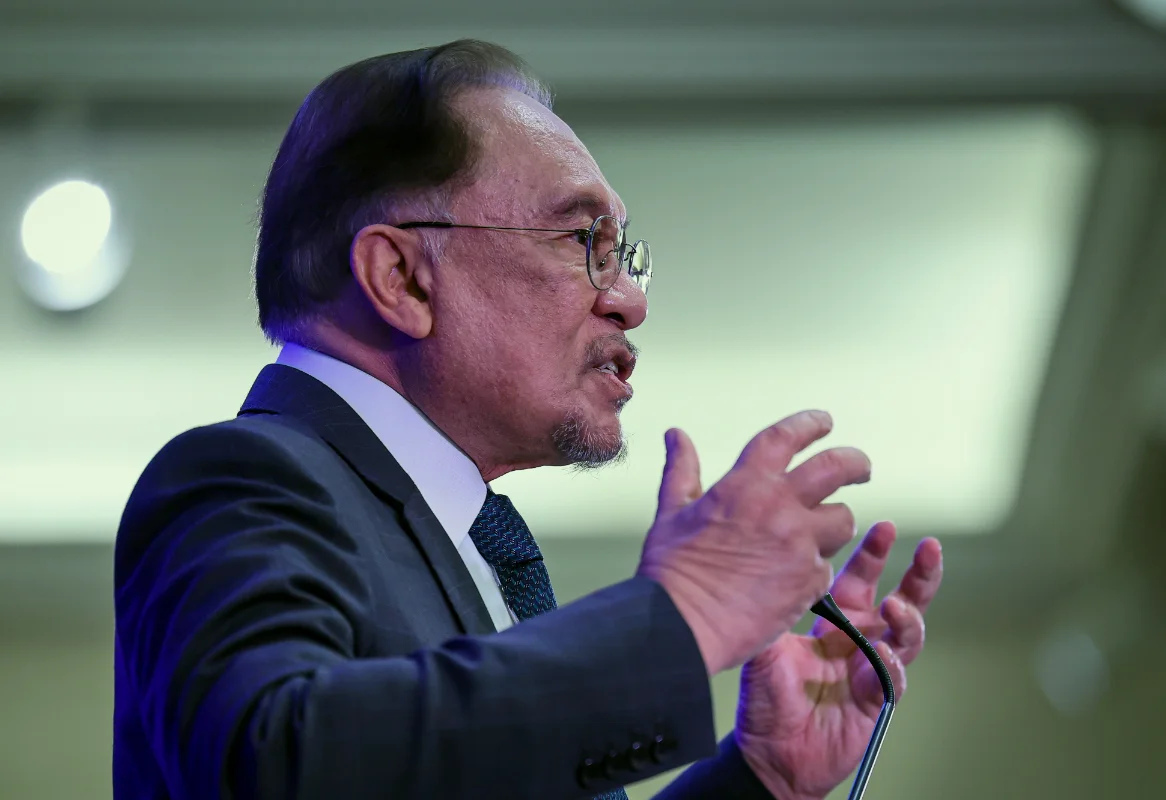
Prime Minister Anwar Ibrahim calls for strategic Malaysia-Turkiye cooperation in technology, digitalisation and AI to tackle global challenges and shared economic vulnerabilities.
ANKARA: Prime Minister Datuk Seri Anwar Ibrahim has called for enhanced strategic cooperation between Malaysia and Turkiye, particularly in technology, digitalisation and artificial intelligence.
He said collaboration is essential for both nations to confront global challenges and achieve mutual prosperity.
Anwar emphasised that their complementary economies make close cooperation vital for significant economic elevation.
He stated this collaboration would help both countries adapt to changing circumstances and maintain flexibility.
This is in response to the failures of developed nations to adhere to a rules-based international order.
Anwar delivered these remarks during a public lecture titled “Power Shift: Strategic Choices For Malaysia and Turkiye” in Ankara today.
He cautioned against both overexuberance and paralyzing fear in the face of rapid technological advancement.
The prime minister is on a three-day official visit to Turkiye which began on Tuesday.
Bilateral trade between the two nations reached USD 5.2 billion in 2024.
A new target has been set to raise this figure to USD 10 billion.
From January to November 2025, Malaysia’s total trade with Turkiye amounted to RM21.2 billion.
Turkiye remains a key economic partner, being Malaysia’s third-largest trading partner in West Asia in 2024.
Anwar, who is also finance minister, highlighted a shift in traditional development models.
He warned that growth models based on employment-intensive manufacturing are under pressure from automation.
“If this transition is poorly managed, the result will be deeper inequality and greater instability,” he said.
He noted both Malaysia and Turkiye face similar practical stakes as manufacturing economies with young populations.
Their challenge is to develop human capabilities that machines cannot replicate, such as critical thinking and creativity.
“This calls for a rethinking of education,” Anwar stated.
He argued that rote learning is insufficient and training must cultivate adaptability and problem-solving.
This ensures technology remains a tool under human control.
Anwar said digital infrastructure is no longer neutral and shapes economic opportunity and governance.
The capacity to set digital standards and protect public trust is now a core government function.
He affirmed that AI, if managed well, can support inclusive growth and improve sectors like healthcare and education.
These initiatives depend on institutional capacity, early investment and aligning technology with social purpose.



