




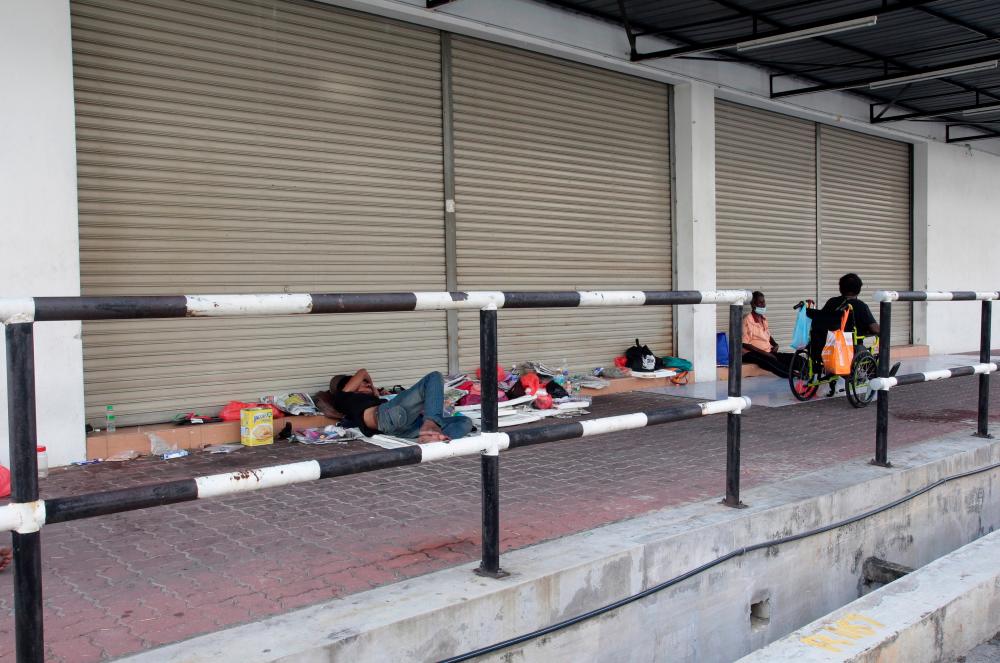
PETALING JAYA: While a lot has been done to ensure affordable housing for the population, many continue to fall through the cracks.
Apart from those who do not fit into any criterion that qualifies them for government-sponsored housing schemes, there are others who do not qualify for bank loans and, more recently, those who have lost everything as a result of the Covid-19 pandemic, leaving many of them without a roof over the head.
While homelessness is not starkly visible in Malaysia, it is a worsening problem. Data on the homeless is scarce, but the most up-to-date figures available from 2016 showed that at that time, there were 1,500 to 2,000 homeless individuals in Kuala Lumpur, compared with only 600 just two years before.
That is a two- to three-fold increase in just two years, and the number is likely to have risen further last year and this, thanks to the Covid-19 pandemic and the economic ruin it has wreaked on the population, according to Universiti Malaya economics professor Datuk Dr Rajah Rasiah.
While the government has advocated low-cost and affordable housing since the 1970s taking cognisance of some of the problems in the sector, Rajah told theSun that the governance processes and nature of allocation have not adequately addressed the problem.
He said the government should put in place a strategy to offer affordable houses to those who cannot afford one as part of a social safety net.
He said the people should also be protected against inflationary pressure that raises cost of home ownership and rental rates.
Rajah cited the government policy on the availability of housing as another cause of homelessness.
Property, he noted, has become the target of price speculation and profiteering. âThe only way to address this is to make housing a public utility, as is the case in France, Germany and the Scandinavian countries.
âOne approach to ensure properties are not significantly diverted to the haves at the expense of the have-nots is to introduce a stiff property gains tax with limitations,â Rajah said.
âGiven that land is a finite resource, prices will continue to be driven by fast-growing demand and little change in supply,â he added.
Rajah said developers in Malaysia have been taking advantage of this demand-supply anomaly. âCoupled with the governmentâs decision to promote the industry by allowing foreigners to buy property here (since the 1997-1998 Asian financial crisis), property prices have been on the rise,â he said.
âAs prices rise, the number of affordable homes also declines. Factors such as unemployment, poverty, urbanisation and the lack of education further add to the social problem of homelessness.â
Universiti Malaya associate professor Dr Goh Hong Ching said that while many can still afford to rent, buying the same property they are renting is beyond their means.
She said the rental rates are still reasonable given the high number of properties available for rent.
Goh, who is with the department of urban and regional planning at the varsityâs Faculty of Built Environment, said many who have the money have purchased several pieces of property, indicating that it is an investment for them.
âAs people continue to buy additional property, it pushes prices up, making it more difficult, if not impossible, for others to buy,â she told theSun.
Goh also noted that those in the M40 group are the worst hit. âThey are only marginally better than those in the B40 group, but they do not get the government assistance that the B40 individuals are entitled to.â



