




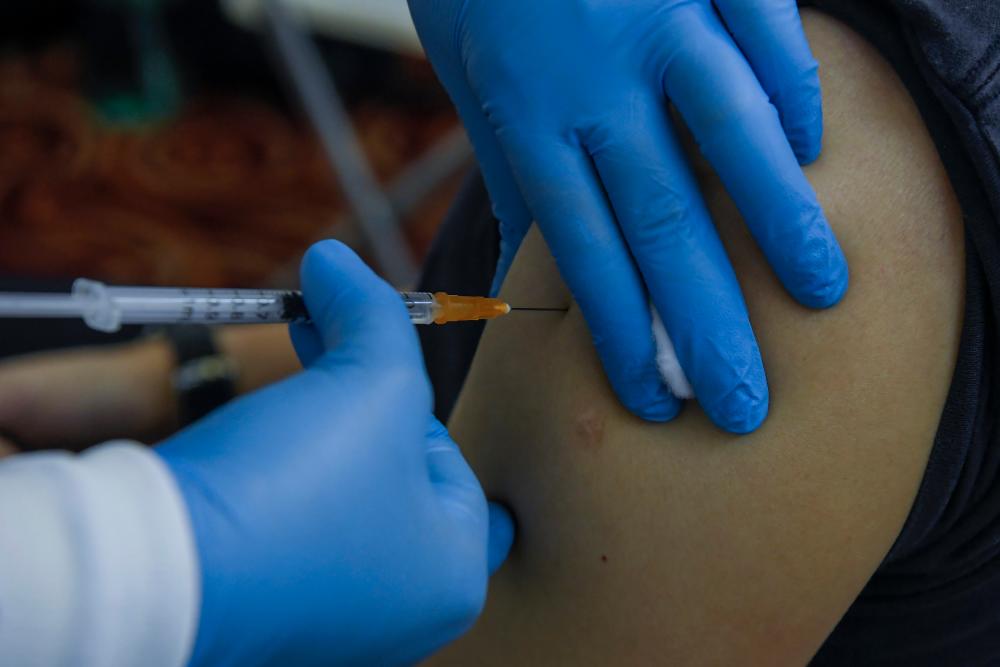
PETALING JAYA: Registering for Covid-19 vaccines under the AstraZeneca opt-in programme has been exasperating for Sharmilla Jeevarathnam.
She tried for two hours but failed to get her parents on the list.
Sharmilla, 24, said getting into the website itself was a challenge.
âIt took almost an hour for it to load. It breaks my heart that I am not able to have my parents vaccinated. I cried with frustration.â
She said both her parents have high blood pressure and her father also has a cardiac stent, making it all the more urgent that they be vaccinated.
The second round of the opt-in programme, offered to those aged 60 and above, started on Sunday in the Klang Valley, Penang, Johor, Kuching and Miri, with 1.24 million doses offered.
Yesterday, the same programme with 300,000 doses was extended to those aged between 18 and 60, and all were taken up in less than an hour.
The slow online registration process, blamed on a failure of the system, drew some backlash, mostly expressed in posts on the Special Committee on Covid-19 Vaccine Supply Access Guarantee website.
Malaysiaâs record of the vaccination process has been less than exemplary. It has surpassed India as the country with the highest rate of infection in Asia, yet remains one of the slowest in the vaccination process.
According to health experts, this calls for drastic measures to help the country cope with an ever-deteriorating situation.
Data from the John Hopkins University shows that on Sunday, Malaysia recorded 185.3 new infections per million people on a rolling seven-day average, compared with 184.99 cases in India and 76.31 in the United States.
Malaysia is still a straggler in the vaccination race. As of May 22, the average daily rate is only 0.26 per 100 individuals, behind even Cambodia, which is recording 0.47 per 100 people and Singapore, which is way ahead at 0.66.
Nonetheless, things have picked up pace in Malaysia. Just a week ago, it was vaccinating a paltry 0.08 per 100 persons.
Universiti Malaya Department of Social and Preventive Medicine head Dr Victor Hoe said there is still a long way to go before Malaysia reaches the exit stage, which is already taking place in countries such as the United Kingdom.
As of early this week, only 3% of the population have been fully vaccinated, way behind the 25.3% recorded by neighbouring Singapore. Cambodia has fully vaccinated 10% of its population.
Hoe suggested that the vaccination process be decentralised to enable state governments to manage their own immunisation programmes, and that vaccination centres be opened around the clock to speed up the process.
âWith decentralisation, we will also be able to improve delivery as the bottleneck is in the supply chain,â he told theSun.
Virologist Dr Sandy Loh of Nottingham University Malaysia agreed that there is a need to speed up the vaccination process, adding that she does not think it is necessary for the process to be conducted around the clock.
âWe should extend the duration to 12 hours a day. Going all the way to 24-hour days will just increase costs and can cause inconvenience for both vaccination administration personnel and those who are receiving the vaccines.â
She said the programme to train personnel in administering vaccines should continue and the number of vaccination centres be increased by using private clinics, university campuses and even non-health facilities.
Apart from public health facilities, 12 private hospitals nationwide have been given the go-ahead to help out in the vaccination process, but the supply of vaccines is still under the control of the government.



