



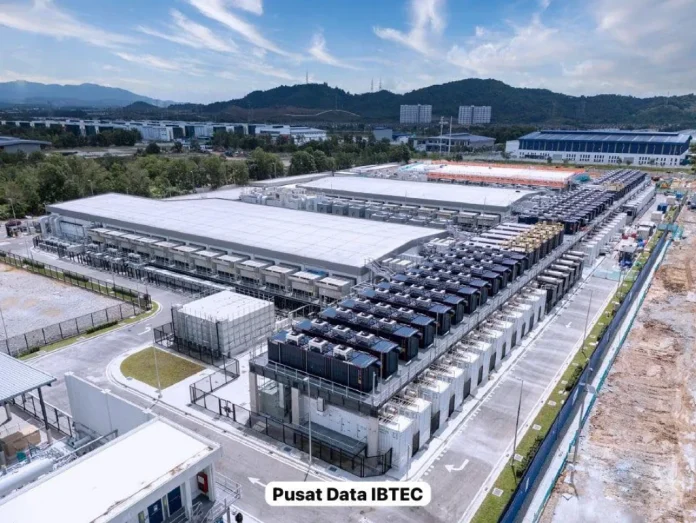
Johor’s special technical committee evaluates data centre projects for water and electricity needs, setting strict water usage efficiency standards
JOHOR BAHRU: The Johor state government has assured that every data centre project undergoes a thorough and rigorous evaluation before approval is granted.
State Public Works, Transportation, Infrastructure, and Communications Committee chairman Mohamad Fazli Mohamad Salleh said a Special Technical Committee has been established to assess each project holistically.
The committee focuses on water and electricity supply needs, utility issues, and the suitability of the development zone.
It comprises representatives from all relevant technical departments and agencies at both the state and federal government levels.
A key aspect assessed is the Water Usage Efficiency (WUE) of the data centres and the total water required for the entire development project.
“Many are concerned about the development of data centres in Johor due to the belief that data centres consume a large amount of water to cool their equipment, which could affect the capacity of treated water available,” he said in a Facebook post.
Johor has set a WUE threshold of 1.8, which is the same standard as Singapore.
He added that even if a data centre achieves a WUE below 1.8, approval still depends on the availability of sufficient water in the area.
Compliance with the WUE standard alone does not guarantee approval, as it also depends on local water resource availability.
He explained that modern cooling technologies can achieve much lower WUE values than the set threshold.
These include Immersion Cooling and Direct-to-Chip Liquid Cooling, which record WUE values ranging from 0.05 to 0.2.
Other cooling technologies do not directly use water, such as Chilled Water with CRAH (Dry Coolers) and DX CRAC (air cooling) systems.
These alternatives only use minimal water for domestic purposes like toilets and kitchens.
If data centres still require water as a cooling medium, the technical committee instructs project consultants to explore alternative water sources.
This is to avoid relying solely on existing treated water supplies.
“In some cases, data centre developers have been asked to use treated recycled water from sewage treatment plants for cooling purposes,” he added.
For example, Bridge Data Centres (BDC) and Computility Technology (Malaysia) have adopted this approach.
Certain data centre projects have also been directed to collaborate with Johor Special Water (JSW) to provide alternative water sources.
This ensures suitable water for cooling tower systems without affecting the treated water supply for public use.



