




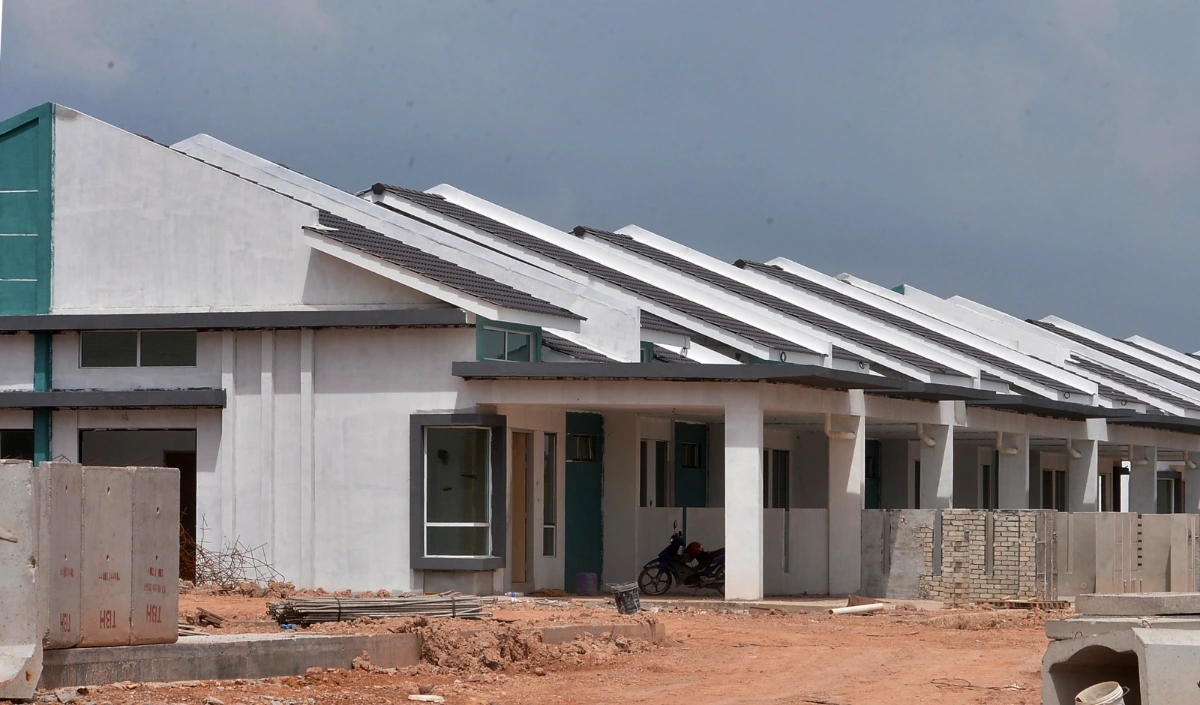
Malaysia has over 30,000 completed homes unsold due to high prices, says an academic who warns of a widening affordability gap.
PETALING JAYA: Malaysia’s housing problem is not a lack of homes but a lack of affordable ones, with more than 30,000 completed units lying unsold while many aspiring homeowners remain priced out of the market.
Universiti Teknologi Malaysia property economics and finance associate professor Dr Muhammad Najib Razali said the country’s growing housing overhang reflects a widening disconnect between what developers are building and what buyers can realistically afford.
READ MORE: Malaysia’s housing affordability crisis driven by price-income gap: Expert
READ MORE: Malaysia records 32,801 unsold homes worth RM16.37bil as housing supply-demand mismatch persists
“Malaysia’s housing market suffers from a mismatch between what is being built and what households can actually afford.
“The latest Property Market Report 2025 recorded 30,471 completed residential units remaining unsold, a 31.6% increase from the previous year.
“Nearly half were condominiums and apartments while terrace houses made up about one-third of the total.”
Najib said the supply pipeline continues to grow, with another 72,384 residential units still under construction, indicating the overhang is likely to persist.
He said the issue is not an overall shortage of homes but a shortage of homes within the price range most Malaysians can afford.
“Buyers earning RM5,000 to RM8,000 a month are typically looking for homes around RM250,000 to RM400,000, but much of the urban supply, especially highrise and serviced apartment products, is priced above that level.”
He said the mismatch is most evident in serviced apartments, where 55.8% of completed unsold units are priced between RM500,001 and RM1 million. Najib said the continued approval of new projects despite signs of oversupply is largely due to how developments are assessed.
“The difficult question is why development approvals continue despite signs of oversupply.
“One reason is that approvals are often assessed project-by-project based on planning compliance, land-use zoning, density rules, infrastructure requirements and technical conditions, not necessarily on whether the wider market can absorb another few thousand units at that price point.”
He said this means a project could meet all planning and regulatory requirements even when demand for homes at that price level is already weakening.
He added that development timelines also contribute to the imbalance, as projects approved during stronger market conditions may only be completed years later, by which time household incomes, lending conditions, interest rates and buyer sentiment have shifted.
“By the time the units enter the market, demand may have shifted.” Najib said policymakers have to contend with competing priorities.
He added that while the government wants to improve affordability and reduce oversupply, the construction sector also supports employment, infrastructure development, state revenue and broader economic activity.
He pointed to Budget 2025 measures, including PR1MA, Rumah Mesra Rakyat, the Housing Credit Guarantee Scheme, first-homebuyer tax relief and step-up financing, as efforts to support both homeownership and the property market. He said ultimately, Malaysia does not have “too many houses” but too many homes in the wrong locations, price brackets and product types for today’s buyers.
“There is excess supply in parts of the higher-priced urban and highrise segment while many households still face a shortage of genuinely affordable, well-located homes.”
Looking ahead, Najib warned that if house prices continue rising faster than wages, the affordability gap could become structurally unsustainable.
“If median incomes grow only around 3% to 4% annually but urban house prices continue rising around 5% to 7%, the affordability gap compounds quickly.
“Within five to seven years, many middle-income households would no longer be able to buy even entrylevel urban homes without very high leverage, family support or government schemes.”
He said the more likely scenario is not a nationwide property crash but a prolonged period of slower growth and adjustment.
“Rather than a sudden nationwide collapse, the more likely outcome is a prolonged period of stagnation and adjustment where real housing returns weaken, speculative activity fades and the market slowly reanchors itself closer to actual household purchasing power.”
Najib said the impact would not be uniform across segments.
He said prime landed homes in limited locations are expected to remain relatively resilient while high-rise and serviced apartment segments with excess supply are likely to face greater pressure.
“The more realistic risk is a long affordability squeeze, where prices do not collapse sharply but ordinary wage earners are gradually priced out of ownership.”
He added that Malaysia is therefore more likely to see slower price growth, extended selling periods and rising reliance on rental housing, rather than a sharp market correction.



