




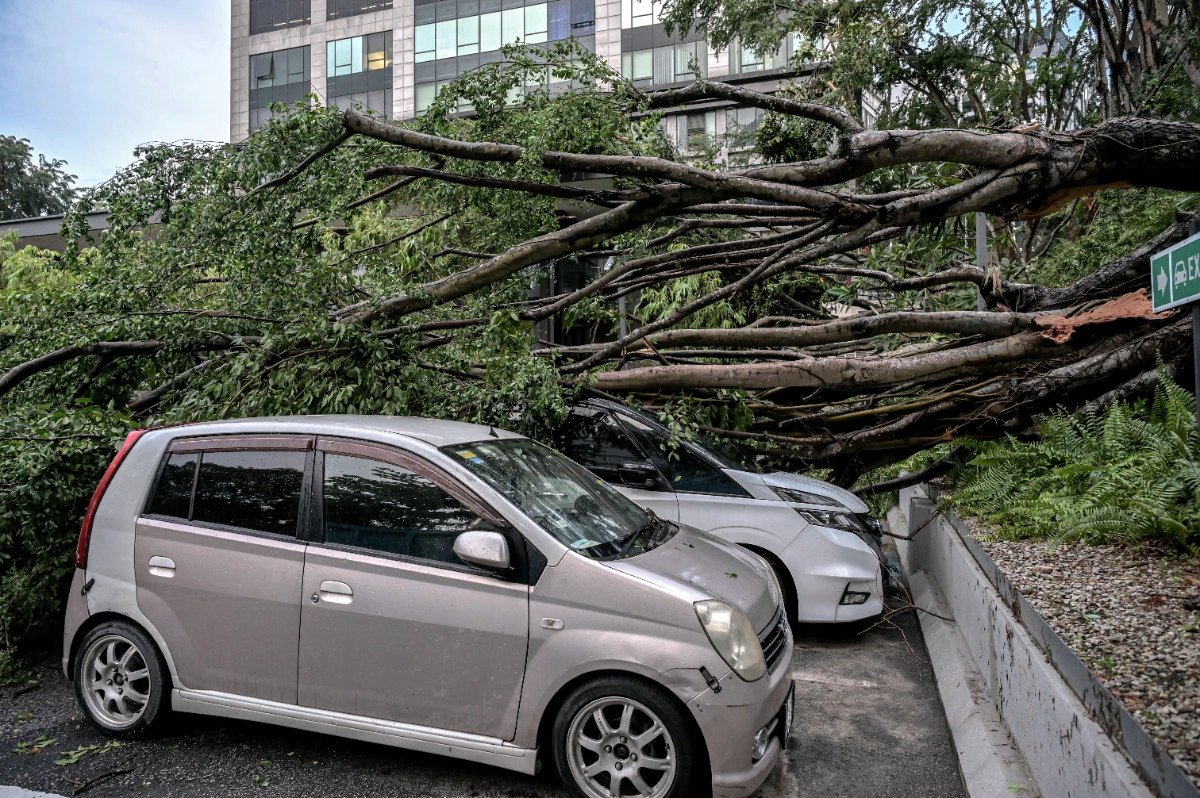
Ecological Association of Malaysia president Prof Dr Ahmad Ismail said tree failures were rarely caused by a single factor, but usually resulted from a combination of issues.
PETALING JAYA: The fatal tree collapse that claimed a motorist’s life in Kuala Lumpur has renewed calls for stricter monitoring of mature roadside trees, with experts warning that proper inspections by qualified personnel, not indiscriminate felling, are key to preventing similar tragedies.
Ecological Association of Malaysia president Prof Dr Ahmad Ismail said tree failures were rarely caused by a single factor, but usually resulted from a combination of issues such as age, disease, inadequate maintenance, root damage, soil conditions and weather.
“The tree may have fallen due to age, disease, inadequate monitoring and maintenance, root damage, soil conditions or weather.
“It is usually a combination of factors rather than a single cause,” he told theSun.
Ahmad, who is also a former president of the Malaysian Nature Society, cautioned against removing mature trees indiscriminately following such incidents, saying each case should be assessed based on the tree’s condition and surroundings.
“It depends on the location and the condition of the tree. Pruning and treatment may sometimes be enough. Experts should advise on the appropriate action.”
He said road widening and heavy traffic could damage tree roots, while resurfacing works, soil erosion and underground water movement could also undermine a tree’s stability, depending on soil characteristics and the species involved.
Rapid urban development, including the construction of high-rise buildings, could place additional stress on mature trees, while extreme weather remained another contributing factor.
Ahmad urged local authorities to ensure tree health assessments are carried out regularly by qualified personnel trained in arboriculture, tree health and disease management.
“Universiti Putra Malaysia and professional bodies such as the Malaysian Society of Arborists could help provide training for local authority staff and contractors responsible for managing roadside trees,” he said.
He added that some mature trees planted decades ago might no longer be suitable for their surroundings as road widening and other urban development could affect their root systems and growing conditions.
Meanwhile, Alliance for a Safe Community chairman Tan Sri Lee Lam Thye described the incident as a wake-up call and called for a thorough and transparent investigation into whether adequate inspections, maintenance and risk assessments had been carried out on ageing trees in high-risk urban areas.
“If negligence or lapses in maintenance are found, appropriate action must be taken to ensure accountability and prevent similar incidents in the future,” he said in a statement.
Lee urged local authorities to immediately review the condition of mature trees along major roads, residential areas, schools, hospitals and other public spaces, saying those posing a potential danger should be professionally assessed, pruned or removed where necessary.
He also called for closer coordination between local authorities, landscape departments and disaster management agencies to strengthen urban tree management and emergency preparedness.
“We should not wait for another life to be lost before taking preventive action. Every avoidable tragedy is one too many,” he said.
The calls came after a 43-year-old man died when a tree fell onto his car along Jalan Tun Razak, in front of Dua Residency near the Singapore High Commission at about 10.20pm on July 18.
He suffered injuries to both arms and internal bleeding, and died while receiving treatment at Kuala Lumpur Hospital at 4am the following day.
Following the incident, Kuala Lumpur City Hall launched a technical investigation with the Malaysian Society of Arborists to determine the cause of the tree failure, including examining the tree’s condition, root system, soil and maintenance records.
City Hall said the 19-year-old yellow flame tree was last inspected on May 15.
The local authority has since begun a 10-week inspection of mature trees along major roads in Kuala Lumpur and plans to install 400 tree-monitoring sensors at high-risk locations, subject to Sirim approval.



