



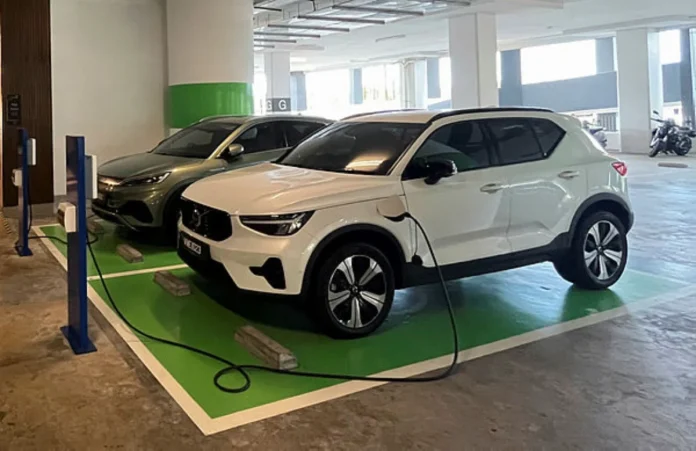
TNB says EVs and public charging stations have multiple safety systems, making electric shock risk almost zero during floods.
KUALA LUMPUR: Tenaga Nasional Berhad (TNB) has moved to allay public concerns over the safety of electric vehicles (EVs) during floods.
The utility giant emphasised that user safety is its top priority, especially during extreme weather like the monsoon season.
TNB stated that EVs are designed with strict safety systems, including automatic power cut-off mechanisms and tightly sealed battery structures.
ALSO READ: TNB cuts power in Kuantan areas for safety amid ongoing floods
“EVs are designed with very strict safety systems to ensure they remain safe during floods,” TNB said in a written response to Bernama.
Modern public charging stations are built with water-resistant designs, automatic cut-off systems, and moisture sensors.
These devices will automatically stop operating when irregularities occur, including when submerged by floodwaters.
Most charging stations are also fitted with flood detectors to detect rising water levels early.
Site conditions are monitored through CCTV and by site partners to ensure accurate flood information.
Charging station operators have a specific Emergency Response Plan for floods coordinated with TNB’s safety procedures.
This ensures charging operations can be shut down and safety actions taken quickly.
The risk to the electricity grid is very low as stations have multiple layers of protection like fuses and circuit breakers.
TNB also uses smart systems like the Advanced Distribution Management System for real-time monitoring.
The company has mapped flood-affected areas in real time through its Flood Analysis and Risk Assessment System.
This data helps TNB take proactive measures like patrols at potentially affected installations.
TNB advised EV users to stop charging immediately and move vehicles to higher ground if flooding occurs.
Users are advised not to touch submerged charging equipment or attempt to move a submerged EV.
They should also avoid charging vehicles during heavy rain or when the surrounding area is flooded.
Zero Emission Vehicle Association president Wan Ahmad Zam Zam Wan Abd Wahab echoed the safety assurances.
He said there have been no reports of electric shock incidents involving EV charging stations during floods.
“Critical equipment, such as control panels and distribution boards, is usually installed at higher levels,” he said.
He added that the systems are designed in a fail-safe mode to safely shut down during abnormal conditions. – Bernama



