



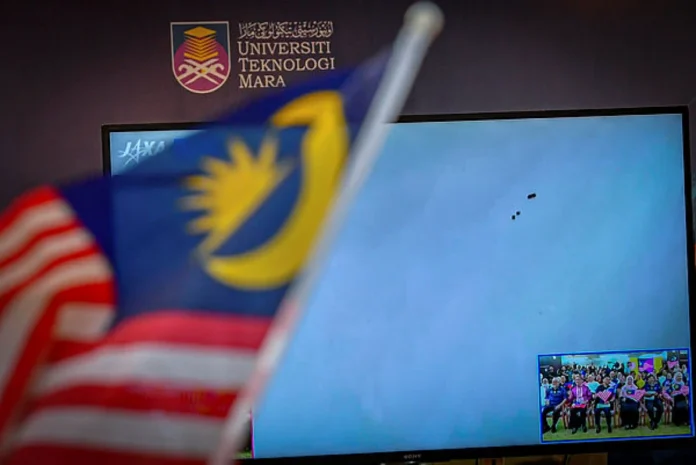
UiTM makes history as its UiTMSAT-2 nanosatellite enters orbit from the ISS, marking a milestone for Malaysia’s space technology capabilities.
SHAH ALAM: Universiti Teknologi MARA (UiTM) has created history with the successful orbital deployment of its second nanosatellite, UiTMSAT-2.
The 1.1-kilogramme CubeSat was released from the International Space Station at 6.52 pm Malaysian time.
Project leader Dr Fatimah Zaharah Ali said the satellite was deployed via the Japanese Experiment Module using the J-SSOD mechanism.
UiTMSAT-2 carries a primary Earth observation camera mission and a secondary space-based Internet-of-Things function.
“It is aimed at transmitting sensor data from remote areas that do not have a terrestrial connection network,” she said.
The satellite will operate in Low Earth Orbit at an altitude of 380 to 400 kilometres.
It is expected to orbit the Earth 16 times every 24 hours.
The project development began in February 2021 at UiTM’s Faculty of Electrical Engineering.
The Flight Model was developed at Japan’s Kyushu Institute of Technology from 2024 to 2025.
Funding was provided by the Ministry of Science, Technology and Innovation through a RM500,000 grant.
UiTM Vice-Chancellor Professor Datuk Dr Shahrin Sahib said the launch proves Malaysia’s technological readiness.
“UiTMSAT-2 is a symbol of local expertise and proof that public universities can drive the country’s strategic technology,” he added.
The satellite was launched to the ISS last October via a Japanese H3 rocket.
Strategic collaborators include universities from the Philippines, Thailand and Japan.



