



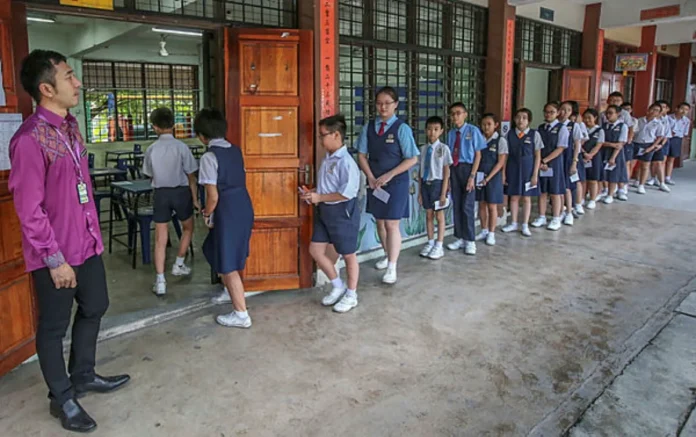
Parents say centralised examination useful benchmark; raise concerns over difficulty of current coursework
PETALING JAYA: Parents have welcomed the introduction of a national assessment for primary school pupils in Year Four beginning this year.
For 41-year-old civil servant who wished to be known as Wani, the return of a centralised examination is a positive step.
However, she stressed that parents’ real concern lies not with the examination, but with the current school syllabus, which she described as challenging.
“From what I’ve read, this assessment will only involve core subjects. I think that is good. But there is a big hope that the syllabus will also be reviewed. The Year Four Mathematics syllabus, for example, feels like what students study in Form Three,” she said.
Meanwhile, Mohamad Sufian Bustamin, 36, said the move would give parents a clearer picture of their children’s actual academic performance.
“If you ask me, it’s good to have this kind of test because we want to know where our children really stand. Right now, teachers’ assessments are based more on observation rather than being results-oriented,” said the human resources officer.
He also agreed with Wani’s view that today’s school syllabus is particularly demanding.
“Sometimes, even parents can’t answer the questions in the current exercise books.”
Prime Minister Datuk Seri Anwar Ibrahim announced that the centralised examination will be introduced in Year Four starting this year and will be administered by the Malaysian Examinations Board.
Anwar said the subjects involved are Bahasa Melayu, English, Mathematics and Science. History will be added in 2027, bringing the total number of assessed subjects to five.
“Teachers should remember that there will be a Year Four assessment this year. Why wait until Year Six? We are implementing this evaluation so that we can identify weaknesses early.
“With two more years, Year Five and Year Six pupils will have sufficient time to improve before entering Form One,” he said at the launch of the National Education Plan 2026–2035 in Putrajaya yesterday.
Previously, the UPSR was abolished in 2021 and replaced with the yearly school-based assessment system, which places greater emphasis on continuous evaluation throughout the learning process rather than centralised examinations.



