



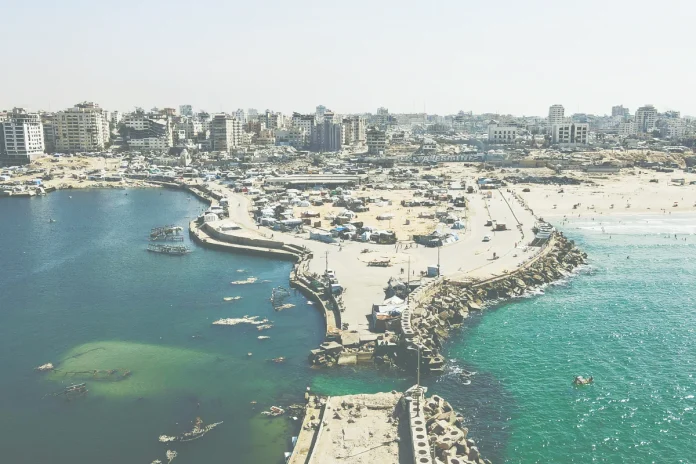
The council’s main operational focus in Gaza is “Project Sunrise”, a US$112 billion revitalisation plan that envisions transforming the war-torn territory into a high-tech “Riviera” coastal city
AT the World Economic Forum meeting in Davos, Switzerland, US President Donald J. Trump officially launched the Board of Peace (BoP).
The BoP was designed as a transitional mechanism for the reconstruction of the Gaza Strip after the devastating war that began in October 2023.
The Peace Council has rapidly developed into a centralised and transactional governing body that challenges the traditional dominance of the United Nations and established norms of international law.
Comprising a select coalition of world leaders and private-sector figures, the board is led by Trump.
It seeks to implement the “Comprehensive Plan to End the Gaza Conflict” – a 20-point roadmap that prioritises economic development, technocratic governance and absolute demilitarisation over traditional political settlements and sovereignty rights.
The conceptual origins of the Peace Council lie in the “Trump Declaration for Peace and Sustainable Prosperity”, a framework codified in late 2025 and endorsed by the UN Security Council through Resolution 2803.
Although the resolution welcomed the council as a transitional administration with authority only until 2027, the official launch of the Peace Council Charter in January 2026 revealed ambitions that far exceeded this narrow mandate.
Specifically, the Peace Council Charter does not mention Gaza, positioning the body instead as a permanent international organisation designed to “restore reliable and legitimate governance” in regions threatened by conflict.
This transition signals a “bait-and-switch” strategy in which the international community agreed to a limited peace process only to find that it has legitimised Trump’s personal diplomatic tool, operating as a “Trump UN”, a parallel structure to the existing multilateral one.
The Peace Council’s “chair-centric” structure concentrates unprecedented power in Trump rather than in the office of the US president.
The charter designates Trump as “first chair for life”, who can only be replaced by voluntary resignation or a unanimous vote of incapacity by an executive board he appoints.
A controversial “pay-to-play” model reinforces this corporate governance model. Although membership is free for the first three years, “permanent membership” is reserved for countries that pay US$1 billion (RM3.94 billion) into a fund controlled by the chair.
Critics have called this model an imperial palace where wealthy countries, such as Saudi Arabia and the UAE, buy ongoing geopolitical influence.
Meanwhile, dissenting countries, such as Canada, risk being “fired” or having their invitations revoked for seeking strategic autonomy.
Gaza’s sovereignty
The council’s main operational focus in Gaza is “Project Sunrise”, a US$112 billion (RM454 billion) revitalisation plan that envisions transforming the war-torn territory into a high-tech “Riviera” coastal city.
The plan is based on the “entrepreneurial” belief that material conditions can shape political possibilities and assumes that the lure of economic prosperity will outweigh the lure of resistance.
The master plan outlines four phases of development, beginning in the south with “New Rafah” and progressing northward to the smart city of “New Gaza”.
A key part of this vision is monetising 70% of Gaza’s coastline by constructing up to 180 skyscrapers and luxury resorts.
This project will utilise an estimated 68 million tonnes of war rubble for land reclamation and the creation of new islands. The plan relies on a “humanitarian bubble” to secure this investment.
This concept involves high-security residential zones where Palestinians are granted only essential services after submitting biometric documents and undergoing security checks.
This effectively creates a fragmented “green zone” reality. The government under the Peace Council has taken a technocratic direction by forming the National Committee for the Administration of Gaza (NCAG).
Led by Dr Ali Shaath, a civil engineer and former deputy minister of the Palestinian Authority, this 15-member committee is tasked with restoring daily civilian life.
However, the NCAG operates under the direct supervision of the Peace Council and its “high representative”, Nickolay Mladenov.
This places the NCAG at the lowest level of a hierarchy that excludes Palestinians from meaningful strategic decision-making.
International legal experts have criticised this plan, arguing that it depoliticises the Palestinian struggle by treating the destruction of Gaza as a business issue rather than a political and international legal one.
Instead, this plan functions as a mechanism for “genocide management” that places the population under external colonial control.
Security in the Gaza Strip is managed by the International Stabilisation Force (ISF).
Although the ISF is intended to replace Israeli forces, it is tasked with carrying out “total demilitarisation” in the Gaza Strip.
This includes destroying all tunnel infrastructure and implementing a programme to “disarm” Hamas.
The Peace Council’s “hidden motives” imply a broader agenda to disrupt the established international order.
Trump has developed a mechanism to circumvent the bureaucratic constraints and vetoes of the UN Security Council by creating a selective coalition outside the UN system.
The Council essentially commercialises peace by involving venture capitalists, such as Marc Rowan and property developers, such as Yakir Gabay, to ensure that “reconstruction” aligns with the interests of international investors.
Furthermore, the BoP serves as a platform for expanding the Abraham Accords, presenting normalisation with Israel as a means to achieve shared prosperity and regional security while effectively disregarding the political aspirations of the Palestinian Authority.
The Council’s implications for Gaza and Palestine’s existence are profoundly negative and potentially devastating for the “two-state solution”.
The Council’s plan reflects an attempt to erase Gaza’s original character by transforming it into a source of cheap labour for an industrial zone that is separated from the West Bank.
The 20-point plan promises non-annexation and a conditional “path to sovereignty”. Still, this path depends entirely on reforms by the Palestinian Authority and the end of accountability actions in international courts.
Furthermore, the BoP strategy deliberately neglects UNRWA (United Nations Relief and Works Agency), aiming to revoke Palestinian refugee status and the associated right of return by taking over aid distribution through the NCAG.
In conclusion, the Peace Council represents a radical shift from traditional diplomacy, replacing “international law” with “Trump model law” that prioritises executive will and corporate investment over the sovereign rights of the Palestinian state.
For Palestine, the Peace Council represents an existential threat of managed fragmentation, replacing the dream of a united, sovereign state with a corporate-managed “Riviera” under permanent external oversight.
Whether the Council will succeed as a “pilot project” for global conflict resolution remains to be seen.
Still, its immediate impact is to transform a humanitarian disaster into a transactional investment opportunity.
Chairul Fahmi is a legal and geopolitical analyst at Ar-Raniry State Islamic University in Banda Aceh, Indonesia.
Comments: letters@thesundaily.com



