




Malaysia’s overcrowded public hospitals require systemic redesign, not just more beds, using airport-style flow management and predictive analytics.
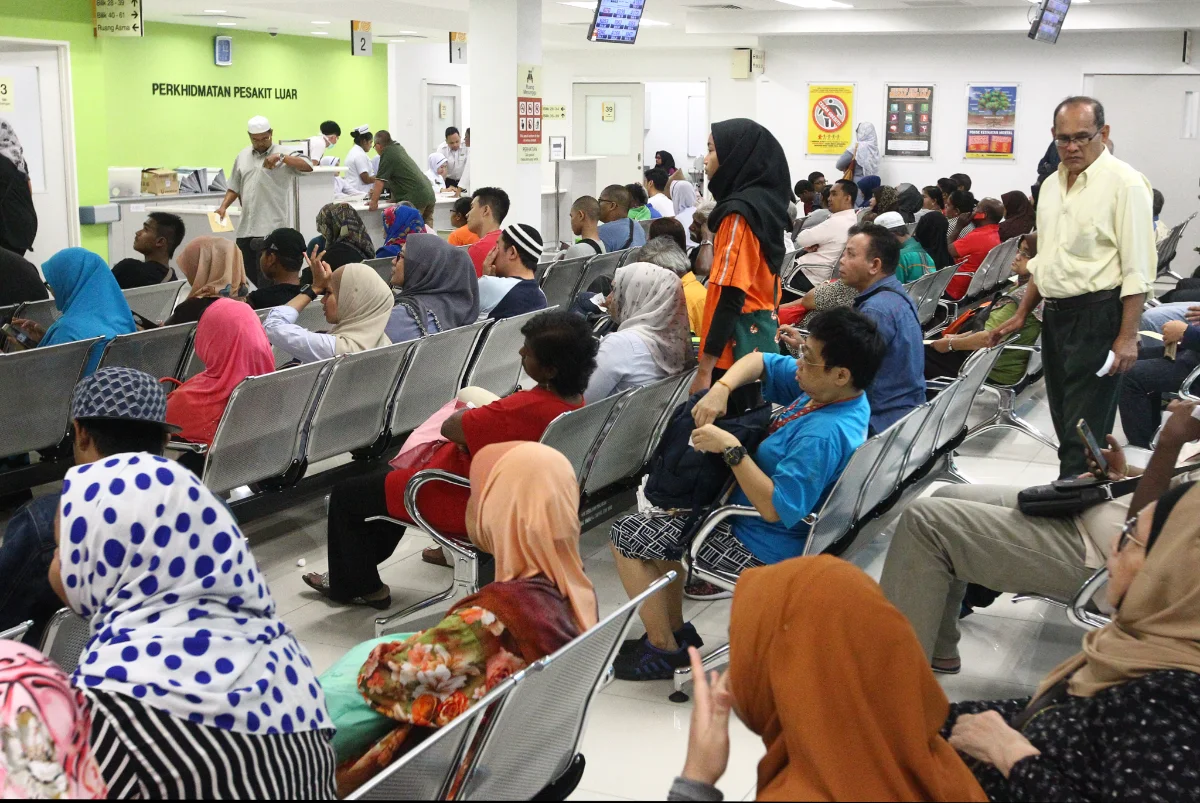
MALAYSIA’S healthcare system is approaching a critical inflection point. Recent visits to public hospitals reveal a familiar pattern: overcrowded corridors, fatigued staff and waiting areas operating well beyond comfortable capacity.
According to the Health Ministry, public hospitals frequently exceed 83% bed occupancy, with some wards reaching full capacity.
Despite the tireless efforts of healthcare professionals, the data points to a structural constraint – simply adding more beds is no longer sufficient to meet demand.
What is required is not incremental expansion but systemic redesign. Hospitals must operate as integrated, coordinated systems rather than fragmented collections of departments.
Airports provide a useful operational analogue. They manage high volumes of people in time-sensitive, high-stress environments governed by strict safety protocols, yet maintain a high degree of efficiency and flow. This is not a function of space but of design – airports are structured as systems of movement, information and coordination.
At first glance, the comparison may seem counterintuitive. Aviation concerns travel while healthcare deals with matters of life and death. However, both are complex, high-stakes systems that require the precise coordination of people, equipment and time under conditions of constant uncertainty.
Although the outcomes differ, the underlying operational challenges – logistics, queue management and resource allocation – are strikingly similar. Yet, in Malaysia, the so-called airport model has largely remained conceptual, with limited translation into practical, system-wide implementation.
Consider the typical airport experience. Upon entering the terminal, passengers are immediately guided by a centralised information display – the departure board – which provides clear, real-time updates on gate assignments and delays. This visibility reduces uncertainty and enables more effective planning and decision-making throughout the journey.
Now, contrast this with the experience in a Malaysian hospital. A patient arrives at the clinic, often wandering through the lobby, unsure of which department corresponds to their symptoms.
In the absence of clear guidance, what begins as a medical concern quickly becomes a confusing and exhausting maze.
Staff shortages further compound the problem. Malaysia’s nurse-to-patient ratio, currently at 1:20, remains below the World Health Organisation recommendation of 1:8, limiting the capacity of nurses to provide continuous updates and coordinated patient navigation.
If hospitals implemented digital patient-flow tracking, similar to how airports track luggage, patients and staff can access real-time updates on queue lengths, bed availability and estimated waiting times.
Such a system would reduce uncertainty and stress, improve communication and enable healthcare workers to focus more directly on clinical care rather than logistical coordination.
Reactive vs predictive
The issue in our hospitals is not about lack of medical expertise but is in system design and operational intelligence.
Airports use modern Airport Management Systems to predict congestion before it happens. Hospitals, in contrast, often respond “reactively”.
In effect, we often wait for the fire to start before we look for water. Airports, by comparison, rely on data and forecasting to ensure the fire is prevented in the first place.
Predictive modelling and simulation techniques, as used in airport design, can be applied to patient flow in hospitals to identify peak demand periods and optimise staffing schedules in advance.
Some may worry that making a hospital as efficient as an airport risks making it feel impersonal. In reality, efficiency and empathy are not mutually exclusive.
When hospital systems function smoothly, staff can spend less time answering repetitive queries or managing queues. This, in turn, allows doctors and nurses to devote more time to patients – listening more carefully and delivering more personalised care.
For example, by using digital dashboards to allocate beds and track patient flow, a nurse can spend additional time with each patient instead of updating charts or manually guiding patients through the system. In this sense, efficiency creates space for empathy. While automated systems may appear impersonal, they can ultimately enable healthcare delivery to become more human and attentive.
Path forward
In Malaysia, there is often a stronger emphasis on acquiring the latest and most expensive medical equipment than on designing the flow of hospital spaces.
Patient flow, however, is frequently neglected, despite being a solvable systems and engineering problem. In airport development, passenger flow simulations are routinely conducted before construction begins, allowing bottlenecks to be identified and addressed in advance.
Biomedical engineers and healthcare planners should adopt a similar approach, treating hospital design as a question of systems efficiency as much as clinical capability.
Hospitals should be treated as systems in which workflow, spatial layout and digital integration are as important as medical equipment. Pilot programmes can be introduced at department level, testing predictive software and patient-flow dashboards before being scaled across the wider hospital network.
Malaysia does not simply need more hospitals; it needs smarter ones. By investing in digital systems, hospitals can reduce waiting times and anticipate bottlenecks before they escalate into crises.
Hospitals that integrate predictive analytics can reduce average waiting times by up to 30%, while also freeing up staff time for direct patient care – thereby improving both patient satisfaction and clinical safety.
Hospitals do not need to become airports. A hospital will always remain a place of healing. However, by adopting the airport’s discipline of flow management and information clarity, we can make our hospitals safer, more dignified and ultimately more humane for all.
Nur Qhamarina Ahmad Sanusi is a final year student at the Department of Biomedical Engineering, Faculty of Engineering, Universiti Malaya. Comments: [email protected]



