



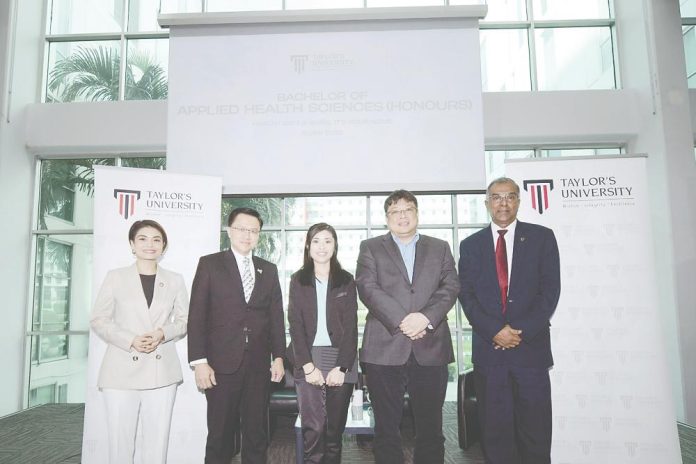
Taylor’s University has responded to the increased demand for health professionals with the launch of its Bachelor of Applied Health Sciences (Honours) programme, which aims to prepare graduates to meet the critical need in the areas of genetics, embryology, neuroscience and nutrition.
At the same time, according to Professor Dr PT Thomas, Executive Dean of the Faculty of Health and Medical Sciences, Taylor’s University, there is a call to action by Malaysia’s Ministry of Health in its Health White Paper (2023), where an urgent need to strengthen the current healthcare workforce is highlighted.
“The country is faced with a critical shortage of specialists, especially in rural areas, which hampers healthcare access and quality.
“The other fast emerging problems include the rise of communicable diseases, non-communicable diseases (NCDs), an ageing population, and the growing emphasis on mental health services.
“The introduction of the programme aligns with Malaysia’s rapidly expanding healthcare sector, which is projected to grow at a compound annual growth rate (CAGR) of 13.5%, reaching USD 48.41 billion by 2028,” he said.
Currently offered under the School of Biosciences, this 3-year undergraduate honours programme provides students with a robust foundation in applied health sciences. The curriculum is designed to equip students with advanced knowledge, hands-on expertise, and research capabilities to excel in Malaysia’s dynamic healthcare landscape.
The four key areas, which will be specialisation of research and development includes Genetics, an understanding of the genetic basis of diseases and advancements in genetic technologies, Embryology, which delves into embryonic development and cutting-edge reproductive technologies, Neuroscience, which explores the complexities of the human brain, including neural pathways, brain-behaviour relationship, and neurological disorders and Nutrition, which examines the impact of diet on health, metabolism, and strategies for disease prevention.
The programme incorporates advanced tools such as Clustered Regularly Interspaced Short Palindromic Repeats (CRISPR), Brain-Computer Interface (BCI), In Vitro Fertilisation (IVF), and wearable-sensing technology, thus preparing graduates to address modern healthcare challenges.



