



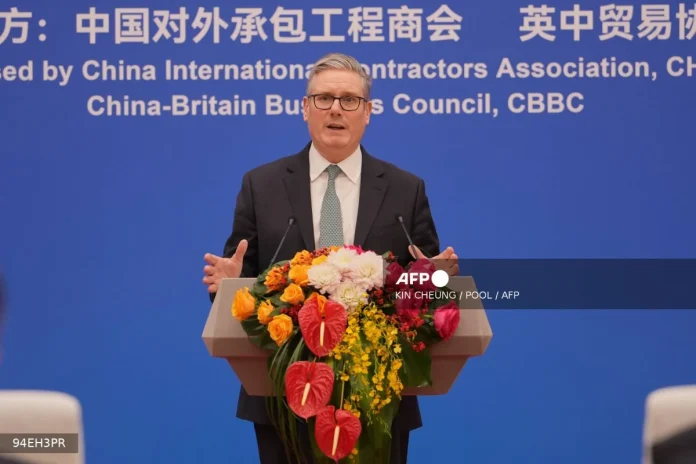
Western leaders including Keir Starmer are warming trade relations with China, driven by US tariff unpredictability and the need for economic growth.
TOKYO: Western leaders are actively thawing trade relations with China, a shift analysts attribute to pressure from unpredictable US tariffs under Donald Trump.
British Prime Minister Keir Starmer’s visit to Beijing this week follows similar diplomatic advances from the leaders of Canada, Ireland, France and Finland.
Most were making their first trip to China in years to refresh partnerships with the world’s second-largest economy.
“There is a veritable race among European heads of government to meet with (Chinese President) Xi Jinping,” Hosuk Lee-Makiyama, director of the European Centre for International Political Economy, told AFP.
He said this is driven by rivalry to secure investments before key China-US summits.
The United States is “no longer a reliable trading partner”, said William Alan Reinsch at the Washington-based Center for Strategic and International Studies.
He argued Trump’s policies ironically pushed the new EU-India Free Trade Agreement across the finish line after 20 years of negotiation.
Starmer told Xi it was “vital” to develop the bilateral relationship, with the Chinese leader also stressing the need for stronger ties.
China remains Britain’s third-largest trading partner, and Starmer’s government is keen to boost UK economic growth.
The European Union also seeks stronger ties but is alarmed by a trade deficit exceeding $350 billion.
In some cases, Trump has retaliated with more tariff threats, including a potential 100% levy on all Canadian goods if Ottawa makes a trade deal with China.
Canadian Prime Minister Mark Carney recently hailed a “new strategic partnership” with Beijing, touting a preliminary trade agreement to reduce tariffs.
Under the deal, China is expected to cut tariffs on Canadian canola seed to around 15%, down from 84%.
In return, Canada will import 49,000 Chinese electric vehicles under a preferential tariff rate.
Carney’s visit signalled a new approach to navigating a fragmented world, wrote Vina Nadjibulla of APF Canada.
She warned it could risk being misinterpreted as a softening of Canada’s stance on security challenges posed by China.
Reinsch predicted the latest agreements would leave the United States at a long-term disadvantage.
He noted the negotiations on lower tariffs are “exactly what the world has been doing for the past 75 years”.
“The outlier is the United States,” he said.



