




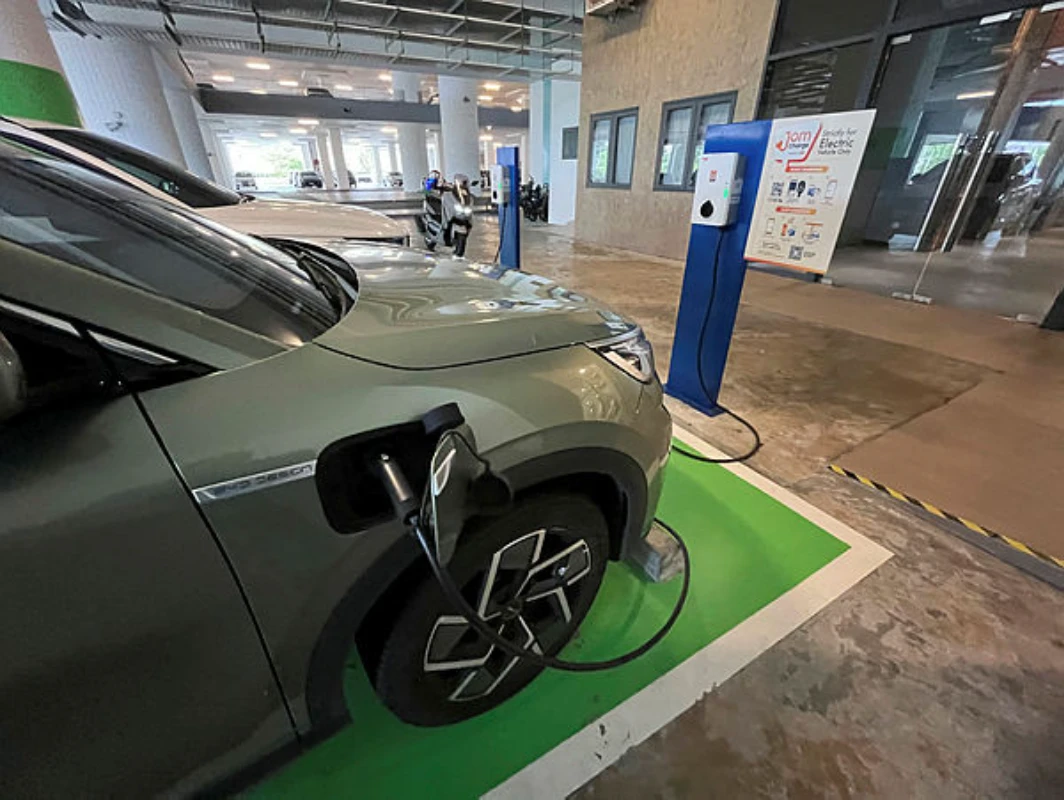
Coal and gas burned to power electricity grid that charges such cars may generate as much carbon as vehicles that run on fossil fuels, says expert
PETALING JAYA: Electric vehicles (EV) are supposed to fight climate change but in Malaysia, they could end up doing the opposite, an energy expert said, unless the country cleans up its power grid.
The electricity grid – the network of power plants and transmission lines that delivers electricity to homes, businesses and vehicles – is still largely powered by coal and gas, meaning charging EVs can produce almost as much carbon as petrol cars, said Universiti Kebangsaan Malaysia senior lecturer Dr Muhammad Ammirrul Atiqi Mohd Zainuri.
He said EVs can, in theory, generate higher lifecycle emissions than internal combustion engine (ICE) vehicles when electricity is still largely produced from coal and gas.
He was responding to a recent RimbaWatch report that challenges the widely held assumption that switching to EVs automatically leads to emissions reductions.
The report found that if all 825,000 cars registered last year had been electric, annual emissions in Peninsular Malaysia would have been slightly higher, reaching about 3.66 million tonnes of carbon dioxide equivalent, after accounting for battery production, electricity generation and battery replacements.
“In theory, EVs can contribute more emissions than ICE vehicles if the electricity grid relies heavily on fossil fuels,” Muhammad Ammirrul said.
“This happens because the region’s power grid is more than 80% dependent on fossil fuels.”
While EVs eliminate tailpipe emissions, he said their true environmental impact must be assessed across the entire lifecycle, including emissions from battery manufacturing and electricity used for charging.
“Without transitioning to renewable power, switching to electric vehicles may ironically increase total carbon output instead of reducing it,” he said, describing this as a critical risk in Malaysia’s EV transition.
Muhammad Ammirrul said the stark contrast between Peninsular Malaysia and Sarawak illustrates how electricity sources determine whether EVs are genuinely low-carbon.
“In Sarawak, where renewables account for more than 60% of electricity generation, EVs emit just 68 grams of carbon dioxide per kilometre, compared with 166 grams per kilometre for petrol vehicles.
“In Peninsular Malaysia, indirect emissions from fossil fuel power plants effectively cancel out any vehicle-level savings.”
He also warned that rapid, large-scale EV adoption could worsen emissions in the short term while placing significant strain on the national power grid.
“Mass adoption would significantly increase electricity demand, much of which is still generated by coal and gas,” he said, adding that replacing ICE vehicles with EVs without decarbonising the grid would merely shift pollution from roads to power stations.
To achieve genuine emissions reductions, Muhammad Ammirrul said Malaysia must move beyond what he described as “tailpipe-only” logic and adopt a lifecycle-based emissions framework for transport policy.
“EVs only become cleaner than petrol cars once the fossil fuel share of the grid drops well below its current level,” he said.
He called for road tax reforms based on total vehicle carbon footprints rather than engine size and urged the government to prioritise the electrification of public transport systems instead of expanding subsidies for private EV ownership.
Technological solutions such as off-grid solar charging, smart charging systems and vehicle-to-grid technology could also help reduce reliance on fossil fuel electricity while improving grid stability, he added.
Muhammad Ammirrul said EV policies must be closely aligned with Malaysia’s National Energy Transition Roadmap (NETR), citing recent measures including the proposed carbon tax and RM16.5 billion in renewable energy investments by government-linked companies.
“Electric vehicles alone aren’t a silver bullet – their impact depends entirely on the grid. To see real emissions reductions, the energy transition must happen first.”



