




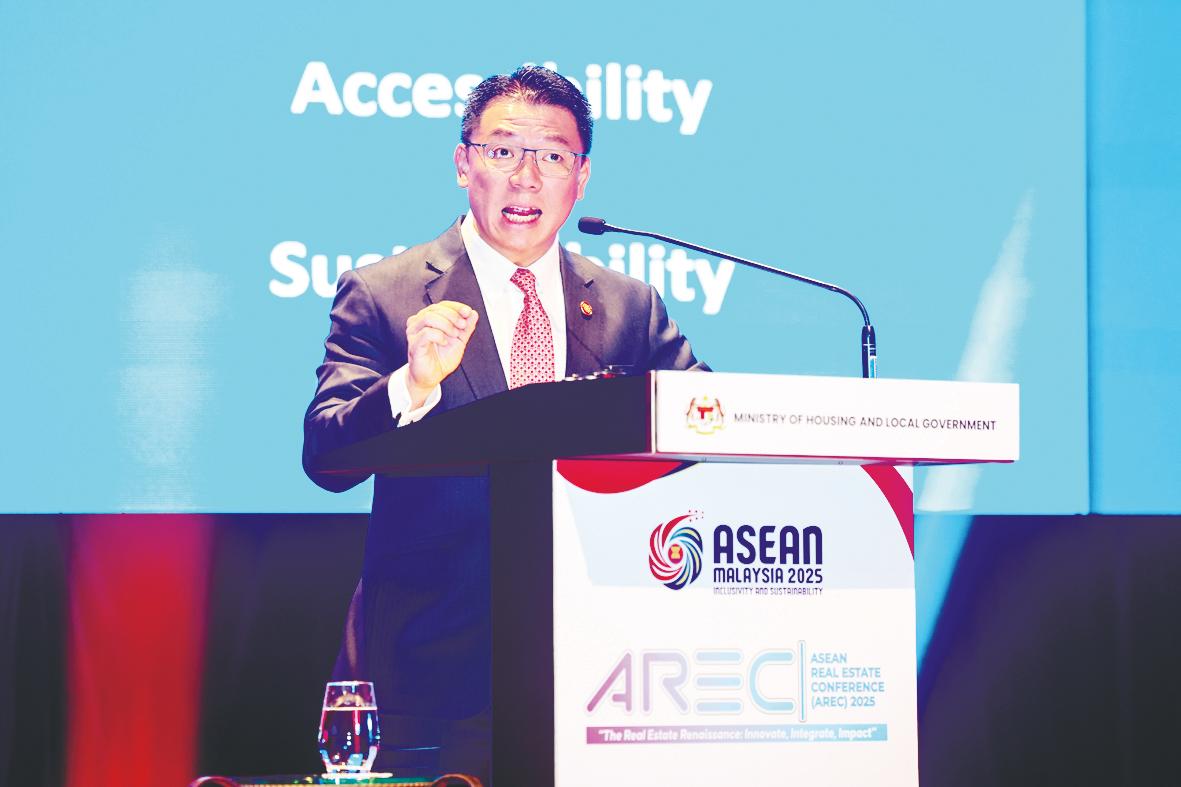
KUALA LUMPUR: As Asean grapples with intensifying demand for housing and global economic volatility, Malaysia is stepping forward with a bold urban leadership agenda.
Housing and Local Government Minister Nga Kor Ming said the region is now at the crossroads of three critical challenges – the intensifying housing trilemma, persistent geoeconomic shocks and a looming demographic surge.
“Within these challenges lies Asean’s extraordinary opportunity. Our region is urbanising at an unprecedented pace. By 2045, 65% of Asean’s population will live in cities.
“This means we must build not just homes, but entire futures – equitable, sustainable and inclusive,“ he said at the Asean Real Estate Conference 2025 (Arec 2025) and the Architecture, Interior Design and Building Exhibition (Archidex), the region’s largest built environment trade fair today.
Nga called on stakeholders to rethink conventional development models, as Asean’s property markets continue to be reshaped by currency fluctuations, volatile construction costs and rising energy prices.
These forces, he said, are already leaving their mark across the region, with property sales declining 6% year-on-year.
In Vietnam, luxury condominium prices have fallen by 8% due to inventory oversupply, while Singapore’s rental prices recorded an 18% spike as economic uncertainty prompted younger buyers to delay homeownership.
Meanwhile, the ringgit, which slumped to 4.80 against the US dollar earlier this year, has only recently begun recovering, further complicating materials procurement and project costing.
“These shocks are not transient. Just as the 2008 financial crisis permanently reshaped global banking, today’s disruptions will fundamentally change how we build and finance real estate,” Nga noted.
He also underscored the need to confront long-term structural shifts. Green features, once considered premium, have now become regulatory standards.
At the same time, escalating land and construction costs are rendering cities increasingly unaffordable – even as urban centres remain vital economic engines.
Globally, capital is being reallocated as investors recalibrate risk amid growing geopolitical fragmentation.
Despite these headwinds, Nga believes Asean is well-positioned to adapt. He pointed to the region’s historical resilience, noting that Asean’s combined gross domestic product has grown from US$23 billion in 1967 to US$3.8 trillion in 2023.
“The question is no longer if change will come – it’s about who will lead it, and how quickly. Malaysia intends to lead with innovation, inclusivity and regional collaboration,” he said.
Highlighting Malaysia’s rent-to-own (RTO) housing scheme as a model that balances affordability with aspiration, Nga noted that the country currently boasts a homeownership rate of 77%, with plans to increase this to 80% by 2030.
Still, he acknowledged that homeownership is no longer the sole benchmark of stability for younger generations.
“There’s a quiet revolution unfolding. Millennials and Gen Z across Asean are redefining what ‘home’ means. In Kuala Lumpur, 43% of individuals under 35 now prefer the flexibility of renting over owning a home through long-term mortgages.
“They’re not rejecting stability – they’re demanding mobility, access and financial headroom,” he said.
Citing Vienna, Austria, where 80% of residents rent high-quality social housing, Nga emphasised the urgent need to enhance Asean’s fragmented rental landscape.
Malaysia’s RTO model, he added, serves as a bridge between leasing and eventual ownership, delivering both affordability and upward mobility.
To carry Arec’s momentum forward, Nga outlined three key initiatives.
First, he proposed institutionalising a Regional Housing Policy Lab to support data-driven policymaking and best practice sharing.
Second, he recommended developing an Asean Urban Progress Dashboard to track affordable housing delivery and carbon reduction metrics.
Finally, he called for Arec to be held annually under the rotating Asean chair to ensure continuity and foster deeper collaboration.
As president of the UN-Habitat Assembly, Nga reaffirmed Malaysia’s commitment to fully implementing the New Urban Agenda, describing it as a blueprint for “dignified homes for the 90 million urban citizens joining us by 2030”.
He stressed that the future of housing must be anchored on three pillars – people-centred smart cities, climate-responsive design and innovative financing models.
“Let us stop quoting the New Urban Agenda and start implementing it – street by street, home by home,” he urged.
“From Jakarta to Hanoi, Bangkok to Manila, our fates are intertwined. Housing is not just about bricks and mortar. It’s about dignity, stability, and building an Asean that endures,” Nga concluded.
As the week-long events continue at the Kuala Lumpur Convention Centre and the Malaysia International Trade and Exhibition Centre, Malaysia is using its moment on the regional stage not only to showcase its design and infrastructure capabilities, but also to craft a forward-looking narrative centred on urban resilience, innovation and cooperation.
Held under Malaysia’s Asean chairmanship and in conjunction with the Kuala Lumpur Architecture Festival, the events are expected to attract more than 56,000 international visitors from 110 countries. Featuring 850 exhibitors across 36,700 square metres, this dual gathering is more than a celebration of design – it is a strategic platform positioning the region’s real estate sector as a critical growth engine in an era of mounting uncertainty.



