




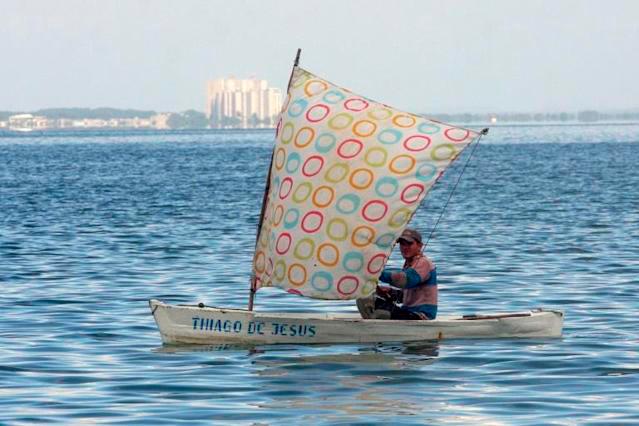
MARACAIBO: Maracaibo is known as the center of Venezuelaâs oil industry, but a chronic fuel shortage has left fisherman Franklin Romero using a sailing boat, and bus driver Manuel working in a cycle rickshaw.
Venezuela sits on the largest proven oil reserves in the world but has fallen from a high of producing more than three million barrels of crude a day in 2014 to just over 500,000 today, meaning the country needs to import fuel.
Experts blame the government of President Nicolas Maduro for incompetent management and corruption.
Under the blazing sun of Venezuelaâs northwestern Zulia state, Romero shows off the handmade oars he uses to propel his boat on Lake Maracaibo, one of the largest in South America.
âWe use sails because thereâs no fuel,â the wiry Romero told AFP as he returned from his fishing excursion.
He began work just before 6:00 am and returned to the shore in Los Puertos de Altagracia at 10:00 am with seven medium-sized croakers â a white meat fish that is popular locally.
The 28-year-old sold five and took two home to his wife and two-year-old daughter.
There was so little wind that he had to row out and back onto the lake, making for an arduous and long journey that used to take just minutes with a motor.
âItâs already normal to row or sail,â said Romero.
Most of the boats are adapted motorboats whose outboard motors have been removed and replaced with wooden masts and plastic sails, or propellers attached to a small motor.
These need only four liters of fuel compared to the 20 liters required for more powerful outboard motors.
– Constant oil spills –
Fuel has become a luxury in a region where few gas stations have supplies, while customer queues stretch for kilometers (miles) at the few that do have some.
While fuel used to be practically free for Venezuelans, it now costs $2 (RM 8) per liter on the black market, which is the only option for most people.
Maduroâs government blames US sanctions blocking the South American country from buying either fuel or unrefined petroleum.
Fishermen often borrow money from fishmongers to buy fuel âon creditâ and then pay for it later with their daily earnings, which can reach $25 dollars (RM 105) on âvery goodâ days.
Sometimes, though, they can return to shore empty-handed but still with a bill to settle.
âToday I lost fuel, I lost work and I didnât catch anything, I just got tired,â said Jonathan, a father of six children who returned with two shrimps and a meagre handful of fish.
Fishermen generally sell their produce in the old colonial city of Maracaibo before returning across the lake to their homes in Los Puertos de Altagracia, but if there is not enough wind they can remain stranded.
The mismanagement of Venezuelaâs oil infrastructure also means that spills are frequent, and dark patches are visible on the Maraciabo lake as fishermen row or sail past them.
According to the Azul Ambientalistas NGO, there are 25,000 kilometers of oil pipelines in Lake Maraciabo, where oil was first discovered in 1914.
âThe leaks are constant,â the NGOâs Gustavo Carrasquel told AFP.
– âI will die hereâ –
In Maracaibo itself, makeshift cycle rickshaws with hand-made textile roofs have taken the place of buses and taxis.
Manuel, who did not give his surname, used to drive a bus that could carry 50 people, now he has to pedal a rickshaw that barely has space for two adult passengers.
âBecause of the fuel question, the (bus) owner had to stop and I found myself out of work,â said the 28-year-old as he repaired a flat tyre.
He said it cost $200 (RM 847) a day to keep a bus on the road, but it was impossible to earn anything close to that sum from passengers paying fares in the battered local currency.
The bolivar has been decimated by four years of hyperinflation and eight years of recession.
GDP has fallen 80% since 2013, and 65% of people live in poverty.
Hender Urdaneta, 51, is a proud militant who supports the socialist government often accused of authoritarianism and repressing dissent.
Pedaling a cycle rickshaw has given him back pain but he cannot afford to stop as he has to support his wife, who lost a kidney and needs medication.
Despite the difficulties, he has no intention of quitting the country or joining the 1.8 million Venezuelans living in neighboring Colombia.
âI was born here and I will die here, struggling with my boots on, like a soldier of the homeland, like a militant for the homeland, Iâm here working with my cart,â he said. â AFP



