




Initiative aimed at addressing structural gaps in education system: Academic
SUBANG JAYA: A literacy programme dubbed “Projek BacaBaca” has marked a significant milestone, having reached over 700 children and achieving 100% improvement in reading outcomes.
Speaking at the Projek BacaBaca ‘100 Readers Celebration’ event at Taylor’s University yesterday, project leader and School of Education senior lecturer Hema Letchamanan said the initiative was developed in response to structural gaps observed within the education system, in which access to schooling has improved but access to learning remains uneven.
“Since 2021, we have made significant progress in ensuring children are in school, with near 100% enrolment. However, being in school is not the same as learning.”
She added that differences in early childhood exposure, including limited preschool access, and socio-economic disparities result in varying starting points among students, which if left unaddressed, evolve into widening learning gaps.
“The programme focuses on children aged six to nine, a critical stage in which students transition from ‘learning to read’ to ‘reading to learn’, and failure to achieve the milestone could significantly affect overall academic progression.”
She said the intervention is structured around diagnostic assessments, one-to-one coaching and continuous monitoring over a six to eight-month period, guided by three core principles: precision, consistency and progression.
“We start from where the child actually is, not based on age, but based on reading ability.
“Each session is intentional, focusing on decoding, fluency and comprehension with tracking of progress from hesitation to confidence.
“We are not just building a volunteer effort, we are also building a supported ecosystem in which coaches are equipped, guided and accountable, while teachers and parents are kept informed of each child’s progress.”
Hema said since its implementation in 2021, the initiative has supported over 700 students and trained more than 500 reading coaches, with consistent outcomes observed across urban low-income communities, rural areas, Orang Asli populations and hospital-based settings.
“What we are seeing is that when support is structured, targeted and consistent, students make progress regardless of context. This gives us confidence that the model is sustainable and adaptable.”
She emphasised that the programme complements formal schooling by providing additional support to students who need it, adding that the next challenge is scaling the model to reach more students at the point when intervention matters most.
The project, a research-driven initiative, has been dedicated to strengthening proficiency in both English and Bahasa Melayu among young learners.It was recently expanded to support students aged 11 and 12 from Chinese and Tamil primary schools in achieving a Mastery Level (TP4 to TP6) in Bahasa Melayu.
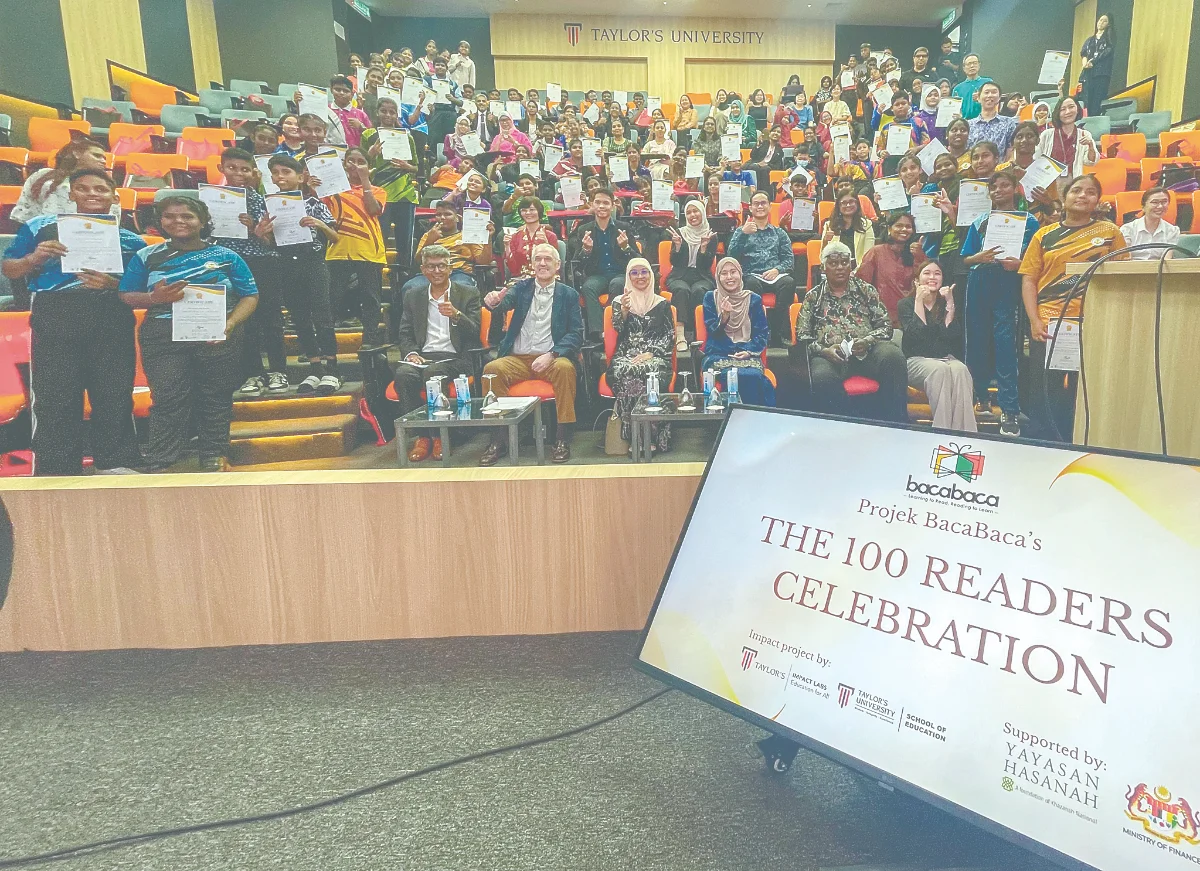
The celebration brought together 100 students alongside their reading coaches, teachers and education partners to commemorate significant milestones in their reading journeys.
The cohort represented communities from SK Bandar Sunway, SJK (T) Batu Ampat, SJK (T) Effingham, SJK (T) Ladang Sg Choh and SJK (T) Vivekananda.



