




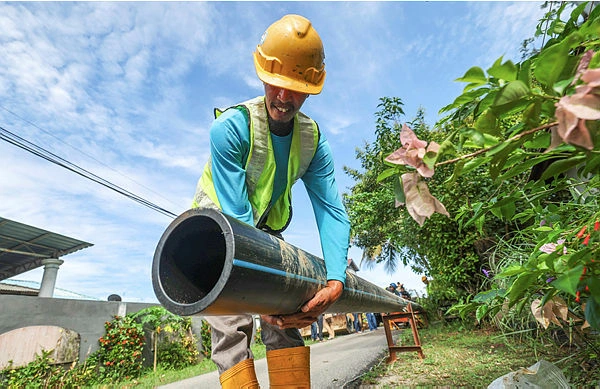
The federal government has approved RM1.7billion to replace 1,800km of critical water pipes under the 13th Malaysia Plan from 2026 to 2030.
KUALA LUMPUR: The federal government has approved an allocation of RM1.7 billion under the 13th Malaysia Plan (13MP) to replace about 1,800km of critical water pipes nationwide between 2026 and 2030.
Deputy Minister of Energy Transition and Water Transformation Datuk Seri Abdul Rahman Mohamad said the programme will prioritise the replacement of ageing asbestos-cement (AC) pipes and other critical pipelines that have exceeded their design lifespan to reduce the country’s Non-Revenue Water (NRW) rate.
“Through the implementation of this programme, the government is committed to strengthening the resilience of the national water supply system through the phased renewal of ageing assets, reducing NRW rates, and ensuring all replacement works are carried out in accordance with stringent safety standards for the well-being of the people,” he said during the question-and-answer session in the Dewan Negara today.
He was responding to a question from Senator Datuk Wu Him Ven on the government’s action plan for replacing asbestos-cement water pipes.
On NRW statistics, Abdul Rahman said the rate for Peninsular Malaysia and the Federal Territory of Labuan stood at 34.4% in 2025, while the figure for 2026 would only be finalised after the reporting year ends.
Addressing concerns over occupational safety related to the release of asbestos dust during pipe replacement works, he said all projects must comply with regulations and safety standards set by the Department of Occupational Safety and Health (DOSH).
Responding to a supplementary question from Senator Phoong Jin Zhe on pipe replacement initiatives in Sabah, Abdul Rahman said the state has identified 110.4km of critical water pipes requiring urgent replacement, with the works estimated to cost RM99.35 million.
He added that, apart from replacing ageing pipelines, the federal government has also allocated RM558,000 to support efforts to reduce Sabah’s Non-Revenue Water (NRW) rate.



