



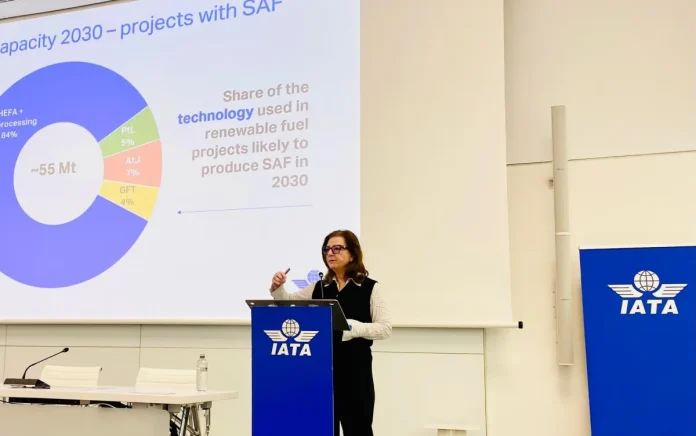
GENEVA: Energy transition, including the development of sustainable aviation fuel (SAF), should be treated as an economic growth strategy by Asia-Pacific governments rather than an aviation-specific issue, according to the International Air Transport Association (IATA).
IATA chief economist Marie Owens Thomsen said the region risks missing out on one of the few real growth strategies available today if policymakers delay investments in renewable energy, feedstock production and SAF capability.
“We have always depended on mobility and energy for economic progress. Aviation does not just contribute to gross domestic product but also increases the rate of growth.
“That catalytic impact makes the energy transition a proper growth strategy for countries,” she said in an exclusive interview with Bernama at IATA’s Global Media Day 2025 held here recently.
The topic of energy transition and the scaling of SAF took centre stage during the media briefing.
She also said governments worldwide have exhausted traditional economic tools such as low interest rates and fiscal space, leaving the energy transition as a rare opportunity to drive long-term productivity.
“There aren’t many real growth strategies left. Countries are over-indebted, interest rates cannot be lowered further, and taxes are already high.
“All the traditional policies are pretty much maxed out. So, I would say the most amazing growth strategy is to really engage with this energy transition. With the energy transition, you can improve your agriculture to produce feedstocks, and you can democratise energy grids. We obviously want more wind, solar or any kind of renewable energy so that all industries can decarbonise, and then ours (aviation) as well,” she explained.
According to IATA’s Global Feedstock Assessment for SAF Production – Outlook to 2050, the transport industry will require approximately 500 million tonnes of SAF in 2050 to achieve net zero carbon dioxide emissions.
In 2025, global SAF production is estimated at just two tonnes.
While every region could generate biomass feedstock for SAF production, some countries and regions are emerging as hotspots.
China and Asean, particularly Indonesia and Malaysia, are also expected to emerge as critical feedstock hotspots.
Together, these countries would account for approximately 240 tonnes of biomass feedstock for SAF production by 2050, representing about 15% of the global total.
These countries have existing biofuel industries and offer substantial potential for producing SAF from biomass.
In Malaysia, the government has launched and sped up the New Industrial Master Plan, National Energy Transition Roadmap, Hydrogen Economy and Technology Roadmap as well as the Malaysia Aviation Decarbonisation Blueprint to achieve net zero carbon emissions by 2050.
Although the region holds significant resources and potential, Thomsen noted that Asia-Pacific’s progress in developing SAF will depend on stronger policy coordination and clearer regulatory pathways.
“The feedstock, capital and technology already exist. With the right policy frameworks, these elements can come together to unlock SAF production at scale,” she said.
She noted that feedstock types differ across countries, with some suited to bio-SAF and others to power-to-liquid (eSAF), depending on land, wind and solar availability.
She stressed that each country could build a pathway suited to local conditions.
“This is something every country can do to varying extents. The question is whether governments want to engage in these market-building conversations. If not, what is their alternative growth strategy?” she said.
Thomsen emphasised that SAF production cannot be accelerated in isolation and must be part of a broader national energy plan.
She warned Asia-Pacific governments against focusing narrowly on industrial policies or digital projects at the expense of foundational energy investments.
“Energy is literally what drives our economies. We need cheap, sustainable and readily accessible energy for everybody. Once that is in place, you can make renewable fuels and, at the end of that chain, renewable aviation fuel,” she said.
IATA estimates that the average yearly investment needed to secure airlines’ use of SAF and meet most of the industry’s decarbonisation needs is US$174 billion (RM713.4 billion) over the 2024-2050 horizon.



