




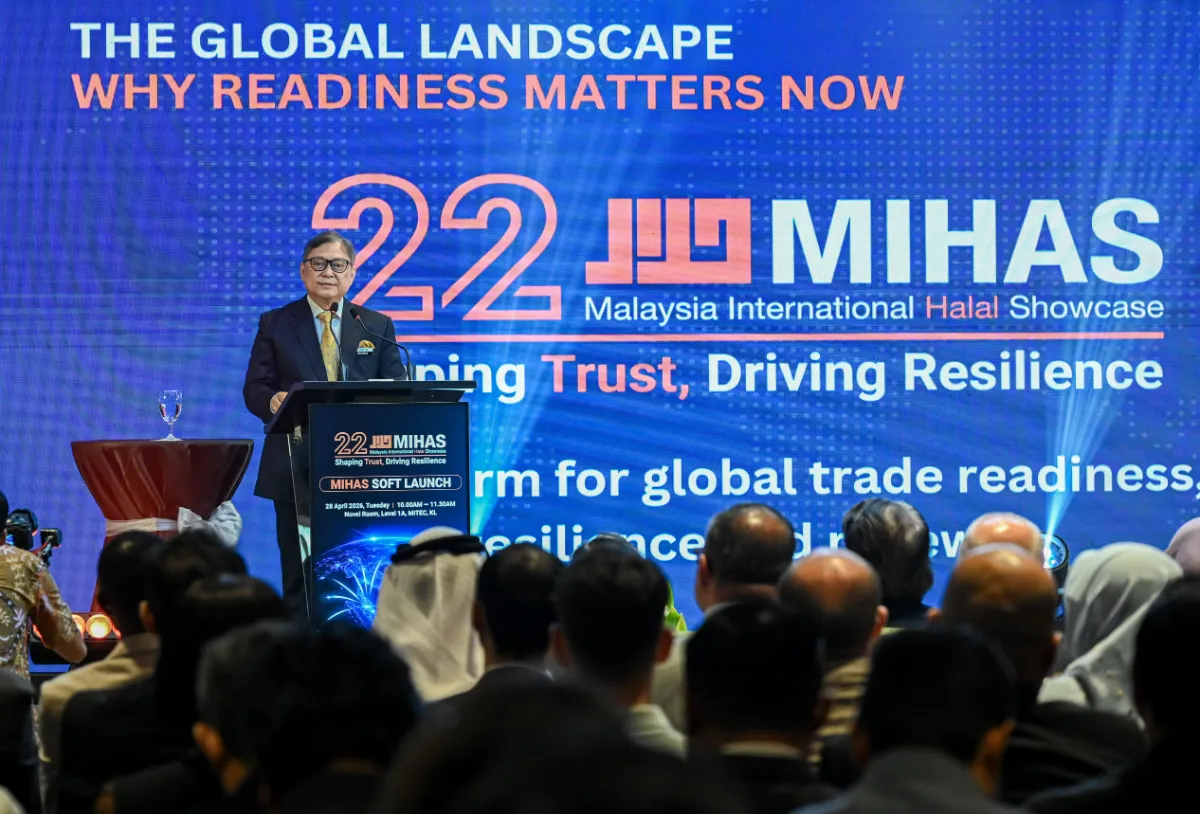
KUALA LUMPUR: Malaysia International Halal Showcase 2026 (Mihas 2026), organised by Malaysia External Trade Development Corporation (Matrade) under the Ministry of Investment, Trade and Industry (Miti), is targeting RM4.5 billion in trade value, alongside 2,380 booths and 45,000 visitors from 45 countries.
Matrade CEO Abu Bakar Yusof said Malaysia is positioning the platform as a more precise, outcomes-driven marketplace to sustain export growth, deepen value creation and reinforce its standing in an increasingly competitive global halal economy.
“In 2026, we are determined to build on the strong momentum of Mihas 2025, which was a record-breaking year that saw 2,400 booths from 43 countries, RM6.05 billion in sales driven by the International Sourcing Programme, and over 50,000 visitors, reaffirming Mihas as a leading global halal trade hub. Building on this success, Mihas 2026 will focus on stronger participation, higher-value buyer engagement and expanded global reach,“ he said at the soft launch of Mihas 2026 today.
Abu Bakar noted that the global halal economy, valued at US$3.5 trillion (RM13,8 trillion), is projected to reach US$5 trillion by 2030, driven by demand for products anchored on trust, safety, quality and transparency.
He said halal has evolved beyond food and religious compliance into a broader value proposition in global commerce. “For many years, halal was understood too narrowly. Today, it represents trust, safety, quality, ethical sourcing, transparency and integrity.”
He said Malaysia’s position is anchored by the Department of Islamic Development Malaysia (Jakim) certification ecosystem. “When businesses carry the Jakim mark, they wield a prestigious global passport of quality. We define its rigorous standards.”
While first-quarter export numbers remained strong, Abu Bakar said, geopolitical pressures are expected to weigh on second-quarter performance, with exporters already facing rising logistics costs, shipment delays and constraints in the movement of goods.
The full impact has yet to be quantified but is likely to become clearer in the coming months as global trade conditions evolve, he added.
To mitigate these risks, Abu Bakar said, Malaysia is accelerating efforts to diversify export markets beyond traditional destinations such as the United States, China, Japan and Singapore, shifting focus towards emerging regions including Africa, Central Asia, South Asia and Asean.
“Exposure to the Middle East remains limited, accounting for about 3% of total trade, although halal exports to the region make up around 10% to 15% of the segment, allowing Malaysia to manage geopolitical risks while maintaining its presence in the market.”
Abu Bakar said geopolitical tensions are reshaping trade flows, forcing companies to rethink sourcing strategies and pushing buyers to prioritise trusted and reliable partners. “Disruption is never permanent. Markets may contract, but they recover. Trade routes may shift, but they reopen. Demand may soften, but it returns.”
He added that while disruptions are cyclical, preparedness will determine which businesses ultimately benefit when conditions stabilise.
“The real question before us is not whether recovery will come, but who will be ready when it does.”
Abu Bakar said Malaysia’s trade remained resilient, with first-quarter 2026 total trade rising 10.4% to RM789.85 billion, exports up 12.7% to over RM426 billion, and the surplus increasing 54% to RM63.22 billion.
Halal exports grew 10.9% to RM68.52 billion in 2025, accounting for 4.3% of total exports, led by food and beverages (53.8%) and halal ingredients (31.2%), while palm oil and derivatives rose 55% to RM4.57 billion.
Malaysia is also shifting towards higher-value segments such as pharmaceuticals, wellness products, cosmetics and advanced ingredients. “Malaysia is not only exporting more, but also exporting smarter and higher in value,” Abu Bajar said.
Under the 13th Malaysia Plan (13MP), halal exports are targeted to reach RM80 billion by 2030, while overall export growth for 2026 is projected at 3% to 5%.
Mihas 2026 will integrate artificial intelligence across its trade ecosystem to improve deal conversion, including buyer verification to ensure engagement with decision-makers, predictive matchmaking based on more than 1,700 data points covering demand, product fit and buyer intent, and automated scheduling to accelerate the transition from introductions to negotiations and agreements.
The platform will also provide market intelligence on demand trends, consumer shifts and emerging growth markets, while expanding access to new trade corridors across Asean, South Asia, Central Asia and Africa, as part of efforts to turn business matching into actual transactions.
“The future of exhibitions cannot be measured simply by booth numbers, visitor traffic or ceremonial handshakes. It must be measured by the quality of opportunities created, the speed of connections made, and the commercial outcomes delivered,” said AbuBakar.
Mihas 2026 will also introduce the Women in Export (WiEX) initiative to expand participation of women-led businesses, which account for about 20% of SMEs but remain underrepresented globally.
“Many women-led businesses are innovative and quality-driven, yet remain largely domestic-focused,“ Abu Bakar said.
WiEX aims to broaden Malaysia’s exporter base, reduce reliance on a narrow group of firms, and strengthen long-term resilience in the halal economy.
Miti Deputy Secretary General (Investment & Management) Datuk Bahria Mohd Tamil said the theme of Mihas 2026 resonates strongly with the aspirations of the National Industrial Master Plan 2030 (NIMP 2030).
“As we embark on the RMK13 (13MP) chapter, the halal sector is no longer just a contributor to growth but a strategic enabler of economic transformation. By aligning with NIMP 2030 priorities, we aim to establish Malaysia as a global halal leader, driving halal exports to RM80 billion and increasing the sector’s GDP contribution to 11% through innovation and resilience.”



