




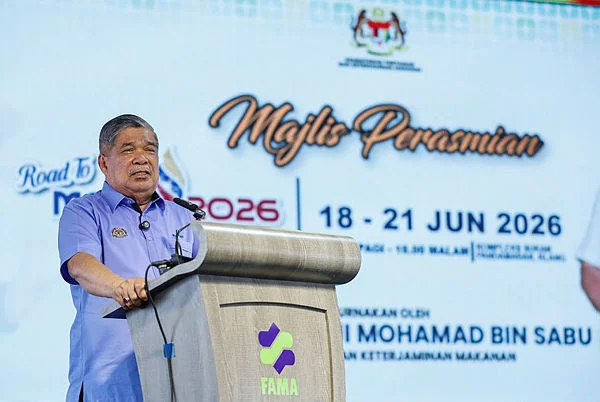
MAHA 2026 will proceed despite spending cuts, featuring global participation, agri-tech innovations, agrotourism and food security initiatives.
KLANG: The Malaysia Agriculture, Horticulture and Agro-Tourism Show (MAHA) 2026 will proceed as planned despite government expenditure cuts, with organisers adopting cost-saving measures to ensure the event remains impactful.
Agriculture and Food Security Minister Datuk Seri Mohamad Sabu said the scale and vibrancy of MAHA 2026 would not be compromised despite operating on a tighter budget.
“MAHA will continue this year even though the government is undertaking expenditure rationalisation. We have also implemented cost-saving measures in organising the event.
“Alhamdulillah, its scale is no less impressive than in previous years. In fact, from what I have seen today, it is even more lively,” he told reporters after launching the Road to MAHA 2026 Central Zone programme today.
Mohamad said international participation at MAHA 2026 is expected to increase, with countries including China, Brazil, Japan, South Korea, the United States, Hungary and Uzbekistan already having confirmed their participation on an unprecedented scale.
He said the growing foreign presence reflects the increasingly interconnected nature of global food security, where countries must work together to address supply disruptions and other challenges.
“This is one of the first times we are seeing such extensive international participation because food security is an issue that no country can solve alone.
“When disasters occur in one country, assistance often comes from others,” he said.
Mohamad said one of the key focuses of MAHA 2026 is sustainability, particularly in encouraging agricultural entrepreneurs to build viable long-term businesses rather than relying solely on government assistance.
He said the exhibition would also expose local participants to modern agricultural technologies and innovations from around the world, while inspiring greater youth participation in the sector.
“Many young people are already entering agriculture, but through MAHA we want to encourage even more involvement.
“We want them to see the technologies and innovations being developed by other countries and adopt modern agricultural practices,” he said.
Mohamad also highlighted the growing popularity of agrotourism, citing attractions such as coffee spots in paddy fields, durian orchards and aquaculture farms, which are increasingly drawing visitors.
He said MAHA would play an important role in promoting the development of agrotourism as an emerging segment of the agriculture industry.
Meanwhile, Mohamad said international participants would bring added value to MAHA 2026 by introducing technologies, services and innovations that may not yet be available in Malaysia.
He added that business matching sessions would also be organised to facilitate trade and partnerships between local and foreign participants.
“Foreign participants will have opportunities to buy and sell their products, while Malaysian participants can also explore overseas markets and establish new business connections,” he said.
Mohamad said food security remains one of the country’s most pressing long-term challenges, requiring stronger international cooperation, technological innovation and greater public participation.
He said food security would continue to be a global concern due to climate change, geopolitical tensions and supply chain disruptions.
“Food security is not an issue that will ever be permanently resolved. Throughout history, every generation has faced its own food-related challenges. What matters is how we respond to them,” he said.
He said the Road to MAHA 2026 programme received a strong public response, with around 20,000 visitors attending the Central Zone event, alongside about 80 agro-food entrepreneurs.
Mohamad said Malaysia must prepare for challenges such as prolonged droughts and changing weather patterns by strengthening international cooperation and adopting modern agricultural technologies.
He also launched the Surveillance and Intervention on Supply and Demand of Agro-Food Systems portal, which will provide real-time data on agricultural supply, demand and prices to help farmers, traders and consumers make informed decisions.
He said access to accurate and timely data would enable the government to respond more effectively to supply shortages, manage surpluses and maintain food price stability.
Mohamad also encouraged Malaysians to cultivate food crops at home, saying home gardening initiatives could help reduce household expenses while contributing to national food security.



