




Malaysia’s unspoken rule: why ignoring the unseen keeps you safe.
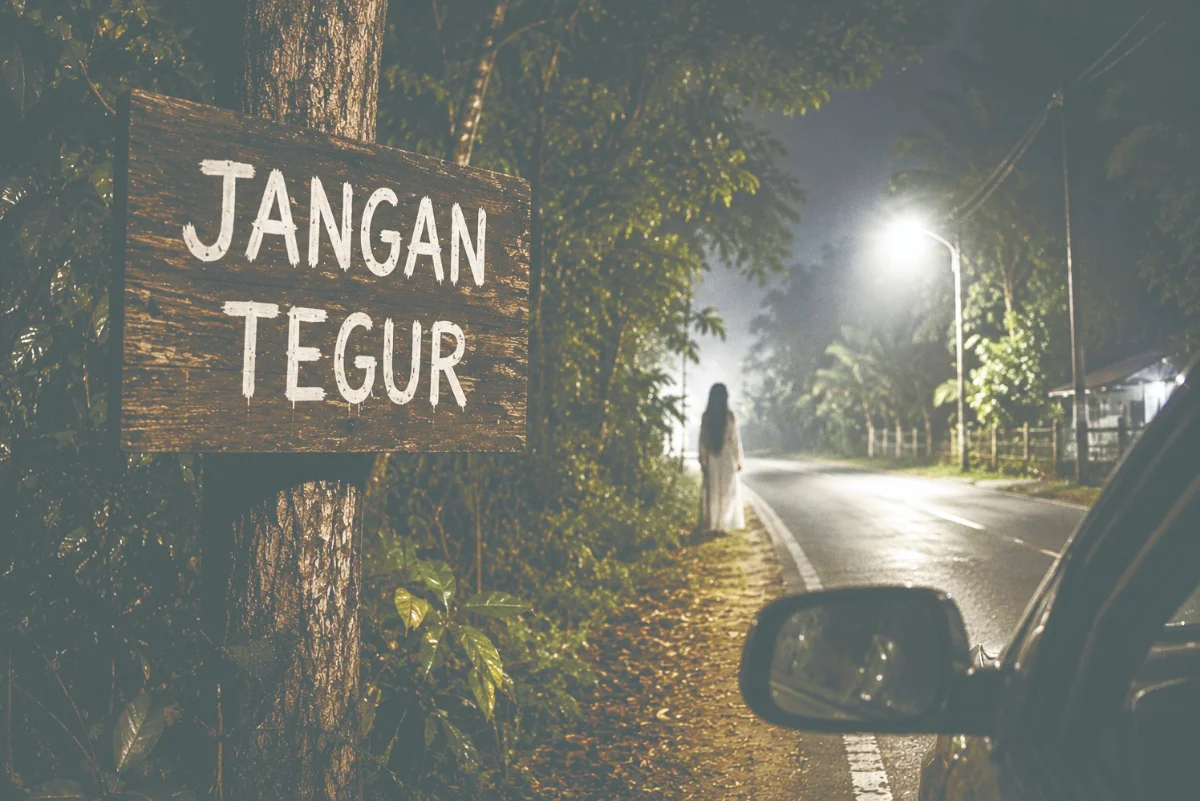
IF there is one phrase that unites Malaysians across race, religion and postcode, it is not: “Have you eaten?” or “Traffic jam ah?” It is this: “Jangan tegur”. Simply put, it means don’t acknowledge. Don’t ask questions. Just carry on your merry way as though the woman combing her hair by the roadside at 2am is a perfectly normal feature of Malaysian life.
The phrase itself seems harmless. It carries the gentle firmness of an elder reminding the young not to play outside at dusk or to always sit down while eating or drinking. Grabbing a bite while standing? Definitely a no-no.
Jangan tegur is most often heard before jungle treks or mountain hikes. You and your family could be halfway up a trail when your uncle suddenly lowers his voice and says: “If you hear someone calling your name, jangan tegur.” Just keep walking.
Somewhere along the line, Malaysians seem to have collectively agreed that the supernatural operates rather like telemarketing. If you respond, you are inviting trouble.
The beauty of jangan tegur is that it usually arrives after you have already seen something alarming – a child standing alone in a plantation at midnight, or a woman with long, sleek black hair silently crossing your path.
Among Malays, the phrase functions almost like an operating manual for navigating the unexplained. If someone calls your name three times at night, don’t answer. If there is a knock on the door after midnight, peek through the window curtains first. And if you smell the scent of flowers in the middle of nowhere… well, you’ve entered a third dimension and it’s wise to just mind your own business.
Why? Because science and superstition coexist remarkably well in Malaysia. We may not necessarily believe every story but neither do we want to be the idiot who decides to test the theory.
This is not uniquely Malaysian, of course. In Japan, folklore warns against responding to mysterious voices in the woods. Irish tradition advises caution around the fairy folk, whose charm often precedes catastrophe. In parts of Latin America, children grow up hearing tales of La Llorona, the weeping woman whose cries should absolutely not be investigated.
There is wisdom in the phrase. Jangan tegur is not necessarily about ghosts. It is about humility, about recognising that not everything demands an explanation or a commentary. Sometimes, the wisest response to the inexplicable is not confrontation but simply silence.
Whether you believe in spirits or not, one truth remains. Jangan tegur is one of those pieces of inherited wisdom that has survived generations precisely because it cannot be disproved.
It is a cultural heirloom. It is not about fear of the unseen, nor about winning an argument with a grandmother who has survived seven decades, raised six children, lived through floods and kampung ghost stories, and still lowers her voice before saying jangan tegur.
Rather, it is about respect for places older than ourselves, mysteries we do not understand and perhaps most importantly, the elders who insist that being alive tomorrow is far more important than being right tonight.
So, if you find yourself driving down a lonely stretch of road one night and you see something strange, whatever it may be, jangan tegur.
Just keep driving.



