




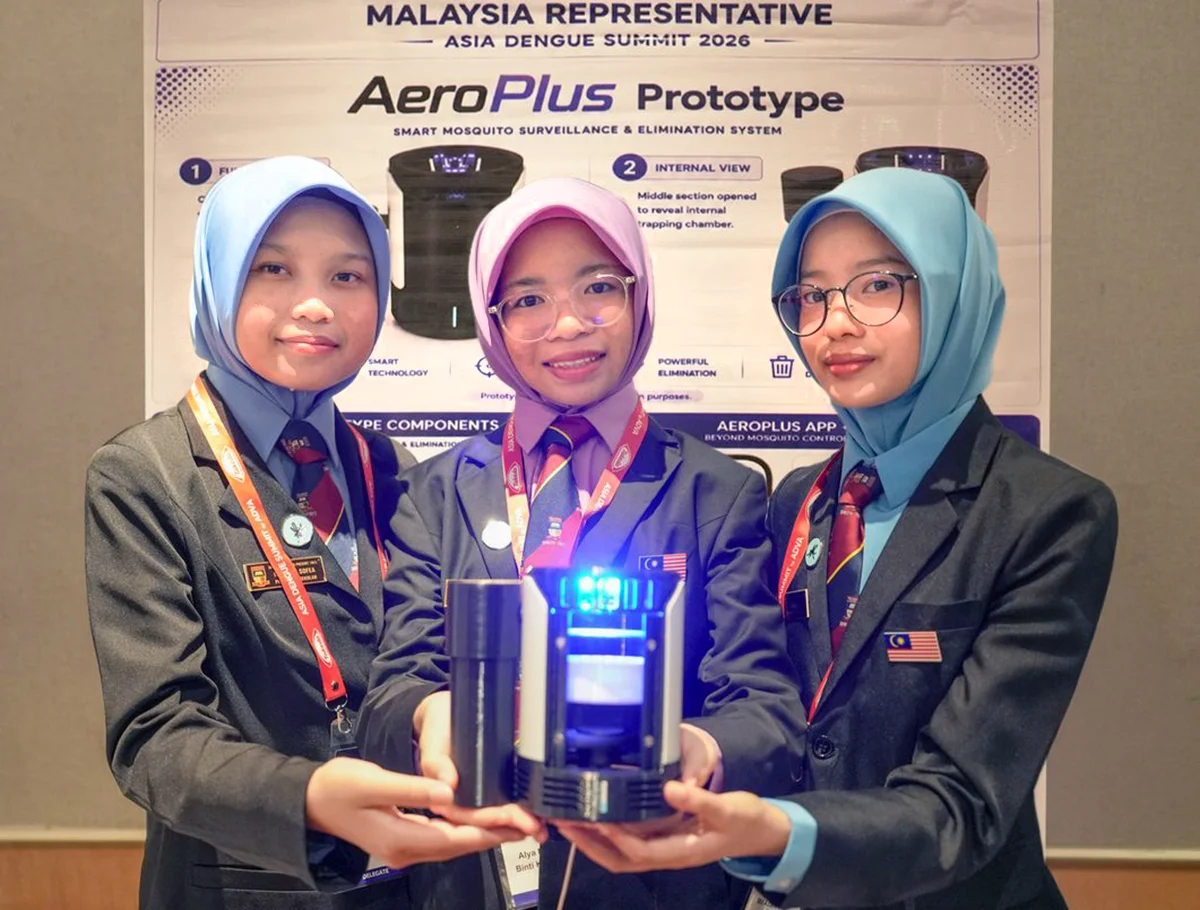
The students said their motivation came from observing how conventional dengue awareness efforts, such as posters and banners, have become largely ignored in their communities despite persistently high case numbers.
PETALING JAYA: A team of 16-year-old students from SMK Putrajaya Presint 18 (1) is reimagining dengue prevention through a blend of technology, behavioural change and community education, presenting their solution recently at the Asia Dengue Summit on June 17.
Calling themselves Vector Vixens, team members Marissa Sofea Saiful Rizal, Raisya Elaina Md Azar Irwan and Alya Nayli Alang Khairul Alang developed a dual-system innovation featuring a smart mosquito trap device and a mobile app aimed at reducing dengue risk in high-incidence communities.
The students said their motivation came from observing how conventional dengue awareness efforts, such as posters and banners, have become largely ignored in their communities despite persistently high case numbers.
“Dengue awareness material such as banners and posters have been just background noise.
“People have been ignoring recent news, and cases remain high. We believe conventional methods need to be paired with innovative, scalable solutions.”
At the core of their project is Aeroplus, a smart mosquito trap system designed to combine multiple scientifically established control methods, including carbon dioxide extraction, UV light guidance, suction trapping and electrical elimination.
The device is paired with a mobile app that allows users to monitor device performance and access educational content. A dedicated information section, referred to as LuxLens, provides updates on dengue symptoms, Aedes mosquito behaviour and prevention strategies.
According to the team, the goal is to shift dengue prevention from passive awareness to active, daily household engagement.
“To truly stop dengue, we need to start from its roots. If awareness in the community is not addressed, the problem will keep rising.”
The students emphasised that Aeroplus is intended to go beyond awareness campaigns by influencing everyday decisions in households and institutions.
“Aeroplus is practical, efficient and designed for sustained use. It helps users understand prevention in a smarter way through consistent monitoring and education.”
Target users include families in dengue-prone areas, as well as schools, hospitals, hotels, childcare centres and government buildings.
Aeroplus integrates established vector control technologies that have already been tested and validated in mosquito management research and practice, combining multiple methods into a single user-friendly system that improves accessibility and real-world adoption.
“We realised public health is not only the government’s responsibility, but also the community’s. Small actions and innovations can create a healthier future.”
The team said participation in the regional competition exposed them to dengue challenges across Southeast Asia and allowed them to refine their ideas through expert feedback and cross-country collaboration.
Asia Dengue Voice and Action (ADVA) group chairperson and KPJ Selangor Specialist Hospital consultant paediatrician and paediatric cardiologist Prof Zulkifli Ismail said eliminating dengue deaths by 2030 would require differentiated strategies for prevention and treatment.
He added that reducing infections depends on vector control and behavioural change, while reducing deaths requires early diagnosis, timely medical care and proper clinical management. He also highlighted the growing role of dengue vaccination in preventing severe cases.
Zulkifli emphasised that dengue control is complex because it is vector-borne, transmitted by Aedes aegypti and Aedes albopictus mosquitoes.
“Human behaviour promotes mosquito breeding, which is why a multi-pronged strategy is essential,” he said, adding that surveillance, community engagement and emerging tools such as Wolbachia-infected mosquitoes are all part of the solution.
He said despite advances in vaccines and control measures, dengue continues to persist due to gaps in coordination and inconsistent implementation across sectors.
“What is missing is a coordinated approach involving every ministry, department and individual to prioritise dengue control.”
The Vector Vixens team participated in the ADVA/JA Dengue Slayers Challenge, a regional youth innovation programme organised by ADVA and Junior Achievement Singapore.
This year’s competition brought together more than 1,100 students from over 160 schools across Indonesia, Malaysia, the Philippines, Singapore and Thailand.



