



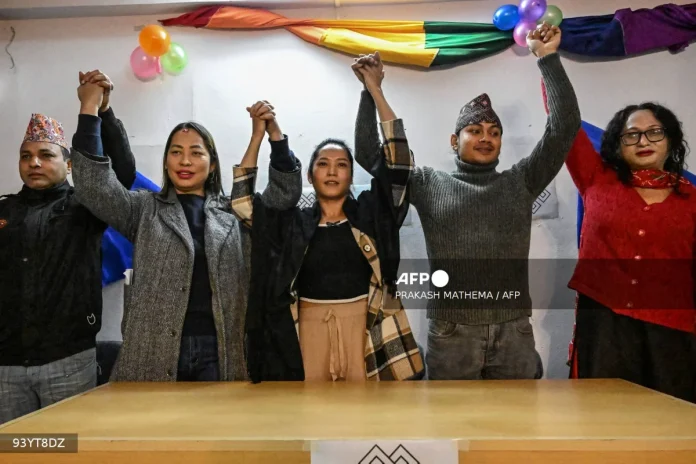
A new Nepali political party led by sexual and gender minorities fields six candidates, challenging the old guard after a mass anti-corruption uprising.
KATHMANDU: A new political party led by Nepal’s sexual and gender minorities has unveiled its candidates for March elections.
The Inclusive Socialist Party, with over 500 members mostly from the LGBTIQ community, will field six candidates, challenging the ageing political elite ousted in last year’s mass uprising.
Party leader Numa Limbu, a third-gender candidate, said having a seat at the table means others don’t have to speak for them.
“We believe that friends from our party and community will reach the parliament,” Limbu told AFP.
The party aims to tackle issues facing not only the LGBTIQ community but also youth and women.
Elections will be held for the 275-seat House of Representatives, with 165 chosen by direct vote and 110 through party lists.
While other parties have listed LGBTIQ candidates on proportional lists, none have fielded them as direct candidates until now.
Nepal has some of South Asia’s most progressive LGBTIQ laws, including a 2023 Supreme Court order allowing same-sex and transgender couples to register marriages.
However, no one from the community has held public office since 2008, when openly gay man Sunil Babu Pant became a lawmaker.
Pant, now an adviser to the new party, said the absence of representation has meant constitutional rights have not translated into laws.
More than 900,000 people in Nepal identify as a sexual minority, according to rights group the Blue Diamond Society.
Despite legal strides, many LGBTIQ people still face discrimination in employment, healthcare and education.
The party’s formation follows a mass anti-corruption uprising in September that left at least 77 people dead.
The uprising was triggered by anger over a brief government ban on social media and built on years of public frustration over economic stagnation and political corruption.



