




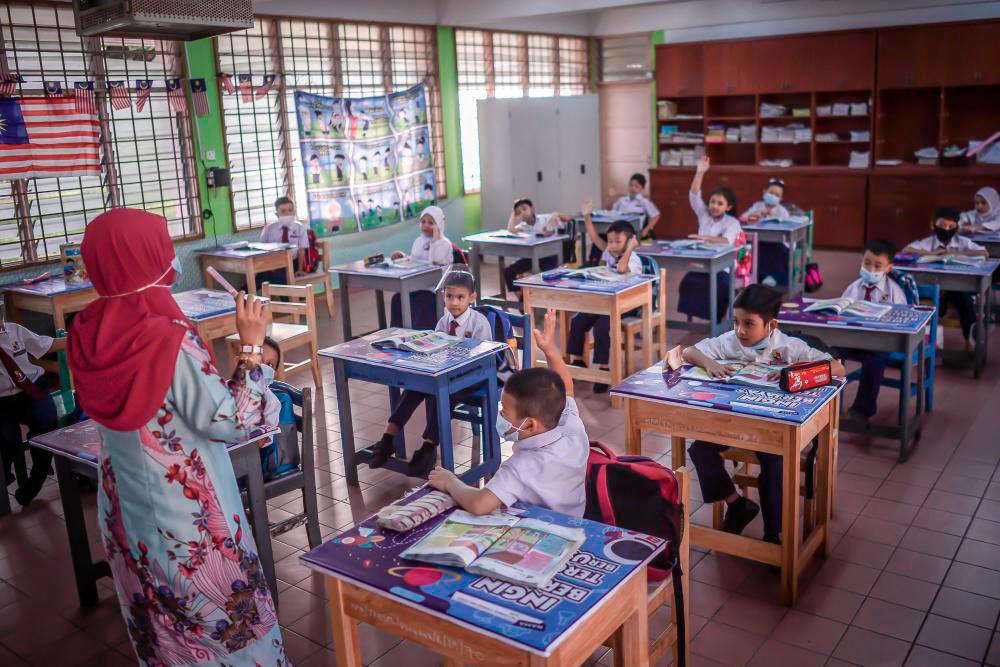
IN Malaysia, schools reopened on June 24, ending 41 weeks of school closure due to the Covid-19 pandemic. For many parents, it was a relief.
Many could not cope with their children learning at home due to a lack of devices as well as poor Wi-Fi connectivity.
Malaysia has been cited as having one of the highest “learning losses”.
Learning loss refers to the lack of learning by students during the pandemic.
“It is a national emergency,” said Datuk Amar Singh, a consultant paediatrician and head of a clinical research centre in Perak.
Amar advised the Education Ministry to take remedial action to assist students left behind in their learning during the pandemic.
Former education director-general Datuk Habibah Abdul Rahim said online lessons are set to define the future of learning and it was therefore important to ensure students have access to the tools and gadgets essential for digital education.
Habibah shared her views during the “Crisis Proofing Education: Post-Pandemic Forum” organised by an independent think tank, Institut Masa Depan Malaysia (The Institute of the Future Malaysia).
“Five million primary and secondary school students in 10,000 schools throughout the country were affected,” said Habibah.
“Overnight teachers had to transform themselves from face-to-face to online teaching and learning.”
An Education Ministry survey from March to April 2020, revealed that 37% of children did not own any digital device, while only 15% of students had personal computers and 50% relied on smartphones.
The smartphones available in families had to be shared among parents and siblings due to financial circumstances among the poorer communities.
The inequity between students who could afford to purchase devices and those who could not is more evident in the interiors of Sabah and Sarawak where many poor families reside, mostly farmers and local Orang Asli who eke out a living in the jungle.
In fact, studies show rural schools coped better as they could still maintain contact with their teachers through traditional means and they could open faster as the infectivity rate was slower due to their isolation.
The government did come up with initiatives to assist students under the fiscal packages to purchase devices, but poor delivery and alleged mismanagement resulted in many students being left without them.
Alleged failure by government to deliver tablets, devices to the needy
Under the PerantiSiswa Keluarga Malaysia initiative, the government was to provide smart devices to B40 students in higher learning institutions, thus, allowing them digital access during their studies.
The lack of delivery of 350,000 tablets worth RM385,310 million was voiced in Parliament by former deputy education minister Teo Nie Ching on Oct 6, who revealed that only 2,764 tablets had been distributed to students.
“We want to know how many students applied. How many qualify (for the tablets)?
“And when will they receive their promised tablets?”
These devices have been promised under Budget 2022 and were to be provided for low-income families, according to the former deputy minister.
This provides insight into why B40 students in higher learning institutions have been unable to successfully access online platforms.
As such, fiscal packages have been prepared by the government to assist the poorer communities, especially those attending universities and colleges.
But this effort has been futile due to the poor delivery of devices and inefficient management systems.
Learning devices never reached needy students
Parent Action Group for Education chairman Dain Noor Azimah Abdul Rahim said the allocation of 150,000 learning devices to deserving school students was made in the budget announcement of November 2021.
“This was important to alleviate the hardship of poor students who could not participate in online learning during the pandemic.
“By June 2021, only 10% had been distributed,” said Azimah.
In September 2021, youth groups from the PKR Education division, including M Jay Raj (Enlight Malaysia President), Calvin Yeoh (Young Democrats Malaysia founder), Farzana Nasir (PKR student council representative), Kiran Raj Saktivel (Youth Parliament member) and Perak assembly youth member Tan Li Pei collectively urged the government to expedite the distribution process.
“The government has failed to effectively distribute the laptops to underprivileged children and we demand an explanation.
“Parents are trying to ensure their children’s future (as a result of the pandemic), had to dip into their savings or endure debt to provide tools for online learning.
“We want an explanation from the education ministry and the (former) minister Datuk Mohd Radzi Md Jidin. Provide a clear statement on laptop distribution.”
Digital divide most evident in rural areas
In a YouTube video, 18-year-old Veveonah Moisbin, who lives in the remote Pitas district of Sabah, showed how she trekked up a hill and slept on a tree just to receive an internet signal for her online examinations.
Eight students from the same state narrowly escaped death, when the bridge they all met on for internet access collapsed and they fell 18m.
Rachel Gong, senior research associate at the Khazanah Research Institute based in Kuala Lumpur said under the Prihatin scheme, during the first stage of the movement control order (MCO) in March 2020, the stimulus package included a collaboration with telecommunication companies to offer their subscribers additional free data.
“This was valued at RM600 million, scheduled to begin on April 1, 2020, and last until the MCO ended,” said Gong.
“In practice, the data packages were not uniform, making it hard for people to keep track of their entitlements and usage.
“In addition, conditions were imposed such as usage of data within specified hours and only for specific applications such as office applications.
“Some websites were zero rated and did not count towards the use of mobile data.”
Gong felt these conditions prevented users from being able to take full advantage of the free internet during the lockdown and may have disproportionately affected those who needed it most. Eventually, these conditions were lifted.
Planning for a post-pandemic world
The Prihatin stimulus package also stated that telcos were committed to investing a further RM400 million to increase network coverage and capacity by improving and upgrading infrastructure.
However, Gong in her blog stated that the cost of infrastructure development remained high, especially in remote rural areas.
Optical fibre is necessary to transmit signals over great distances with minimal data loss but the cost is prohibitive and only 40% of the country’s base stations have been fiberised.
Thus, the plan to improve network coverage and quality of service in a short time post-pandemic seemed unfeasible and at this point not possible, Gong concluded.
“Firstly, internet access should be treated as a basic right, and thus digital infrastructure needs to be planned.
“States and local authorities should provide blanket approval for digital infrastructure development but in Malaysia land rights are under the control of state governments,” said Gong.
“Malaysia needs to deliver on its plan to have by 2025, 100% high quality 4G coverage in populated areas and 5G rollout.”
Govt failed to fully assist marginalised communities
Former Klang MP Charles Santiago spoke about the failure of the government to reach out effectively to various marginalised communities such as the Orang Asli, those in the B40 category and single mothers.
“In my constituency of Klang, there were more than 150 students from the primary school who said they had no access to Wi-Fi and for me these young students would lose two years of schooling.
“These marginalised communities were already living in poverty when Covid-19 arrived at their doorstep and it only added to their problems and further impoverished them,” said Charles, who did his best to assist by providing groceries and smart devices to those who needed it most.
“The students who took down notes from online classes would share it with the other students who had no access but it cannot be denied, that many shied away from going back to school as they were afraid they could not cope.”
Post-Covid rehabilitation steps to improve ‘learning loss’
Amar said no one-size national solution would work in Malaysia. The post-Covid-19 situation required a framework of ideas or suggestions and the Education Ministry can not do it alone.
“The government may require a simple, rapid assessment tool that assesses each child’s education status, in each of the core subjects and then also their mental health and social or family circumstances.
“Currently, governments are still struggling to cope with the post-pandemic situation where economies are struggling to recover and for life to return to normal.
“But life cannot return to normal for the time being as many pressing issues need to be addressed and solutions found to combat ‘learning loss’ in education.
“Malaysia will find that long-term issues will begin to take root unless they can find solutions to assist their students to ‘catch up’ and normalise their education to fit their individual standards,” Amar added.
This article was produced by Dharshini Ganeson under the ‘Uncovering Southeast Asia Covid-19 Financial Stimulus Fellowship Programme’ of KiniAcademy in partnership with the Philippine Center for Investigative Journalism and Tempo Institute. Comments: [email protected]



