




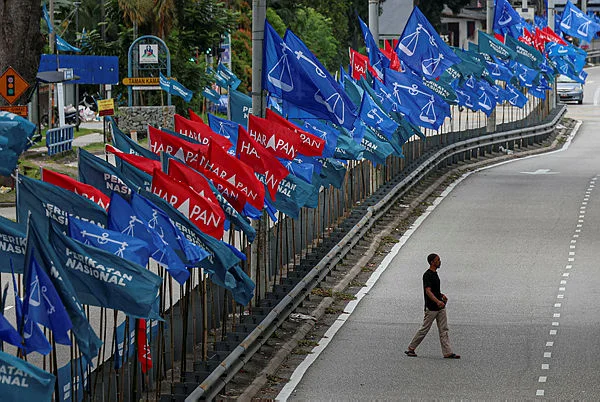
Veteran analyst says ruling coalition must consolidate support and accelerate reforms to win public confidence ahead of the next general election.
PETALING JAYA: The Madani government still has much work to do to strengthen public confidence ahead of the 16th general election (GE16), with electoral trends suggesting that support has yet to fully consolidate, said veteran newsman Datuk A. Kadir Jasin.
Drawing on voting patterns since 2022, he said the ruling coalition remains on a competitive footing, although challenges persist in translating its position into a clear majority mandate.
In an analysis of the current political landscape, Kadir pointed to the outcome of GE15 and the 2023 state polls as indicators of a still-evolving support base.
He said Pakatan Harapan (PH) fell short of a simple majority in GE15, leading to the formation of a unity government with Barisan Nasional (BN), particularly Umno.
“That result alone should be taken as the baseline. PH did not win outright. It formed the government through post-election alignments,” Kadir told theSun.
He said the six-state elections in 2023 – widely viewed as a referendum on the federal administration – also offered mixed signals on voter sentiment.
“If those state elections are any indication of national sentiment, then PH together with Umno did not perform convincingly.
“In fact, in several areas, they underperformed,” he said, citing the narrow retention of Pahang as a cautionary sign.
He also said cooperation with Umno has yet to translate into a broader consolidation of Malay support, which remains a key electoral battleground.
“Umno itself is struggling with credibility issues, and that burden does not disappear simply by being part of the government.”
He highlighted the pace of institutional reform – a core pillar of PH’s political narrative – as an area closely watched by the public.
“There is a perception that reformasi has slowed. Efforts at parliamentary reform have not made the kind of impact many hoped for.”
Kadir said clearer and more consistent visibility from leaders driving reform could help reinforce public confidence.
“Leadership on reform must be visible and consistent. Without that, the narrative weakens.”
He added that economic pressures, particularly the cost of living, continue to shape voter sentiment and remain a key test for the administration.
“When people feel that their situation is not improving, political goodwill dissipates quickly.”
Looking ahead, Kadir said much would depend on how effectively current challenges are addressed before GE16.
“Based on present indicators, it would be difficult for PH to improve on its 2022 performance. The risk is that it could do worse if underlying issues are not addressed.”
GE15, held on Nov 19, 2022, resulted in Malaysia’s first hung Parliament, with no single coalition securing a simple majority.
PH emerged as the largest bloc (81 seats), followed by Perikatan Nasional (74) and BN (30).
Other parties that gained representation included Gabungan Parti Sarawak (23 seats), Gabungan Rakyat Sabah (six), Warisan (three), Parti Bangsa Malaysia (one), Parti Kesejahteraan Demokratik Masyarakat (one) as well as two independent candidates.
The outcome led to a five-day political impasse, prompting the intervention of the Yang di-Pertuan Agong and culminating in the formation of a unity government.
Datuk Seri Anwar Ibrahim was sworn in as Malaysia’s 10th prime minister on Nov 24, 2022.
While GE16 is constitutionally due by Feb 17, 2028, there is ongoing speculation that Parliament could be dissolved earlier.
One scenario under discussion is aligning the general election with upcoming state polls, particularly in Malacca and Johor, whose legislative terms are set to expire in December 2026 and April 2027 respectively.



