




Table of Contents
What happens when the performance of sensitivity replaces actual accountability? You get the performative male
At first glance, the performative male looks harmless. In fact, he often looks ideal.
He reads feminist theory. He knows the right language. He talks about emotional intelligence, respect and healing masculinity. He might even bake sourdough, collect vinyl or romanticise quiet mornings in independent bookstores. But beneath that carefully curated aesthetic is a growing feminist critique: what happens when the performance of sensitivity replaces actual accountability?
In feminist discourse, the performative male refers to men who publicly align themselves with feminist values not necessarily because they embody them, but because those values are socially rewarding. The result is a version of masculinity that looks progressive on the surface but remains unchanged in practice. It is not that men cannot be feminist allies. It is that allyship becomes hollow when it is built around being seen as good, rather than doing the work of being good. And modern pop culture is full of him.
Aesthetic of sensitivity
The performative male is not defined by overt aggression or obvious misogyny. He is defined by contrast.
He speaks softly but expects emotional labour. He understands consent in theory but struggles with boundaries in practice. He presents himself as not like other men, yet still centres his own desires, validation and worldview.
In many ways, he is not a new archetype. What is new is how recognisable and self-aware he has become in modern storytelling.
He is the man who knows all the right words, but not necessarily the right actions.
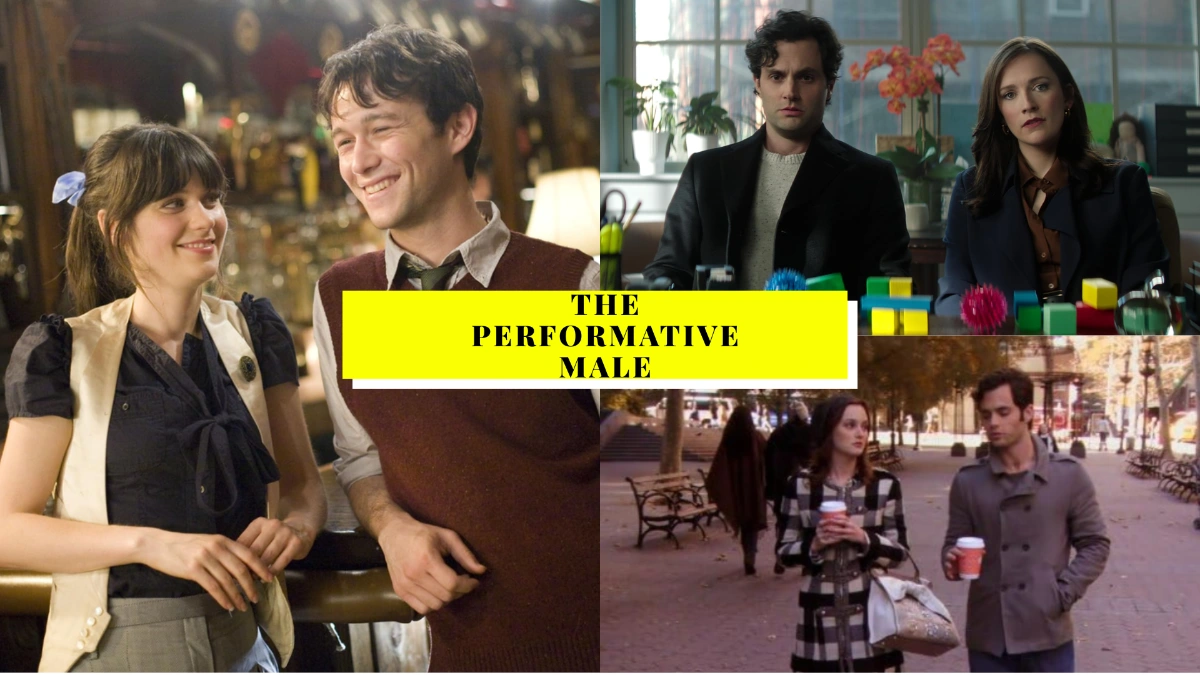
Joe Goldberg: Performative male taken to its darkest extreme

In You, Joe Goldberg is perhaps the most chilling evolution of this archetype.
On the surface, Joe is the perfect anti-hero: sensitive, well-read, observant and softly spoken. He works in bookstores, quotes literature and frames his obsession as love. He appears emotionally intelligent compared to the men around him.
But this sensitivity is not innocence. It is a strategy.
Joe carefully constructs a persona that allows him access to women while masking stalking, control and violence. His romantic internal monologue reframes coercion as destiny and obsession as devotion.
He is what happens when performative sensitivity is no longer about social approval, but about justification. Joe does not just perform goodness. He weaponises it.
The horror of You is not that Joe is a monster in disguise. It is that his disguise is so convincing.
Dan Humphrey: Outsider who curated belonging

In Gossip Girl, Dan Humphrey begins as the classic outsider with integrity. He is the Brooklyn writer observing the wealthy elite from a moral distance. He positions himself as authentic in contrast to the superficial Upper East Side. But as the series progresses, Dan’s good guy identity becomes increasingly constructed.
He uses his outsider status as narrative leverage. He writes himself into the world he claims to critique. His sensitivity and artistic identity become tools for infiltration, control and reinvention.
Dan is particularly interesting because his performative identity is not just romantic, but strategic. He does not simply want love or connection. He wants access, relevance and legitimacy within a world he resents.
His nice guy persona becomes both shield and weapon.
Sad boy protagonist: Emotional depth or emotional self-absorption?

A softer version of the performative male appears in films like 500 Days of Summer and Lost in Translation.
These characters are often framed as introspective, artistic and emotionally complex. They are sensitive observers of the world, navigating heartbreak, loneliness or existential drift.
But feminist readings of these narratives often highlight a different tension: the women in these stories can become secondary to the men’s emotional journey.
In 500 Days of Summer, Summer is frequently interpreted through Tom’s perspective, with her autonomy filtered through his expectations of romance. In Lost in Translation, Charlotte becomes more of a reflective surface for Bob’s midlife crisis than a fully realised narrative centre.
The issue is not sadness or sensitivity itself. It is when emotional depth becomes self-centred narration, where women function less as characters and more as catalysts for male growth.
This is where sad boy storytelling overlaps with performative masculinity: emotion exists, but it is often turned inward rather than outward in accountability.
From performance to entitlement
Across these archetypes, a pattern begins to emerge.
The performative male is not simply someone pretending to be good. He is someone who understands that being seen as good carries social reward, romantic access or moral authority.
But when performance replaces reflection, the gap between identity and behaviour grows dangerous.
This is where feminist critique becomes sharper. Many of these characters do not see themselves as harmful. Joe believes he is loving. Dan believes he is misunderstood. Sad boy protagonists believe they are emotionally honest. Yet in each case, women often bear the consequences of their unexamined desires.
Why this archetype resonates now
The reason the performative male has become such a visible figure in modern media is because masculinity itself is being publicly re-evaluated.
Terms like emotional intelligence, vulnerability and allyship are now part of mainstream discourse. That shift is important. But it also creates space for mimicry.
When feminist language becomes socially valuable, it can be adopted as aesthetic rather than practice.
This is where fiction becomes useful. Characters like Joe Goldberg expose the extreme endpoint of unchecked performance. Others, like Dan Humphrey or the sad boy archetype, reveal more subtle versions of the same dynamic: identity built for observation rather than responsibility.
Beyond performance
The critique of the performative male is not a rejection of softness, vulnerability or emotional expression. Feminist thought does not oppose those traits. In many ways, it calls for them.
The issue is not sensitivity. It is sincerity without accountability. A genuine shift in masculinity is less about how men present themselves and more about how they behave when no one is watching, applauding or rewarding them. Because ultimately, feminism does not ask men to perform better.
It asks them to be better.
READ MORE:
Album review: Genesis of Sid Sriram’s ‘Sidharth’
TV Show Review: Netflix’s Avatar is bending viewers’ patience
Caliban reimagines Shakespeare’s ‘The Tempest’ through Nusantara lens



