




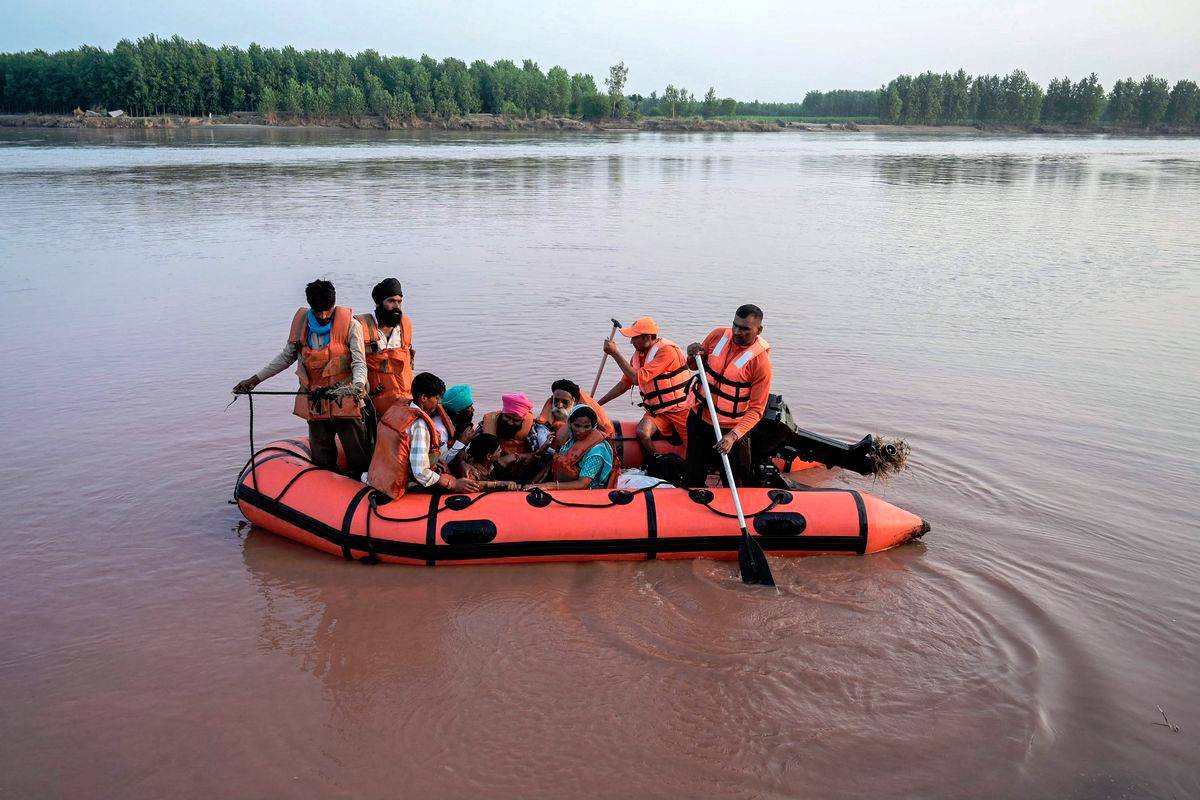
GURDASPUR: Record monsoon rains have devastated India’s agricultural heartland of Punjab, leaving fields filled with rotting crops and the air thick with the stench of decay.
Floods have swallowed farmlands nearly equivalent to the combined size of London and New York City in this region often called the country’s granary.
India’s agriculture minister confirmed during a recent state visit that crops have been completely destroyed and ruined by the unprecedented flooding.
Punjab’s chief minister described the deluge as one of the worst flood disasters to hit the region in decades.
Seventy-year-old Balkar Singh from Shehzada village confirmed this assessment, stating that the last comparable flood occurred in 1988.
The rushing waters have transformed Singh’s paddy field into marshland and created dangerous cracks in his home’s walls.
Experts attribute the increasing frequency and severity of such disasters to climate change combined with poorly planned development.
Punjab experienced rainfall surges nearly two-thirds higher than the August average according to national weather data.
The flooding has killed at least 52 people while affecting over 400,000 residents across the region.
Prime Minister Narendra Modi has announced a relief package worth approximately $180 million for Punjab’s recovery efforts.
The village of Toor, located between the Ravi river and Pakistan, lies in complete ruins with collapsed crops, animal carcasses, and destroyed homes.
Farm worker Surjan Lal described how waters rose to ten feet within minutes during the midnight flooding on August 26.
Lal explained that villagers remained stranded on rooftops for nearly a week as waters carried away their animals and possessions.
Farmer Rakesh Kumar from adjacent Lassia village reported losing his entire investment in both owned and leased farmland.
Kumar expressed concern that his fields might not recover in time for the crucial winter wheat planting season.
He noted that heavy machinery cannot access the area until muck dries and the seasonal pontoon bridge becomes operational.
Landless labourer Mandeep Kaur faces even greater uncertainty after losing both her home and source of income.
Kaur now sleeps under a tarpaulin in her courtyard, facing additional dangers from snakes moving through the damp terrain.
Punjab serves as the largest supplier of rice and wheat to India’s food security programme feeding over 800 million people.
Analysts suggest that while buffer stocks will prevent domestic shortages, basmati rice exports will likely suffer significantly.
International Food Policy Research Institute expert Avinash Kishore confirmed that both Indian and Pakistani Punjab’s basmati production will be affected.
Existing US tariffs on Indian basmati have already reduced competitiveness, with the floods exacerbating this challenging situation.
Punjab’s recovery faces additional complications after the state opted out of the federal government’s crop insurance scheme.
Seventy-year-old farmer Singh summarized the situation by noting that water remains knee-deep on his farm with an uncertain future ahead. – AFP



