





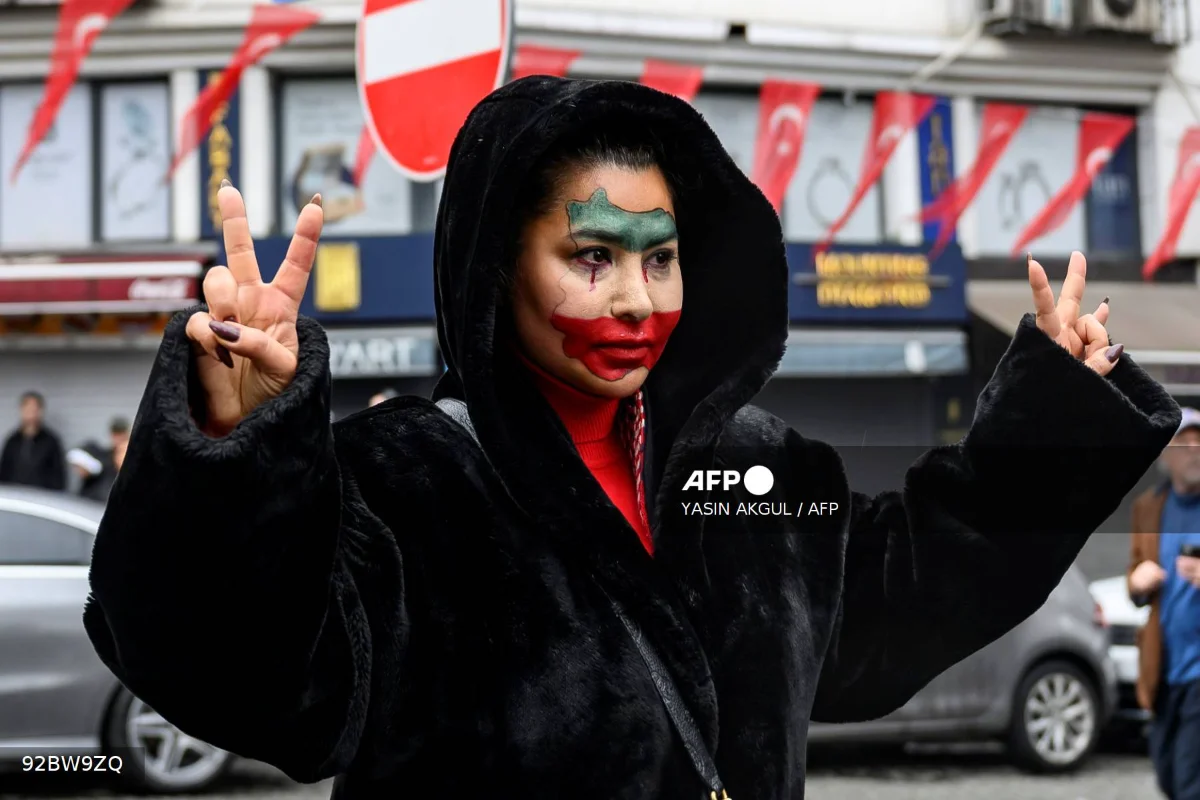
Turkish police cordon off Iran’s consulate in Istanbul, preventing Iranian nationals from demonstrating in solidarity with ongoing protests in Iran
ISTANBUL: Turkish authorities prevented Iranian nationals from holding a protest outside Iran’s consulate in Istanbul on Sunday.
Police cordoned off the area and blocked crowds from gathering, as demonstrations in Iran entered their third week.
Iran has been gripped by nationwide street protests since December 28, posing a significant challenge to the theocratic government.
Turkey, a majority Sunni Muslim nation, shares a roughly 500-kilometre border with its Shiite neighbour Iran.
It hosts more than 74,000 Iranians with residence permits and approximately 5,000 refugees.
Demonstrators gathered under steady rain in Istanbul to show solidarity with the movement.
“It’s been 72 hours since we had any news from the country, from our families,” said a young Iranian exile named Nina, who had the Iranian flag and red tears painted on her face.
“The regime kills at random — whether families are on foot or in a car, whether there are children. It spares no one,” she added.
The protests were initially ignited by anger over the rising cost of living but have since spiralled into a broader movement.
Amir Hossein, a singer from Tehran exiled in Turkey for 20 years, expressed frustration with the restrictions.
“In every country, permits are granted to demonstrate for freedom, for democracy, but in Turkey, unfortunately, never,” Hossein said.
He called for international intervention, stating, “Our regime is not normal; it kills.”
According to the Norway-based NGO Iran Human Rights, at least 192 protesters have been killed in Iran’s biggest movement against the Islamic republic in over three years.
“But this time, victory is ours and we are going to win,” Hossein asserted.
He highlighted Reza Pahlavi, the exiled son of the ousted shah, as a prominent leader calling for the protests.
Nearby, a young woman unfurled the former Iranian flag, which features a lion and sun and was used before the 1979 Islamic revolution.
Not all protesters supported a return to monarchy, however.
“We want democracy, a republic, not a monarchy,” said an exiled engineer named Mehdi, who stressed that the shah’s son was “incapable of uniting people.” – AFP



