




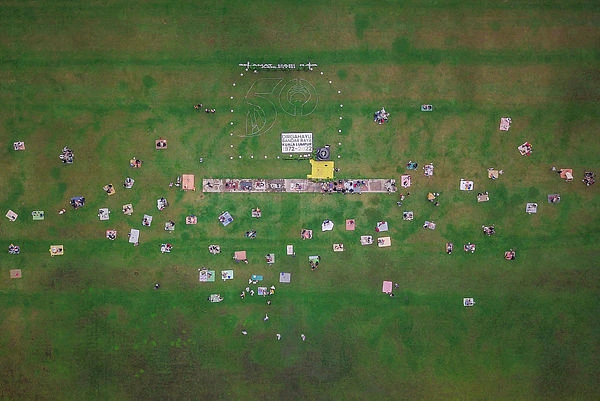
THERE is a certain irony in watching a football match where players chase glory, only to see fans leave behind a legacy of trash.
The recent images of Dataran Merdeka, our historic independence square, blanketed in rubbish after the football World Cup finals were more than a photo opportunity. They were a reflection of our national character.
The argument that we lack awareness or education feels outdated. We have campaigns, laws against littering and no shortage of reminders that cleanliness is next to godliness.
Yet, the sight of thousands treating a national monument as a personal dumping ground proves that we have failed to internalise the principle that civic duty begins with oneself. It exposes the “bayar cukai, lepas tangan” (pay taxes, wash hands) mentality that Hannah Yeoh, the minister in the Prime Minister’s Department, rightly lamented – a mindset that mistakes paying taxes for a licence to shirk personal responsibility, as though it absolves one of something as basic as putting an empty bottle into a bin.
To be fair, we are not entirely without role models. Yet, it is telling that many of the examples of “conscious cleaning” we admire come from beyond our shores. In countries such as Vietnam, a rapidly developing nation, both locals and tourists have embraced a “green tourism culture”, with some islands actively pursuing plastic-free goals and communities participating in sea-bed cleanups.
Japan remains the gold standard, a nation so disciplined that football fans pick up their own trash and players leave dressing rooms spotless – a stark contrast to the mountains of waste left by the “Malaysian side”.
Even closer to home, the contrast is just as striking. Consider the religious sphere. A random Buddhist temple in Banting, Selangor which I visited recently, sits on sprawling grounds that are meticulously maintained to ensure devotees have a lasting memory of peace and cleanliness.
It is a sanctuary where every corner reflects a devotion to order. Meanwhile, many Hindu temples in Malaysia and elsewhere, including major attractions such as Batu Caves, have historically been known for neglect. They are often cited as among the world’s most litter-strewn attractions, a condition often blamed on “monkeys” and “overtourism” but ultimately points to a failure in management and a reflection of a pervasive “every man for himself” attitude.
While there is appreciation for better management at some sites and “clean environment” reviews for places like the Sri Maha Mariamman Temple in Johor, the overall standard remains inconsistent and often deficient.
This brings us to the crux of the issue: The toilet. If the street is the face of a city, the toilet is its hidden character. The government’s introduction of the “Toilet of the Year Award” and the BMW (bersih, menawan, wangi) standard is an admirably desperate measure.
It signals a recognition that we are so fundamentally uncivilised that we need an awards ceremony to teach adults how to keep a lavatory clean.
While the Housing and Local Government Ministry boasts of upgrading over 12,000 public toilets and now tying business licences to toilet standards, the very existence of these policies is an indictment of our civic consciousness.
Vietnam is again a potent contrast. In tourist-heavy areas, there is a visible push for a “smoke-free” environment, a move to enhance visitor experience through clean air and public health.
They see cleanliness as a cornerstone of sustainable tourism. Malaysia, by contrast, is scrambling to implement laws that were standard in developed nations decades ago while our citizens cheer for football and leave a trail of plastic cups and food wrappers in their wake.
On that note, I support the government’s recent initiative to impose on-the-spot fines for littering. It may yield the results we want – at least in the short-term. The fear of a monetary penalty may just jolt the average Malaysian into thinking twice before tossing that polystyrene container onto the pavement. But then again, how long will it need for this to be part of our DNA? A generation? Two? Perhaps longer.
Consider this: Singapore introduced draconian fines for littering decades ago and while their streets are undeniably spotless today, their success is less about the fine and more about a generational shift in mindset.
The fine was merely the shock to the system while the real transformation came when parents began teaching their children that dropping a wrapper was a social disgrace, not just a financial misstep.
In Malaysia, we are still at the stage where we cheer for the fine but grumble about the enforcement. We see the saman as bad luck rather than a moral correction. The law is a stick but we have yet to cultivate the internal compass that makes the stick unnecessary.
The truth is, we have conditioned ourselves to delegate responsibility. We expect the cleaners to sweep, the contractors to scrub and the authorities to legislate. But no amount of policy can compensate for a lack of personal shame. The football fans at Dataran Merdeka felt no shame because they saw a crowd doing the same thing.
The temple-goer who leaves a mess feels no shame because they believe the “maintenance” will handle it.
Until we view that empty wrapper not as litter to be picked up but as a personal failing, Malaysia will forever remain a nation that cleans up after itself, rather than a nation that lives cleanly. And no on-the-spot fine, however well-intentioned, can accelerate that journey. It is a marathon through a swamp and we have only just begun to wade.
Dr Bhavani Krishna Iyer holds a doctorate in English literature. Her professional background encompasses teaching, journalism and public relations. She is currently pursuing a second master’s degree in counselling. Comments: [email protected]



