




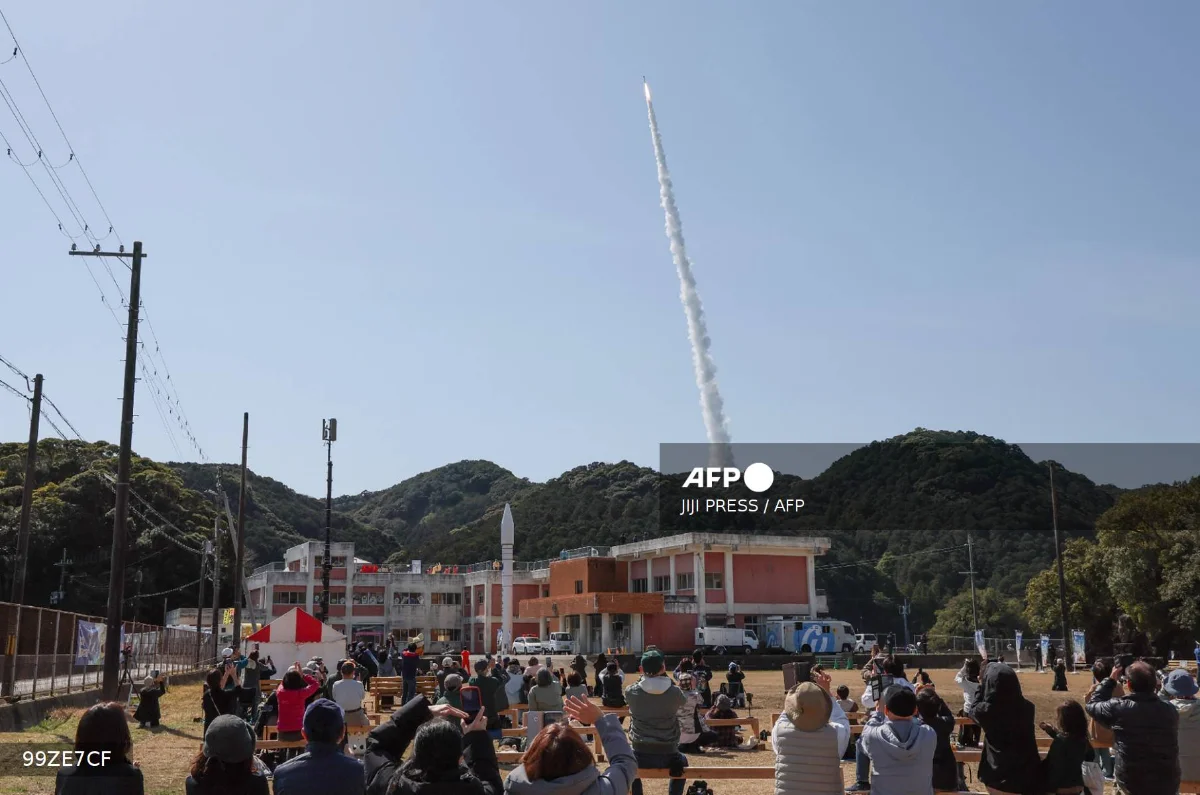
Space One’s Kairos rocket spiralled back to Earth shortly after launch, marking the firm’s third consecutive failure to reach orbit.
TOKYO: A Japanese startup’s third attempt to launch a satellite into orbit ended in failure on Thursday. The Kairos rocket spiralled back to Earth shortly after take-off from a coastal site in Wakayama.
Tokyo-based Space One said the cause of the failure is under investigation. The firm suggested a potential issue with the flight interruption system, a safety mechanism designed to automatically end a mission.
“No major anomalies had been identified within the aircraft itself and the rocket had not deviated from its flight path,” the company stated at a press conference. Television footage showed the 18-metre rocket ascending before appearing to lose power and spin downwards.
The rocket was carrying several satellites, including one for a Tokyo high school. Space One aims to become Japan’s first private firm to successfully place a satellite in space.
This latest setback follows two previous failed launches. The company’s first rocket exploded seconds after lift-off in March 2024.
A second attempt was terminated by engineers due to a technical problem, causing the rocket to spiral down. Wednesday’s scheduled launch was also aborted just 28.9 seconds before ignition due to a glitch.
Founded in 2018, Space One hopes to offer cheaper, more frequent launch services, emulating firms like SpaceX. Its shareholders include Canon Electronics, IHI Aerospace, Shimizu, and the Development Bank of Japan.
The failure occurs amid broader challenges for Japan’s space sector. The national agency JAXA experienced multiple failures with its H3 rocket before a successful launch in February 2024.
A subsequent H3 launch in December failed to deploy a satellite due to engine failure. Japan did achieve a lunar landing with its SLIM probe in 2024, making it the fifth country to do so.
Private lunar ambitions also faced setbacks, with ispace’s unmanned craft believed to have crash-landed last year. The company had aimed to be the first private firm outside the US to achieve a controlled Moon landing.



