




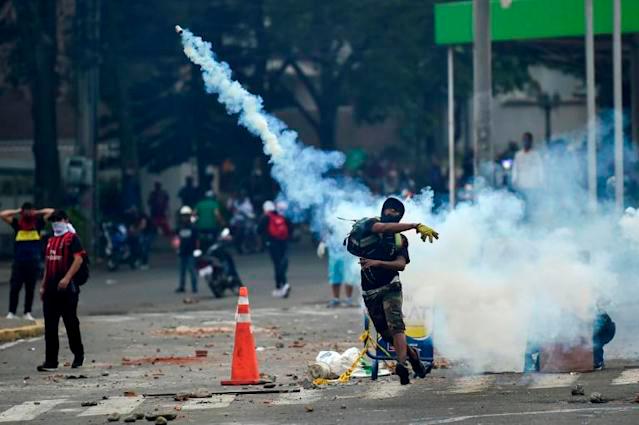
CALI: Poverty, long-simmering racial tension, drug trafficking and a recent outbreak of violent anti-government protest: the Colombian city of Cali has come to encapsulate all the ills of a country that recently emerged from half a century of conflict but tumbling back into crisis.
With 2.5 million inhabitants, just over half of them black, the tropical melting pot near the Latin American nationâs Pacific coast is weighed down by crushing poverty and unemployment.
It is a âcocktail with racist components, empowered by irritation and weariness towards the government,â professor Delfin Grueso from the University of Valle told AFP.
Once famous as the fiefdom of the feared Cali Cartel, which dominated the worldâs cocaine market; or as a hotbed for salsa, the city is now paralyzed by road blocks, protests and clashes between civilians and police.
Mass demonstrations against poverty and inequality that began across the country two weeks ago have spiraled into deadly violence, with dozens killed.
In Cali, says the NGO Temblores, the violence has led to the deaths of 35 civilians â at least 14 of those at the hands of police.
Colombia has come under fire for its severe response, and in particular for the deployment of heavily-armed police more accustomed to fighting drug trafficking and the remnants of left-wing guerrilla groups.
Grueso said the cityâs deep social fissures â combined with âclass components, exacerbated by political rhetoricâ â have emboldened a national government that ârepressed (the protests) as if it was subversion.â
– âBarbaricâ –
The crackdown has been âbarbaric,â according to Maria del Pilar Castillo, also from the University of Valle.
âIt flares up at night… helped by helicopters, armed civilians or police dressed as civilians,â she said.
Authorities have not recorded the number of police killed in the city, but videos of civilians shooting firearms are all over social media.
âItâs a friend-enemy problem. If the police see that (the armed civilians) are against their enemies, which in this case is the demonstrators, it doesnât make sense to attack them. Itâs the logic of war,â said Castillo.
– âRacist cityâ –
An important element in the protests has been the involvement of indigenous people. Last weekend, a dozen were wounded by gunfire in Cali.
âCali is a racist city. But itâs barely been noticed because the city is segregated,â said Castillo.
On social media, there have been calls to join the âwhite movementâ â protesters dressed in white and driving white trucks that seek to break up roadblocks.
âTheyâre mixed race but think of themselves as whites because theyâre differentiating themselves from the Afro-descendants and indigenous people, whom they call Indians,â added Castillo.
For Juan Manuel Torres, from the Peace and Reconciliation Foundation, these people are âdrug-trafficking elitesâ who want to âadminister their own justice.â
âThey have the weapons, the resources, armored trucks, they have their bodyguards and dogwashers (small time gangsters), theyâre forming squadrons to murder protesters,â he said.
– In the crossfire –
When authorities signed a historic 2016 peace accord with the Revolutionary Armed Forces of Colombia (FARC), the largest left-wing rebel group in the country, local authorities branded Cali the âpost-conflict capital.â
For decades, people displaced by violence and those lacking opportunity in coastal towns moved to Cali and settled in âmarginal neighborhoods, without access to work or education,â said Grueso.
But despite the peace accord, the cycle of violence has continued.
The Pacific region has the largest concentration of coca plantations in the country, according to a recent UN report. Coca is a prime ingredient in the production of cocaine.
Locals found themselves in the crossfire between armed groups, as violence has surged with massacres, assassinations and mass displacements on the rise.
FARC dissidents, members of the National Liberation Army (ELN) â the last recognized rebel group â and armed gangs made up of disbanded right-wing paramilitaries are fighting over the regionâs lucrative drug-trafficking, illegal mining and extortion markets.
Justifying its heavy-handed crackdown, the government has insisted the current protest violence has been coordinated by armed gangs infiltrating demonstrations.
– âAbnormal collective psycheâ –
The localsâ sense that they are being repressed has been inflamed by the punishing restrictions that have come with the pandemic.
Forced indoors, skeptical of government institutions and connected to social media, Caliâs young people have led the protests.
The pandemic has pushed âa good part of the middle classes into poverty and a good part of the poor into misery,â said Grueso.
Meanwhile the thriving salsa scene has been put on hold, producing an âabnormal collective psyche,â city mayor Jorge Ivan Ospina told El Pais, among a cohort used to partying.
âWeâre committed to reducing infections and we didnât understand what confinement does to a youngster from Cali,â Ospina said. âMaybe for a youngster from Scotland, confinement is different.â â AFP



