




KUALA LUMPUR: Malaysia is aiming to scale up to 3,000 smart factories under its industrial transformation agenda as the government tightens foreign labour access and pushes manufacturers towards automation and higher-value production.
Deputy Investment, Trade and Industry Minister Sim Tze Tzin said the country currently has about 400 smart factories, but warned that reliance on low-cost foreign labour is becoming increasingly unsustainable.
“What I want to say is that the government will move towards controlling labour.
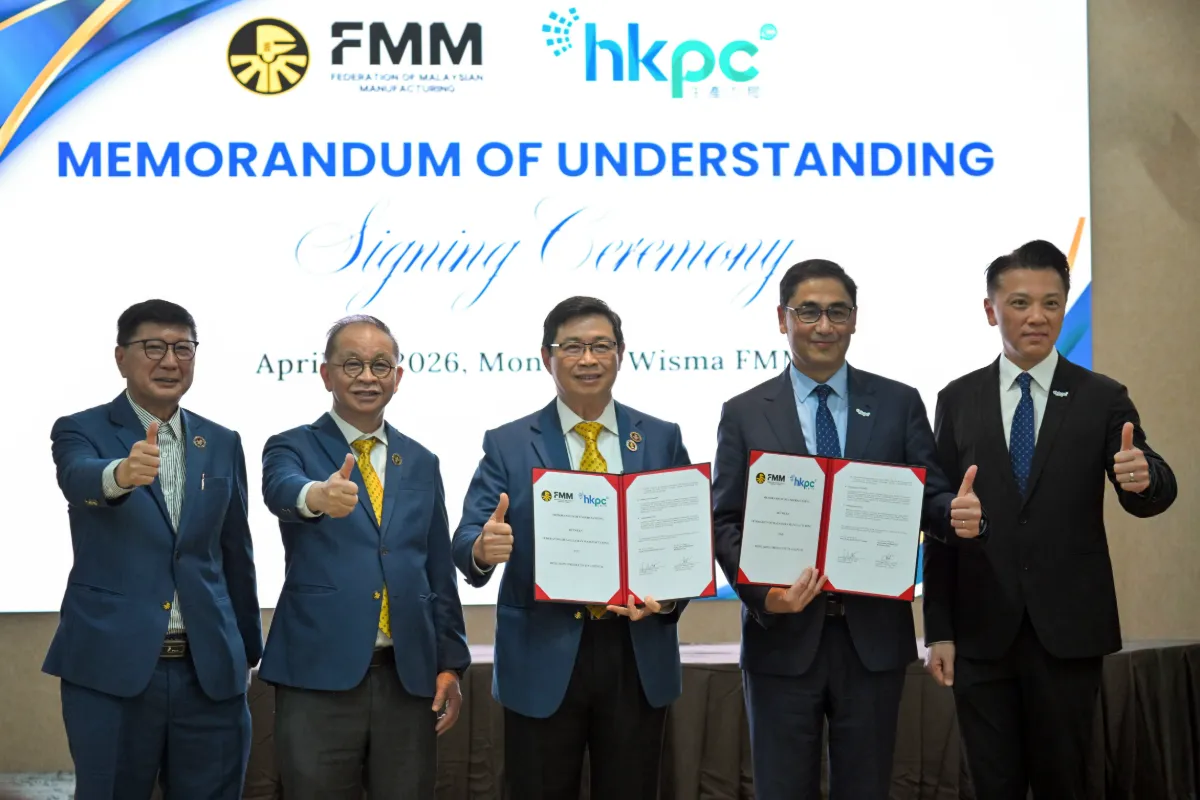
Industry will find it increasingly hard to get foreign labour and the only way out is automation,” he said at the Malaysia-Hong Kong Industrial Partnership Forum and memorandum of understanding signing between the Federation of Malaysian Manufacturers (FMM) and the Hong Kong Productivity Council (HKPC) today.
Sim said the policy direction is aligned with the New Industrial Master Plan 2030, which focuses on moving Malaysia up the value chain through higher productivity, automation and skilled workforce development.
He added that the government is supporting the transition through grants and agency partnerships, including with Malaysia Productivity Corporation, to help manufacturers modernise operations.
Sim said companies that continue to adopt a “wait-and-see” approach risk falling behind, as structural changes in labour policy will gradually tighten supply. “Access to labour will be getting more and more challenging. It is important that manufacturers plan now to move towards automation. It is a worthwhile investment.”
The deputy minister pointed to Malaysia’s near-full employment situation, saying the tightening labour market would naturally push firms towards technology adoption rather than manpower expansion.
On geopolitical and energy-related disruptions, Sim said global conflicts have continued to affect supply chains and input costs, but stressed that Malaysia has managed the situation comparatively well through subsidies and supply stability measures.
“Malaysia is not unique. The world faces rising fuel costs and supply disruptions. But we have maintained subsidies for the majority and ensured supply continuity.”
Sim added that inflationary pressure from global energy shocks is unavoidable, but said the government is working to cushion the impact while maintaining industrial competitiveness.
Meanwhile, FMM president Jacob Lee Chor Kok said Malaysia’s manufacturing sector remains a key economic pillar, contributing 23% to gross domestic product and employing about 2.5 million workers, with 86% of exports driven by manufacturing activities.
He said Malaysia’s trade performance has reached historic levels, supported by strong electrical and electronics exports, and highlighted the need for deeper industrial collaboration amid global supply chain realignment. “The synergy between Malaysia and Hong Kong is clear. Malaysia offers a strong manufacturing base and Asean connectivity, while Hong Kong brings technology, finance, professional services and global market access.”
Lee said FMM is focusing on four key pillars to support industry transformation, including talent development, market expansion, technology and artificial intelligence adoption, and building a stronger research, development and commercialisation ecosystem.
He added that collaboration with HKPC will help accelerate smart manufacturing adoption, particularly among SMEs, which often lack resources to invest in advanced technologies.
HKPC chairman Sunny Tan said the partnership comes at a critical time as global supply chains undergo restructuring amid geopolitical tensions, tariff uncertainties and rising trade fragmentation. “Manufacturers that move early will lead the game. This is where Hong Kong plays a distinctive role as a connector between China, Asean and global markets.”
Tan said HKPC is an applied technology institute focused on taking innovation from research into industrial application, particularly in smart manufacturing, AI, robotics and green technologies.
He added that the collaboration with Malaysia will support supply chain diversification and resilience, while enabling SMEs to access advanced production systems at lower cost.
Both sides highlighted opportunities in Industry 4.0, digitalisation and green manufacturing, with HKPC noting that energy efficiency and environmental, social and governance compliance are becoming key competitiveness factors in global trade.
Lee said the collaboration with HKPC is expected to strengthen Malaysia’s industrial transformation agenda, particularly in helping SMEs move into Industry 4.0 adoption.
He added that many local manufacturers are still in early stages of digitalisation due to cost concerns and reliance on labour, but partnerships like this will help bridge capability gaps through practical technology transfer and training.
Tan said the council will work closely with FMM to drive applied innovation across the supply chain, not just at factory level but at cluster level.
HKPC’s role is to “democratise technology” so SMEs can also access smart manufacturing tools and improve productivity in a more affordable and scalable way, he added.



