




KUALA LUMPUR: Taiwanese industrial technology company Advantech Co Ltd is strengthening its Asean strategy as global manufacturers accelerate diversification amid geopolitical uncertainty, shifting supply chains and rising demand for industrial AI applications.
Speaking during the Advantech Asean Connect Conference 2026 (APC 2026) in Penang, Advantech representatives said the company is expanding its regional footprint by building stronger country-specific capabilities across Southeast Asia rather than relying on a single-market operating model.
Advantech managing director of Asia and Intercontinental Region Vincent Chang said the company has progressively invested across Asean markets based on each country’s strengths and industrial positioning.
According to Chang, Singapore serves as a regional hub for finance, business intelligence and semiconductor-related activities, while Malaysia plays a larger role in engineering support and industrial services due to its strong technical talent base.
Thailand, meanwhile, is emerging as a key market for smart-city and smart-manufacturing development.
“The diversification strategy has become increasingly important as companies navigate geopolitical tensions, trade disruptions and supply chain volatility. In the past, many companies concentrated operations in one location.
“Today, businesses are looking at diversification more seriously to manage risks and maintain continuity,” he said.
Chang also pointed to Vietnam’s growing role as an alternative manufacturing base, particularly as Chinese manufacturers continue to relocate production to Southeast Asia.
He added that Advantech is expanding its presence across Asean markets, including Indonesia and the Philippines, although momentum remains strongest in Malaysia, Singapore and Thailand.
Beyond supply chain realignment, Chang said industrial AI and energy infrastructure are emerging as key long-term growth drivers in the region.
Rising demand for AI computing is expected to significantly increase the need for energy infrastructure and power management solutions.
“In the past, discussions around green energy were largely driven by ESG goals. Moving forward, industries will focus more on power infrastructure and energy capacity required to support AI computing,” he said.
Against this backdrop, Advantech sees industrial AI adoption and energy infrastructure development as major long-term opportunities in Asean.
Advantech vice-president of IoT automation sector Lin Chingpo said many companies are keen to adopt AI but still struggle with translating it into practical industrial applications.
“One of the main obstacles remains the lack of domain expertise and standardisation in industrial AI deployment. AI depends heavily on the right expertise, training models and industry knowledge.
“Without proper understanding and the correct data, outcomes may not be meaningful,” he said.
Lin added that successful industrial AI deployment requires stronger collaboration across the ecosystem, including hardware providers, software developers, system integrators and local partners.
“No single company can handle industrial AI transformation alone. Ecosystem collaboration is necessary to create solutions that are scalable and practical for real industrial environments,” he said.
Advantech is also working to simplify AI deployment frameworks to support manufacturers, particularly SMEs with limited AI budgets or technical resources.
Advantech representatives also said AI agents, edge AI systems and automation platforms are expected to become more deeply embedded in industrial workflows, shifting from passive monitoring towards more proactive operational decision-making.
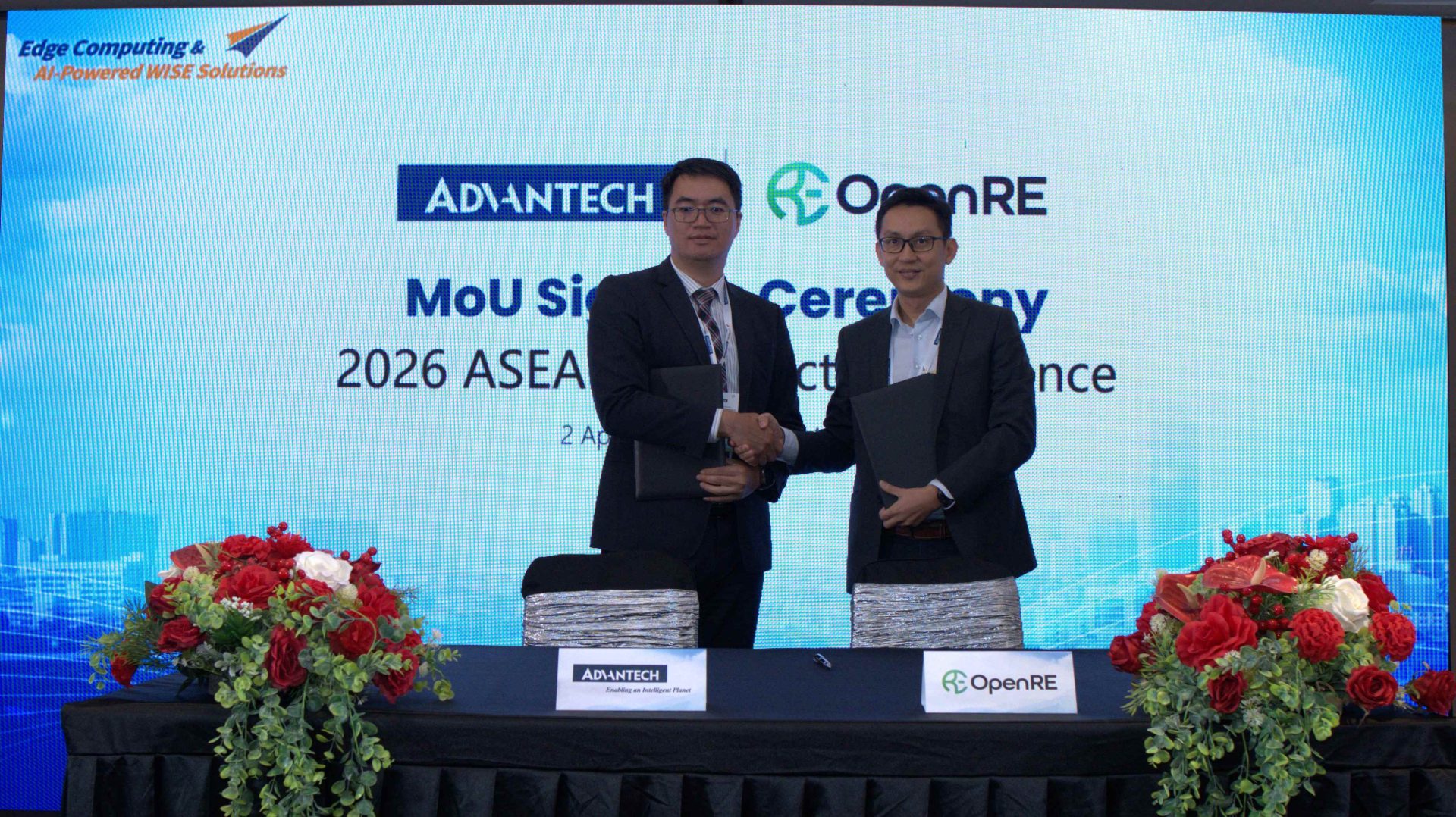
The multinational signed three memoranda of understanding (MoUs) during APC 2026 with Malaysia-based Open RE Sdn Bhd, Thailand’s Get On Technology Co Ltd and Qonnect (BIIC Co Ltd), and Australia’s Pacific Automation Pty Ltd, to support industrial innovation and regional collaboration across ASEAN.
Held in Penang, APC 2026 brought together industry players, technology partners, and manufacturers from across the region to discuss industrial AI, smart manufacturing, the energy transition, and Asean’s evolving role in global supply chains.



