




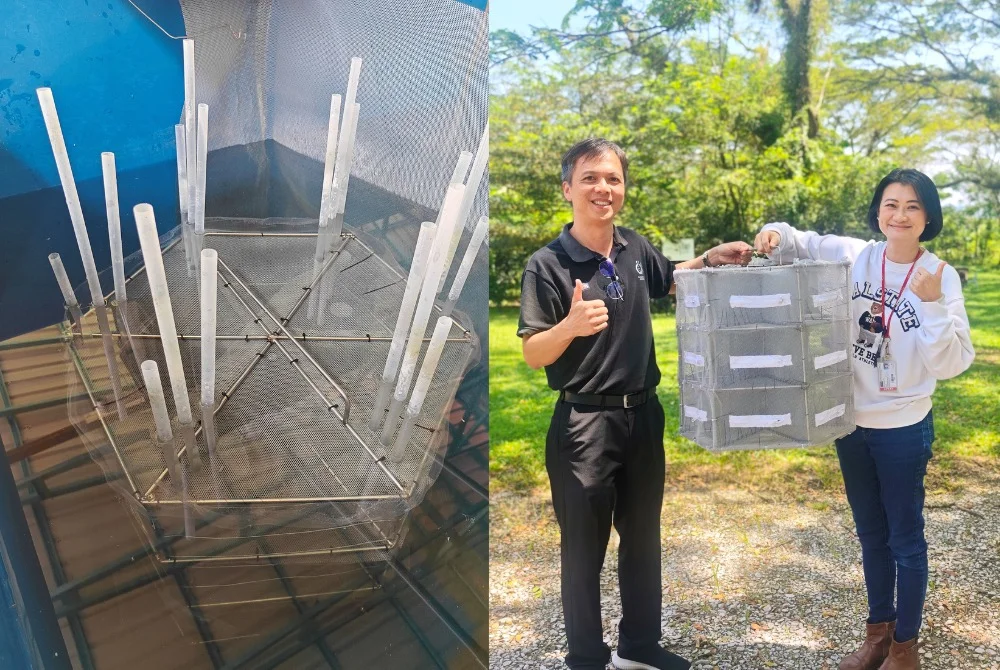
KUALA LUMPUR: Researchers from Universiti Tunku Abdul Rahman (UTAR) have developed an innovative aquaculture cage designed to improve the productivity and sustainability of crustacean farming, with a particular focus on the giant freshwater prawn (Macrobrachium rosenbergii).
The technology, which is currently under review for a Malaysian patent (PI2025008522), was developed by Faculty of Science researchers Associate Professor Dr Wong Wey Lim and Associate Professor Ts Dr Teoh Chaiw Yee to address long-standing challenges faced by the aquaculture industry, including cannibalism, uneven growth and inefficient use of farming space.
The triangular prism-shaped cage features individual compartments that mimic the natural crevices preferred by crustaceans. Each compartment is separated by permeable walls and equipped with integrated feeding tubes, allowing individual prawns to grow in isolation while maintaining continuous water circulation.
Dr Wong, who is the principal investigator of the study, said conventional shrimp and prawn farming often suffers from aggressive behaviour among the animals, leading to lower survival rates and reduced yields.
“Traditional shrimp and prawn farming faces persistent challenges such as cannibalism, aggressive behaviour, uneven growth, inefficient land use and low productivity.
“Considering the commercial and cultural importance of this hatchery method, we were inspired to develop the triangular prism-shaped cage with permeable walls, allowing each shrimp to occupy an individual refuge with continuous water circulation,” he said.
He said the design allows high-density farming through vertical and horizontal stacking, enabling greater production without increasing land use.
“For high-density farming, these triangular compartments can be arranged and stacked in multiple orientations, enabling vertical and horizontal expansion. This approach significantly increases the number of crustaceans produced per unit area while moving towards sustainability by reducing land requirements and maximising the use of the water column,” he added.
During a 70-day intensive cultivation trial using giant freshwater prawns in recirculating aquaculture systems (RAS) and biofloc technology (BFT) systems, the researchers recorded improvements in survival rates and overall yields.
The study also found a higher proportion of blue-claw and double-cheliped male prawns, which are commercially valued due to their larger size and higher marketability.
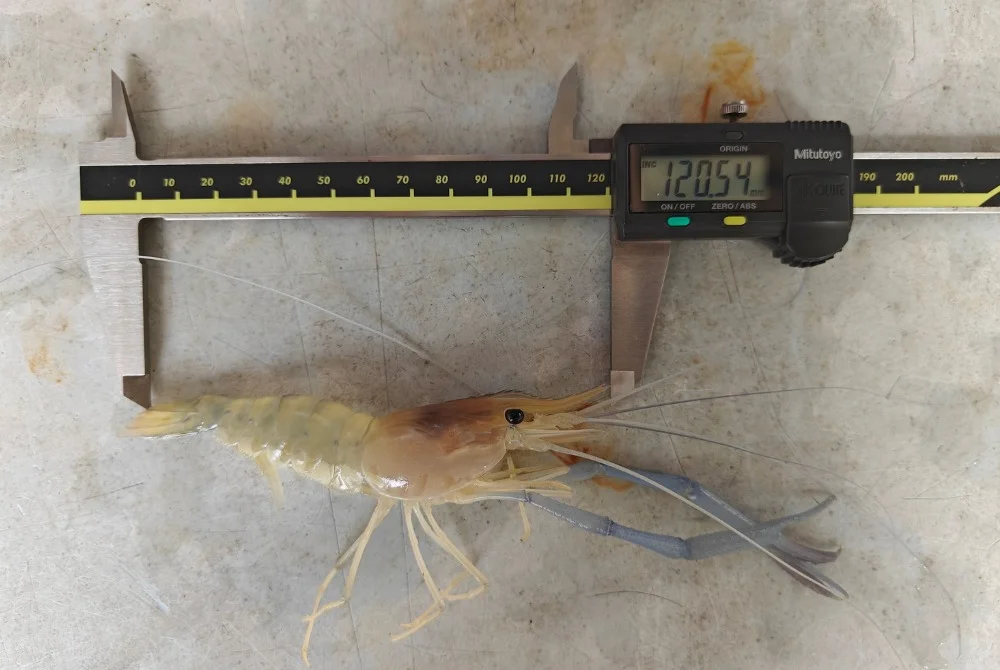
“The shift in morphotype distribution is likely attributed to the individual separation provided by the novel cage, as it reduces cannibalism and aggressive interactions during cultivation.
“Given the improvements in survival rate, total yield and male morphotypes, the novel aquaculture cage demonstrates a more viable and cost-effective strategy for enhancing productivity under intensive giant freshwater prawn cultivation,” said Dr Wong.
He noted that producing larger male prawns is critical to improving the profitability of the industry, as current harvests are often dominated by smaller individuals with lower commercial value.
“Without targeted management, a significant portion of the harvest will comprise small or even unmarketable individuals, which weakens the economic viability of the farm,” he explained.
According to Dr Wong, the new cage technology could help create a more sustainable aquaculture sector by reducing land requirements, supporting automated feeding systems and improving overall production efficiency.
“The aquaculture cage enables higher stocking density while maintaining animal welfare. It reduces farm space requirements, supports automated feeding, and enhances overall production efficiency for commercial aquaculture operators.
“With a more reliable crustacean farming method, it creates opportunities for sustainable aquaculture businesses and promotes innovation in agrotechnology, benefiting local and regional communities,” he added.
The project forms part of broader research initiatives undertaken at UTAR’s Agriculture Park and aligns with the university’s goal of integrating scientific research with sustainable agriculture and industry applications.
UTAR offers more than 140 programmes ranging from foundation studies to doctoral degrees across various disciplines. The university will hold its Open Day on Aug 29 and 30 at its Kampar and Sungai Long campuses.



