




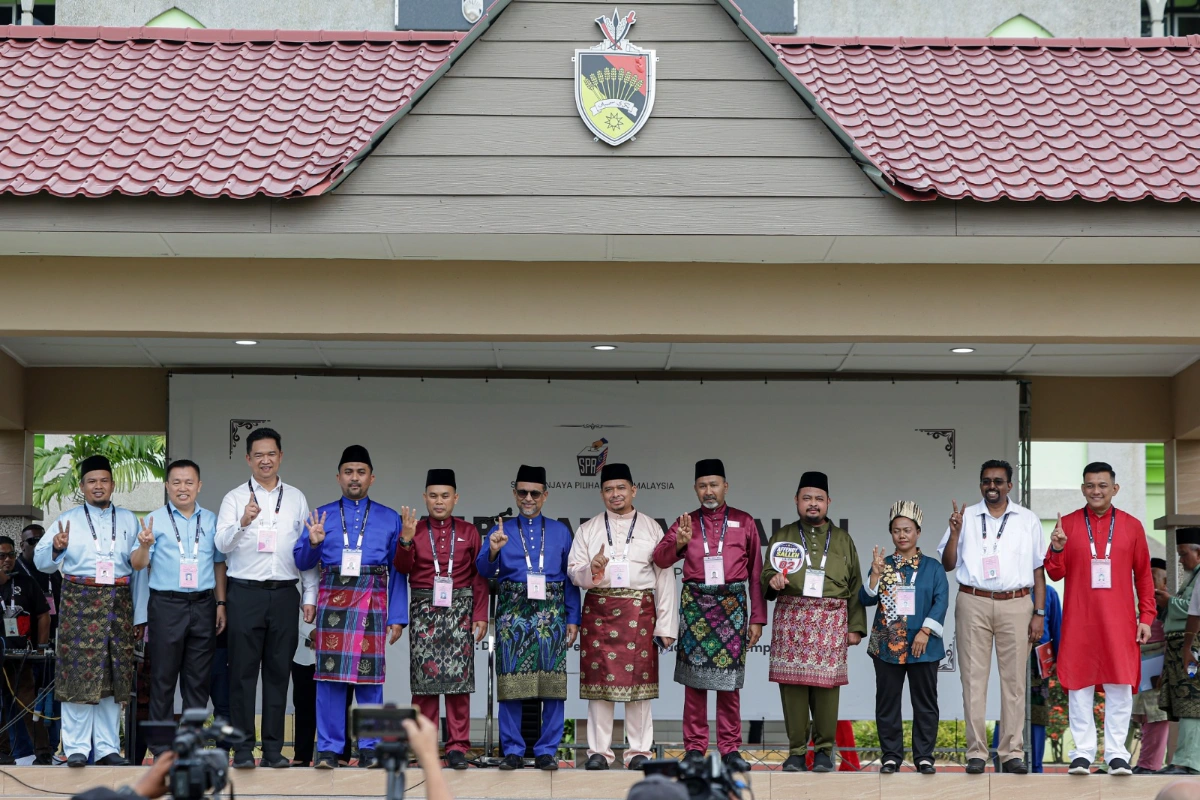
NEGERI SEMBILAN voters will go to the polls on Aug 1 in what may become one of Malaysia’s closest and most politically consequential state elections in recent years.
The contest is no longer a straightforward battle between the incumbent Pakatan Harapan government and a united Opposition. Instead, voters are confronted with three competing political formations: PH, the electoral understanding between Barisan Nasional and Perikatan Nasional and Bersatu, which is contesting independently despite technically remaining a member of PN.
There are 36 seats in the Negeri Sembilan State Legislative Assembly. A coalition requires at least 19 seats to form a government. PH is contesting all 36 constituencies, BN is fielding 25 candidates, PN is contesting the remaining 11 under a no-clash understanding with BN, while Bersatu has placed candidates in 24 seats under its own logo. Altogether, 103 candidates are contesting, with only 11 straight fights and 25 constituencies involving three or more candidates.
Based on the present electoral map, PH should be regarded as the narrow favourite to emerge as the largest individual bloc. However, BN and PN together have an almost equally credible route to forming the government. Bersatu, meanwhile, has little realistic prospect of winning the state independently, but could split enough votes to decide the outcome in several marginal constituencies.
A radically different election from 2023
In the 2023 state election, PH won 17 seats, BN secured 14, and PN captured five. PH and BN consequently formed a state unity government with a commanding 31-seat majority.
That arrangement has now collapsed. The withdrawal of support by all 14 BN assembly members during the state’s political and constitutional crisis eventually led to the dissolution of the assembly and an election more than two years before it would ordinarily have been due. The 2023 results cannot therefore be transferred mechanically into 2026.
BN candidates previously benefited from some PH voter support, particularly in mixed constituencies. PH candidates similarly benefited from BN’s ability to reassure traditional Malay and rural voters. This time, PH and BN are opponents, while BN expects supporters of PAS and other PN components to vote for its candidates.
The most important question is consequently not simply which party is more popular. It is whether voters will follow the new instructions issued by their respective party leaders.
PH’s advantage: A stronger starting base
PH begins with a relatively secure foundation of urban, semi-urban and mixed constituencies, particularly around Seremban, Nilai and parts of Port Dickson. DAP won all 11 seats it contested in 2023, many with comfortable margins, giving PH a dependable bloc that BN-PN must first break before it can take control of the state.
The coalition also possesses several organisational advantages.
First, PH is the only major coalition contesting all 36 seats under a single political identity. Voters understand that a vote for any PH candidate contributes directly towards an Aminuddin Harun-led government. By contrast, BN and PN are campaigning for each other without formally merging, while Bersatu continues to insist that it remains part of PN despite contesting against PN candidates.
Second, PH can campaign on continuity. Aminuddin’s administration can point to programmes already implemented and present its manifesto as an extension of existing policies. PH’s manifesto contains 10 principal commitments involving employment, housing, welfare, education, investment and clean administration, aligned with the longer-term Negeri Sembilan Maju 2045 agenda.
Third, the division involving PN and Bersatu benefits PH in multi-cornered contests. Bersatu is meeting BN in 16 constituencies and PN in eight. There is no straight contest involving Bersatu. Even where Bersatu is unable to win, the votes it receives may reduce the total available to BN or PN and allow PH to prevail with less than 50 per cent support.
This fragmentation is particularly valuable in a state where small movements can overturn several constituencies. Nearly one-third of Negeri Sembilan’s seats were decided by fewer than 1,000 votes in 2023. Analysts have estimated that a movement of only 500 to 1,000 votes could change the winner in several battlegrounds.
PH’s weakness: Support may not translate into 19 seats
PH’s apparent statewide advantage does not guarantee victory. A Vodus Research survey conducted between July 9 and 21 placed PH at 42 per cent of the statewide popular vote, compared with 35 per cent for BN and seven per cent for PN. Its constituency forecast showed PH leading in 17 seats, BN in 15 and PN in two, with another two PH-BN contests too close to call.
This means PH could win the most votes and still fail to secure the 19 seats necessary to govern.
BN’s support is concentrated more efficiently in rural and semi-rural constituencies, whereas PH’s large majorities in urban seats may increase its popular vote without producing additional representation. Winning a seat by 10,000 votes is no more valuable in the assembly than winning it by 100.
The Vodus findings also identified a significant weakness for PH. BN recorded a net governing-trust score of 45 per cent, compared with 19 per cent for PH. Aminuddin’s personal favourability was measured at 31.7 per cent. These figures suggest that PH’s general popularity is not necessarily accompanied by equally strong confidence in its leadership or administrative performance.
The survey should nevertheless be treated as directional rather than conclusive. It involved 437 registered voters through an online methodology, with the sample subsequently weighted according to age, gender and ethnic composition. That is useful for identifying broad sentiment, but modest for predicting 36 individual constituency outcomes.
PH must also confront dissatisfaction over the cost of living, housing, congestion, water supply, employment quality and the pace of political reform. Its defeat in the recent Johor election, where BN won 48 of the 56 seats while PH retained only eight, may weaken campaign morale and encourage undecided voters to support a coalition perceived to possess momentum.
BN-PN’s advantage: The arithmetic is already close to 19
The strongest argument for a BN-PN victory is remarkably simple.
BN won 14 seats in 2023, and PN won five. If both sides retain their previous constituencies, they will collectively possess exactly 19 seats—the minimum required to form a government.
Their no-clash arrangement gives them a plausible route towards achieving this. BN is contesting 25 seats and PN 11, covering all 36 constituencies without opposing one another. Leaders from both sides have said their campaign machinery will assist whichever candidate represents the understanding in each constituency, although BN continues to describe the relationship as an “understanding” rather than a formal alliance.
BN brings extensive local networks, experienced candidates and strong connections with village, FELDA and traditional community organisations. PN, especially PAS, contributes a committed ideological base and grassroots machinery capable of mobilising Malay-Muslim voters.
BN also enters the election with the psychological advantage of its landslide in Johor. That result demonstrated that the coalition remains capable of consolidating Malay support while attracting sufficient non-Malay and centrist backing when voters view it as the most stable governing option.
Its message is also supported by high-profile local personalities. Mohamad Hasan remains dominant in Rantau, while senior figures such as Jalaluddin Alias provide BN with recognisable state-level leadership. Rantau itself is unlikely to determine the government, but the size of Mohamad Hasan’s majority will indicate whether BN’s Johor momentum has crossed the state border.
BN-PN’s weakness: Vote transfer is not automatic
The BN-PN arrangement appears convincing on paper, but elections are decided by voters rather than coalition leaders.
Some traditional BN supporters—particularly MCA, MIC, moderate Malay and non-Malay voters—may be unwilling to support PAS or other PN candidates. Equally, some voters who previously supported PN as an anti-establishment alternative may hesitate to vote for UMNO.
The Johor result cannot simply be replicated in Negeri Sembilan. Negeri Sembilan has a larger number of highly competitive constituencies, a stronger PH urban base and a more fragmented electoral field. Analysts have cautioned that the state’s demographics and political balance differ substantially from Johor.
BN must also defend several constituencies that it won narrowly in 2023 while receiving support from PH voters under the unity-government arrangement. Those PH supporters are now being asked to vote against BN. To compensate, BN needs a sufficiently strong transfer of votes from PN.
Even a transfer rate of 70 or 80 per cent may not be enough in seats decided by only a few hundred votes.
The royal and customary dispute that preceded the election creates another uncertainty. The controversy surrounding Negeri Sembilan’s unique constitutional monarchy and the Undang institution has become intertwined with the political crisis, although parties have generally urged campaigners not to exploit adat and royal matters. Its electoral impact is difficult to measure and may differ substantially between urban voters and communities where customary institutions retain a strong influence.
Bersatu: Not the likely winner, but potentially the decisive player
Bersatu’s decision to contest 24 constituencies under its own logo is one of the election’s most important developments.
The party said it acted independently because it was excluded from PN’s seat-allocation discussions and objected to PAS negotiating with BN. Bersatu maintains that it remains a PN member, but its candidates are directly opposing PAS and Parti Wawasan Negara candidates in eight constituencies.
Bersatu has attempted to demonstrate its seriousness by introducing a 76-point manifesto covering nine pillars. Its promises include 50,000 high-income jobs, a RM100 million rent-to-own housing fund, education assistance, healthcare funds, support for gig workers and equal allocations for government and opposition assembly members.
Nevertheless, a manifesto cannot overcome weak electoral mathematics.
Bersatu is contesting many seats without the broader PAS and PN machinery that previously helped its candidates. It faces three- or multi-cornered contests everywhere it stands and lacks a large group of safe constituencies from which to build towards 19 seats.
Its realistic objective is therefore not to form the government independently. It is to retain one or two constituencies, demonstrate that it still commands a significant Malay electoral base and weaken the BN-PN arrangement.
Should Bersatu win even one or two seats in an assembly divided 18-16 or 18-17, those assembly members could become kingmakers. Bersatu may therefore lose the statewide contest but still decide who becomes Menteri Besar.
The seats that will reveal the eventual winner
Several constituency types deserve attention on election night.
Chennah, where DAP secretary-general Anthony Loke faces MCA in a straight fight, will reveal whether Chinese and urban voters remain firmly behind PH or whether BN has recovered meaningful non-Malay support.
Linggi is equally significant because Aminuddin has moved from Sikamat to challenge the BN incumbent in a three-cornered contest involving Bersatu. A victory would strengthen his authority to continue as Menteri Besar; defeat would create a major leadership crisis for PH even if the coalition performs reasonably well elsewhere.
Seats such as Paroi will test whether Bersatu divides the Malay opposition vote sufficiently to benefit PH. Meanwhile, the rural and semi-rural constituencies that were decided narrowly in 2023 will determine whether BN can replace the PH votes it has lost with votes transferred from PN.
The election will probably be determined not by dramatic swings across the whole state, but by six to eight marginal seats where turnout, candidate reputation and several hundred votes could alter the final government.
Final prediction: PH by the narrowest of margins
The most likely single result is approximately PH 18, BN 16, and PN two, producing an 18-18 division between PH and the combined BN-PN camp. A movement of one seat in either direction would then determine whether a government can be formed immediately or whether post-election negotiations become necessary.
PH remains the slight favourite because it possesses the strongest core of relatively secure seats, contests under one banner and benefits from the division between PN and Bersatu. It is therefore the coalition most likely to emerge as the largest bloc.
However, PH is not the overwhelming favourite. BN-PN has a realistic and perhaps more direct path to 19 if it successfully retains the 14 BN and five PN seats won in 2023. Its ultimate success will depend on whether BN and PN supporters are genuinely willing to vote for one another.
Bersatu is highly unlikely to form the Negeri Sembilan government. Its real role is that of spoiler and potential kingmaker. Every vote it takes from BN or PN in a marginal constituency improves PH’s prospects, while any seat it wins could become decisive in a divided assembly.
The safest prediction is therefore that Negeri Sembilan will not produce another Johor-style landslide. It is heading towards a closely divided legislature in which PH has a narrow advantage, BN-PN remains within touching distance of power, and Bersatu may influence the identity of the winner without becoming the winner itself.
Afi Roshezry Abu Bakar
Adi Wira Mohd Zin
Universiti Tunku Abdul Rahman (Kampar Campus)



