




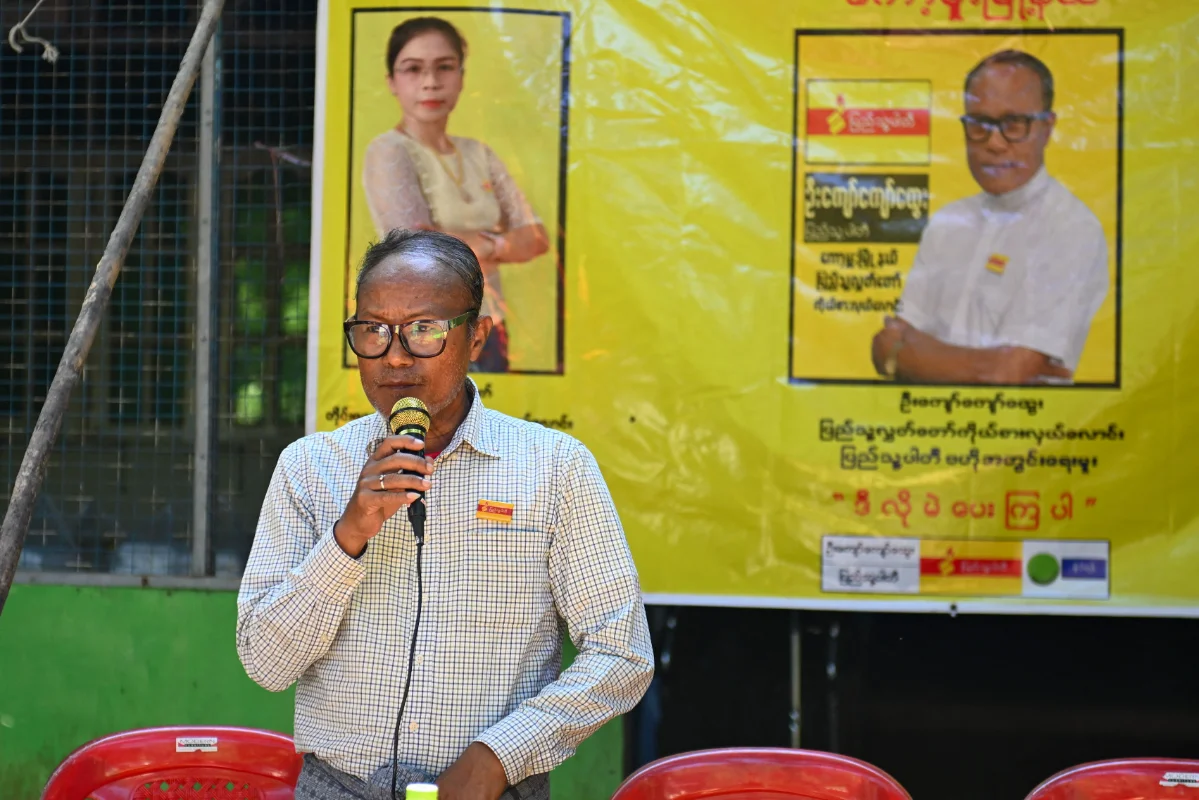
Ex-junta prisoner Kyaw Kyaw Htwe runs for Aung San Suu Kyi’s former parliamentary seat in a military-managed poll, aiming to revive political engagement.
KAWHMU: A former political prisoner is campaigning for the parliamentary seat once held by Myanmar’s ousted leader Aung San Suu Kyi in an election organised by the ruling military junta.
Kyaw Kyaw Htwe, known by the nickname “Marky”, spent around 15 years in jail for pro-democracy activism alongside Suu Kyi during the 1988 uprising.
The 60-year-old candidate for the People’s Party is now vying for votes in the Kawhmu constituency, a district south of Yangon that Suu Kyi represented before the 2021 coup.
“We do not expect the whole country will be covered with gold after elections,” Marky told AFP.
“We can get other opportunities step-by-step, only when the country has stability.”
The military, which seized power in 2021, has scheduled new polls pledging a return to democracy, a move many international observers dismiss as a rebranding of military rule.
Criticism of the vote is punishable by up to a decade in prison under a junta crackdown.
Marky’s campaign in Kawhmu focuses on reviving political engagement in an area where apathy has set in since Suu Kyi’s detention.
“People here have let politics go since Daw Aung San Suu Kyi was detained,” he said.
“Politics has disappeared lately. So we have to try to get it back on track.”
His campaign involves unglamorous, slow work by volunteers in party colours, often speaking to just handfuls of voters at a time.
“Now doing politics is being seen as committing a sin,” Marky added.
His wife, Su Su Nway, a more ebullient campaigner, uses loudspeakers to curry support by alluding to Suu Kyi, whose party she once joined.
Casting herself as a proxy, she tells locals: “I’m mother’s daughter. Please do not say that mother cannot come.”
Suu Kyi’s son, Kim Aris, based in Britain, views anyone running to overwrite his mother’s 2020 mandate as delusional.
“Some people just lose their path,” Aris said.
“This is so far from being free and fair that anybody even being involved in it is just being delusional.”
Some Kawhmu voters, however, approach the poll with a nothing-to-lose mindset.
The new parliament will reserve a quarter of its seats for army officers, with the pro-military Union Solidarity and Development Party considered the frontrunner.
Marky may find himself serving in an opposition deemed illegitimate by many, but he remains committed to participation.
“We believe there will be a beginning of a better road after the election,” he says.
“If we do not do this work, who else will?”



