



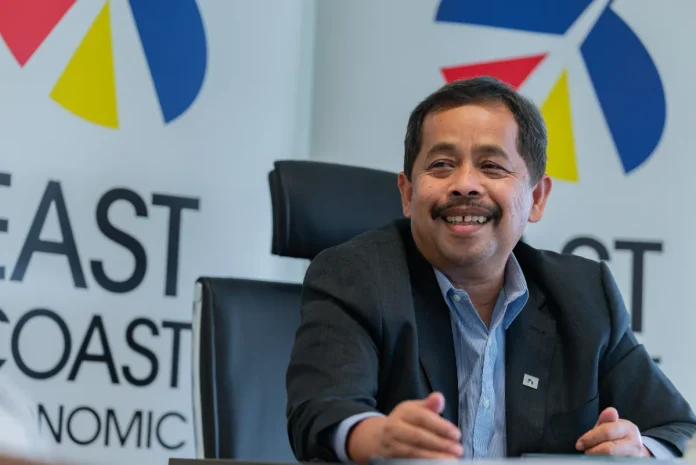
KUALA LUMPUR: The East Coast Rail Link (ECRL) is set to be a transformative catalyst for economic growth in the East Coast Economic Region (ECER), reshaping the region’s development landscape by unlocking new investment opportunities, accelerating job creation, and significantly improving quality of life.
East Coast Economic Region Development Council CEO Datuk Baidzawi Che Mat said once operational, the mega rail infrastructure project is expected to enhance connectivity between the east and west coasts of Peninsular Malaysia, stimulate industrial expansion, and position the ECER as a more competitive and attractive destination for both domestic and foreign investors.
“I must say that the ECRL will be a game-changer. It will fundamentally change the way goods are moved, allowing exports to flow both ways more efficiently. When you look at shipping and sailing times, logistics ultimately comes down to time – and the ECRL addresses that challenge directly.
“Kelantan will have 2 ECRL stations, and it is only a matter of time before logistics activity, industrial development, and broader economic growth begin to take shape along the rail corridor.
“We have key transit-oriented developments such as Kota Bharu Central, Kuala Terengganu Central and Kuantan Central. Several stations are located within or near industrial areas, including Kemasik. With the ECRL in place, workers will be able to commute more easily to and from these industrial hubs,“ Baidzawi told SunBiz in an exclusive interview.
Baidzawi said when Kuala Lumpur began developing in the 1960s and 1970s, Petaling Jaya was merely a satellite town.
At the time, he added, people preferred to live closer to the city centre – places such as Kampung Baru, Kampung Pandan or Ampang. Even in the 1980s, areas such as Damansara were not considered desirable residential locations.
However, as industrialisation and economic activity expanded in Petaling Jaya, the dynamics changed.
“Today, people no longer aspire to live in the city centre; they prefer areas such as Damansara. Applying that analogy, we can expect the ECRL to usher in a similar transformation in the future.
“In the future, people may choose to live in places like Bentong. With the ECRL, travel time from Kuala Lumpur to Bentong could be as short as 15 to 20 minutes. Bentong offers a greener and more pleasant living environment, and I believe it has the potential to become the Petaling Jaya of Kuala Lumpur,” Baidzawi said.
Moving on, Baidzawi remarked that the EDERDC’s focus is to ensure that investment and infrastructure translate into direct benefits for people and businesses across the ECER.
Over the next five years, the agency will prioritise four core clusters – food security through agriculture, tourism, green and advanced manufacturing, and the marine economy.
For food security, Baidzawi said, the strategy is to scale up high-tech agriculture and reduce import dependence by facilitating private sector participation through enabling infrastructure, targeted grants, and incentives.
Pointing to tourism, he said the East Coast has world-class islands, but growth must be supported by practical, high-impact infrastructure such as jetties, waste and sewage systems, and reliable utilities to protect the environment while meeting rising demand.
On manufacturing, Baidzawi stated that the region is decisively moving towards green growth, which includes renewables and carbon capture, utilisation and storage. This shift leverages assets such as depleted oil and gas fields as potential carbon storage sites.
Additionally, strategic minerals such as rare earths and silica must be developed through downstream processing on the East Coast to retain value instead of exporting raw materials, he said.
“For the marine economy, there is a significant opportunity to localise value capture by building domestic repair, maintenance, and overhaul capabilities so vessel servicing and related work no longer flow to other hubs. This will require a clear public-private partnership approach, with the government playing its role to derisk investment and strengthen local capabilities.
“Across all clusters, technology adoption – including AI and Industry 4.0 – will be a key lever to raise productivity, attract higher-quality investments and accelerate sustainable growth in the region,” Baidzawi said.



