




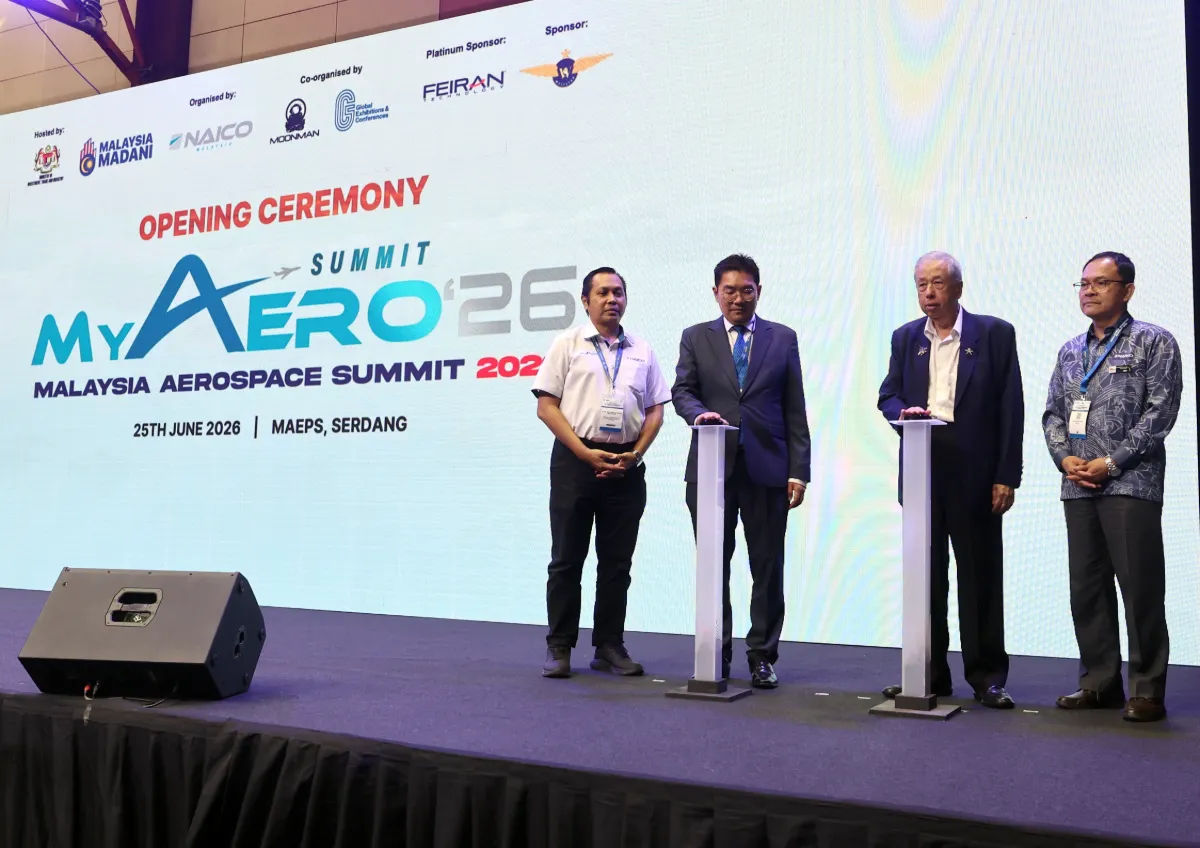
SERDANG: Malaysia’s aerospace industry is targeting revenue growth of 15% to 20% this year, driven by strong global aircraft demand, expansion in maintenance, repair and overhaul (MRO) services and increased production of critical aerospace components.
Deputy Investment, Trade and Industry Minister Sim Tze Tzin said the outlook remains positive as aircraft manufacturers continue to face delivery backlogs, creating opportunities for Malaysia to expand its role in the global aerospace supply chain.
“Looking at the trend of global aerospace expansions, we are looking at 15% to 20%. Aircraft are in great demand, and both Airbus and Boeing still have delivery delays, so there is a lot of capacity that we can grow exponentially,“ he told reporters today after officiating the opening of the MyAERO Summit 2026 at the Malaysia Agro Exposition Park Serdang.
Malaysia is currently home to about 250 aerospace companies that generate approximately RM32.5 billion in annual revenue, with strengths in MRO, advanced manufacturing, and the production of critical aircraft components.
Sim said the country’s MRO capabilities remain a key growth driver, supported by an established aviation ecosystem that includes major airlines such as AirAsia and Malaysia Airlines, as well as Singapore Airlines’ expansion of maintenance operations in Malaysia.
“Malaysia is very famous for MRO. This is a space where we have significant strength. We also manufacture critical components, and these activities complement one another within the aerospace ecosystem.”
He added that sourcing critical components locally enables MRO providers to access them more quickly while allowing Malaysian engineers to gain valuable technical know-how and design capabilities through maintenance operations.
Sim said Malaysia’s aerospace capabilities received greater international recognition during the Covid-19 pandemic, when movement restrictions disrupted exports of locally manufactured aerospace components, underscoring the country’s importance in global supply chains.
“Malaysia’s aerospace equipment and components became very critical to the global aerospace supply chain. During that time, Malaysia’s name became recognised globally as an aerospace hub,“ he added.
Looking ahead, Sim said the government wants Malaysia to evolve beyond being an MRO destination into a comprehensive aerospace ecosystem encompassing manufacturing, technology development, talent and emerging aviation segments.
He said dedicated aerospace clusters such as the KLIA Aeropolis, the Subang aerospace hub and other industrial parks are strengthening Malaysia’s attractiveness to global aerospace investors. “We want to build more ecosystems in Malaysia. There is increasing international interest in Malaysia’s aerospace capabilities.”
Beyond conventional aerospace, Sim said Malaysia also aims to position itself as an early participant in the emerging low-altitude economy, which covers commercial drone operations, autonomous aerial systems and electric vertical take-off and landing aircraft.
Miti, together with its agencies, including National Aerospace Industry Corporation Malaysia (Naico Malaysia), will work with industry players to develop policies supporting the new sector.
“This is a new space. It is a new industry that not many countries have entered. If we are among the first movers, we will enjoy the first-mover advantage,“ Sim said.
In his opening remarks earlier, the deputy minister said Malaysia’s aerospace ambitions have progressed beyond attracting manufacturers to building an integrated ecosystem that connects investors, suppliers, technology providers, universities and government agencies.
He noted that aerospace has been identified as one of the strategic industries under the New Industrial Master Plan 2030 because of its high technological intensity, its ability to generate high-value business opportunities, and its contribution to developing skilled talent.
To strengthen the sector, Sim said, several ongoing initiatives, including the Aerospace Industry Ecosystem Enhancement and Innovation Fund, which has evolved into Malaysia’s first blended financing mechanism combining grants, subsidies, soft loans and equity financing to help SMEs expand and secure contracts with global original equipment manufacturers.
He highlighted the rollout of the Malaysia Aerospace Digital System, a national digital platform linking manufacturers, MRO providers, airlines and regulators, as well as the MyAERO Centre of Excellence, which focuses on robotics, automation, advanced materials and augmented and virtual reality technologies.
In addition, Malaysia is expanding local aerospace certification capabilities through Sirim QAS by offering AS9100 certification for manufacturers, developing AS9110 certification for MRO organisations and planning AS9120 certification for aerospace distributors as demand grows.
Sim said the government’s objective is to ensure discussions at MyAERO Summit translate into tangible outcomes. “The measure of success is clear: conversations must lead to contracts, interest must lead to investment, and connections must lead to technology partnerships and stronger regional supply chains.”



