




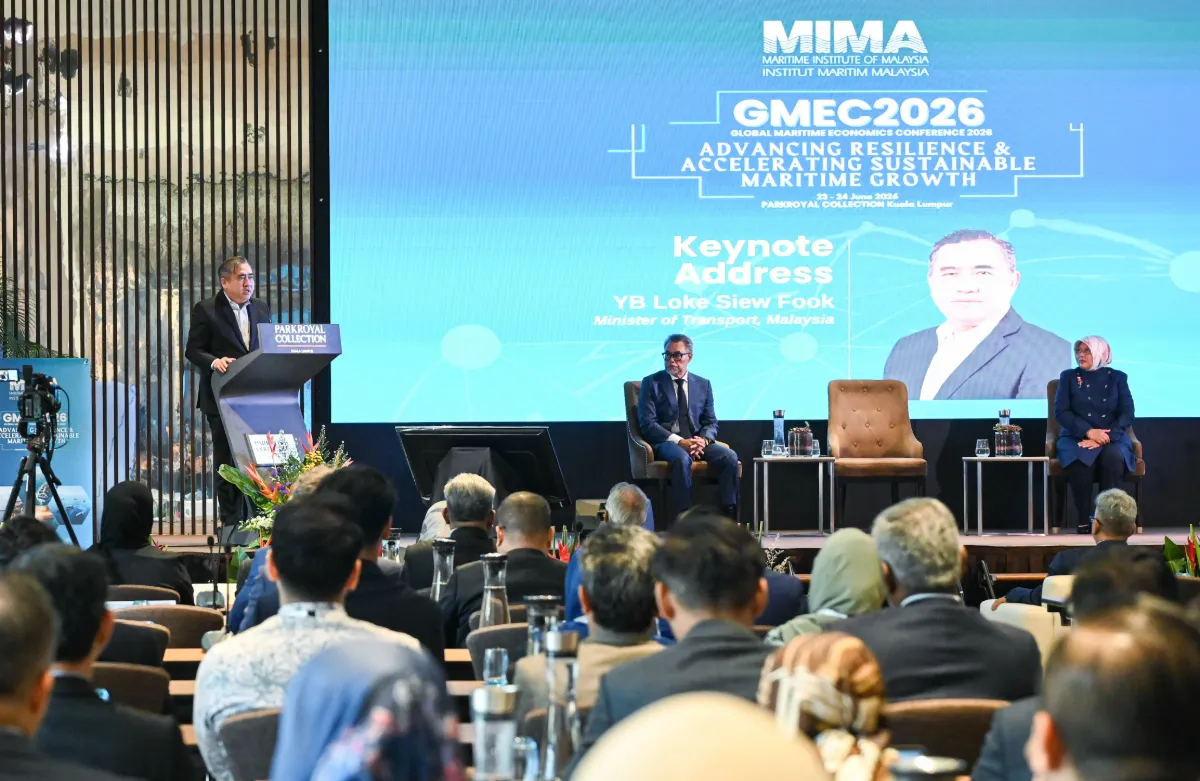
KUALA LUMPUR: Malaysia is tapping into new trade flows as global shipping routes shift amid rising geopolitical tensions, with maritime chokepoints such as the Strait of Hormuz and the Red Sea reshaping the dynamics of international trade.
Transport Minister Anthony Loke Siew Fook said the global shift has direct implications for Malaysia’s energy security, inflation and economic stability.
“Approximately half of Malaysia’s crude oil supply is linked to shipments that must pass through the Strait of Hormuz. Any disruption in the corridor could quickly reverberate through domestic fuel prices, public finances and the broader economy,” he said in his speech at the Global Maritime Economic Conference 2026 today.
Loke highlighted how recent conflicts and security risks have forced vessels to reroute, increasing average shipping distances, fuel consumption and freight costs.
These pressures, he said, are ultimately transmitted to consumers through higher prices.
Malaysia has so far cushioned the impact through targeted fuel subsidies and market interventions, shielding households from the full brunt of global oil price volatility.
However, Loke acknowledged that such measures come at a steep fiscal cost, requiring billions of ringgit in government spending each month.
Against this backdrop, he stressed the need for Malaysia to move beyond a reactive approach and instead build a resilient, future-ready maritime economy. “The maritime sector can no longer be viewed strictly through the lens of logistics; it must be treated as a cornerstone of national economic sovereignty.”
Central to this strategy is leveraging Malaysia’s location along the Strait of Malacca, one of the world’s busiest shipping lanes, which handles roughly a quarter of global trade.
As global shipping routes shift to avoid high-risk areas, Malaysia is well-positioned to capture increased traffic and reinforce its role as a key logistics and transshipment hub.
The government is focusing on three pillars – resilience, connectivity and cooperation – to drive this transformation.
This includes accelerating port modernisation, deploying advanced automation, strengthening maritime security and expanding multimodal logistics networks.
Major infrastructure projects such as the East Coast Rail Link, which will connect Port Klang on the west coast to Kuantan Port on the east coast, are expected to enhance land-sea connectivity and create new trade corridors linking Southeast Asia to China and Central Asia.
At the same time, Loke said, Putrajaya is seeking to revitalise the bunkering sector, which has lagged due to fragmented oversight and regulatory complexity despite Malaysia’s strategic location.
Efforts are under way to streamline regulatory processes and position the country as a competitive hub for marine fuel supply, including emerging low-carbon alternatives such as liquefied natural gas (LNG), ammonia and methanol.
Beyond Peninsular Malaysia, developments in East Malaysia are also gaining momentum.
The transition of Bintulu Port to state control is expected to strengthen Sarawak’s role in the global LNG trade and support its ambitions in new energy.
Loke said these initiatives are part of a broader effort to transform Malaysia’s ports from mere gateways for imports and exports into engines of economic activity that can attract investment and generate higher value-added services.
He said that maintaining open and secure sea lanes is critical, as more than 80% of global trade is carried by maritime transport.
Disruptions, whether caused by conflict or accidents, can trigger cascading effects across supply chains, energy markets and food security, Loke noted.
As such, he added, Malaysia is emphasising regional and international cooperation, alongside investments in digitalisation, maritime cybersecurity and sustainable infrastructure, to ensure long-term resilience.
“With our strategic location, strong infrastructure and proactive policies, Malaysia has the opportunity not only to weather global uncertainties but to emerge stronger as a leading maritime and logistics hub,” Loke said.



