



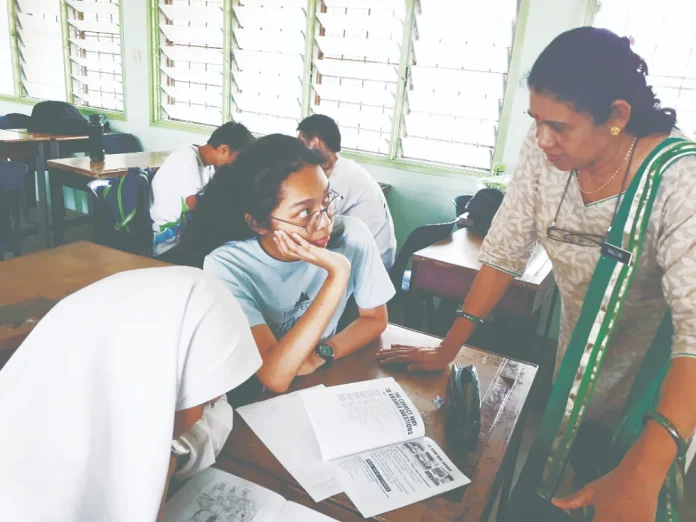
An independent scholar argues anti-corruption and governance values must be taught from a young age to build a foundation for national development.
RECENTLY I attended a MOU signing ceremony between Malaysia’s Anti-Corruption Commission (MACC) and a private university, only to be overwhelmed by a feeling of great disappointment at the amount of rhetoric on the need for integrity and governance at all levels in Malaysia.
Why? Simply because it struck me as being late in the day to bring integrity and governance to adults, who probably had not been exposed as to how corruption and lack of integrity weakens the very foundation of government.
There is a saying, “when the fox is already in the chicken coop, it’s too late to close the door”, describing a situation where a person who cannot be trusted is put in a position of trust and it then becomes late in the day to remedy the situation. Corruption should therefore be taught at an age, where it can be understood, sooner rather than later.
A nation such as Malaysia cannot hope to join the ranks of developed nations, if we become well-known for the wrong reasons, and sustained prosperity depends not only on economic growth but also on fairness, social cohesion, accountability and public confidence in the system.
To nurture leaders at a young age, who value honesty and integrity requires a community to work together, parents, educators, caregivers, religious bodies to emphasise its importance and the benefits it brings to a nation.
For the younger generation, there is temptation to choose shortcuts to reach the final goal of being top in class, top in school, university and so on. Using AI is one way to reach the top. Plagiarism is rife in schools and universities, showing there is systemic failure in the education system to even teach honesty in schools. Is this then to be carried forward to their adult lives?
While there are some initiatives such as anti-corruption and integrity courses in higher learning institutions, they are still few and not sufficient to address the issue.
Starting young
Dr S. Munirah Alatas, independent scholar, author and researcher who served as former deputy director and principal research fellow at the Allianz centre for governance, Universiti Malaya believes integrity and governance should start at a young age and said:
“These values must be taught at a young age, ideally from primary school itself. For the politician or anyone planning the nation’s education, it is necessary for them to conceptualise planning into four parts, involving manpower (ie teachers and staff), building, finance and administration, methods and content of education and aims and ideals of education.
“Numbers three and four are vital when planning a system, and ideally all four components must link up to produce a broad-based, flexible and diverse education goal for Malaysia.
“Embedded in this goal is the need to educate about integrity, good governance, ethics, compassion for our fellow human beings, respect for diversity and guardianship of the planet.
“These values apply to the teachers and staff of the schools (manpower), to those responsible for the finance and administration of schools, and to those who devise the contents of what school-going children learn in the classroom.
“All these values must be taught at a young age.
“After all, other aspects of child rearing and development such as learning to be polite, keeping to set routines daily to build disciplined character, “how to say please and thank you”, and how not to solve disagreements with physical violence are basic values that we teach children from a young age; we do not wait till they reach secondary school or even university,” said Sharifah.
When and how to embed integrity and good governance
Munirah shared the ways it could be embedded.
“Similarly, important subjects such as integrity and good governance must be taught, no matter how conceptually complex it may seem.
“There are experts whom the politicians and those tasked with mapping the nation’s education system can consult.
“Many academics and civil society groups are capable ‘watchdogs’ of the nation’s education.
“They are very capable of helping to create teaching modules that are simple and fun, while conveying philosophical messages of ethics and morality.
“It is therefore critical that young children are exposed to subjects on corruption, and bad governance in primary school.
“Lastly, it is very important to engage parents, civil society groups, academics and enforcement agencies on how to formulate modules so that children remain engaged and understand complex concepts embodied in the study of corruption and governance.
“There must be an “all of society” approach to this,” she added.
Munirah also added that the Ministry of Education (MOE) receives the lion’s share of the budget for Malaysia annually.
“It would be excellent if they can redirect some of the funds for research in this area and then train teachers to deliver at all levels.
“Teaching about why corruption is bad and giving examples of how it retards society is important,” said Munirah.



