




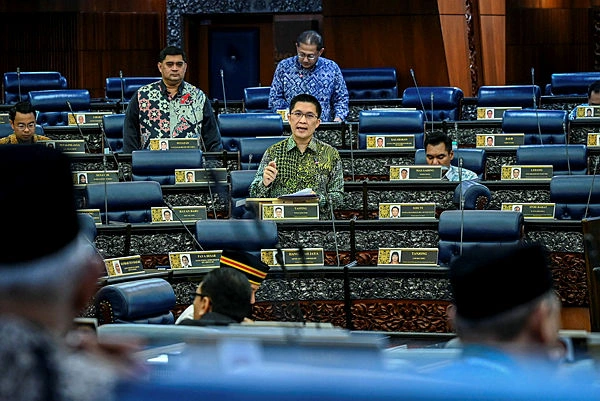
As of May 2026, 161,891 special needs students are registered at MOE institutions, with autism as the largest group in the learning difficulties category.
KUALA LUMPUR: The number of students with special needs registered at Ministry of Education (MOE) institutions stood at 161,891 as of May 31, 2026, Deputy Education Minister Wong Kah Woh said.
He said 141,545 students were in the learning difficulties category, with autism the largest group at 53,169.
The other categories recorded were intellectual disabilities with 39,254 students, followed by specific learning difficulties (24,148), ADHD (13,337), Down syndrome (4,501), global developmental delay (3,741) and other conditions (3,395), he said.
“Students with special educational needs under the learning difficulties category are provided access to education through the Integrated Special Education Programme (PPKI) at Special Education Schools, or the Inclusive Education Programme (PPI),” he said in Parliament today.
He said this in response to Tan Kok Wai (PH-Cheras), who asked about the number and categories of children with learning disabilities registered in the country, as well as the current capacity of the special education system to meet their needs.
As of May 31, this year, special education programmes were being offered in 7,406 schools nationwide, comprising 35 Special Education Schools, 2,907 schools with PPKI and 4,406 schools with PPI, Wong said.
Wong said the MOE was continuing efforts to improve physical infrastructure and welfare provisions for special needs students through national education development plans to support the rise in enrolment.
According to him, the government has approved eight new Special Education School construction projects from the 11th Malaysia Plan (11MP) to the 13MP, with one approved under the 11MP, five under the 12MP and two under the 13MP.
“Under the 12MP, the ministry approved 80 projects involving the construction of new or additional PPKI buildings, including five completed projects, 22 ongoing and 53 in the pre-construction phase,” he said, adding that the approved 38 special education building expansion projects under Budget 2026 are in the planning stage.
Meanwhile, Wong said the MOE had adopted the Industrialised Building System (IBS) as part of efforts to speed up the construction of the facilities.
He said 40 PPKI classrooms had been built in 10 schools using the method in 2025 and were already operational, while another 241 classrooms in 46 schools are targeted for completion this year for use next year.
Meanwhile, 95.8% of special education teaching posts nationwide had been filled as of today (July 9), he said.
He also said that from 2023 to July 2026, 1,055 new special education teachers were appointed to fill DG9 Education Service Officer vacancies, comprising 664 primary school teachers and 391 secondary school teachers.
In response to Tan’s supplementary question on the ratio of special education teachers to students, Wong said the MOE aims for a ratio of one teacher to seven students in PPKI classes, but acknowledged that the target is difficult to achieve, especially in urban areas such as Kuala Lumpur and Selangor due to high student numbers.
However, Wong said the MOE will continue to enhance recruitment and training for special education teachers to meet staffing requirements.
“The number of trainees projected to be admitted under the Bachelor of Teaching Programme for the special education option increased to 460 in 2025, compared with 194 in 2024, 100 in 2023, 90 in 2022, 180 in 2021 and 115 in 2020.
“This reflects the MOE’s commitment to training more special education teachers in the future,” he added.



