



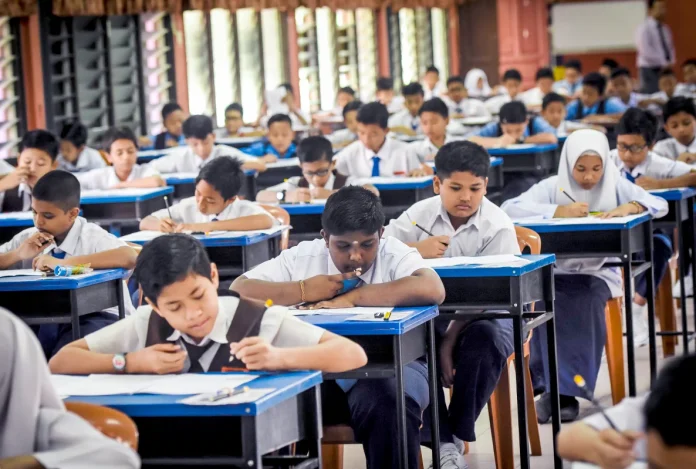
A new Year Four assessment in Malaysia aims to identify literacy and numeracy gaps, enabling targeted interventions and supporting post-UPSR reforms
KUALA LUMPUR: The implementation of a basic assessment for Year Four pupils is seen as a crucial reform to strengthen literacy and numeracy in primary schools. This move follows the abolition of the Ujian Pencapaian Sekolah Rendah (UPSR).
Deputy Vice-Chancellor (Student and Alumni Affairs) of Universiti Malaysia Terengganu Associate Professor Dr Mohd Izani Mohd Zain said the assessment should serve as a diagnostic mechanism. It will identify learning weaknesses early, allowing for targeted, data-based intervention plans.
He stated that the absence of a standard assessment post-UPSR necessitates a system to clearly gauge pupils’ mastery of basic skills. This is essential before they progress to more complex learning phases.
“In my view, an assessment is still needed so we can know the actual mastery level of pupils. However, preparations and involvement of all parties must be done earlier so that pupils and parents understand the real purpose of this assessment,” he told Bernama.
During the presentation of the National Education Plan (RPN) 2026–2035, Prime Minister Datuk Seri Anwar Ibrahim said the Year Four learning measurement will start in 2026. It will involve four core subjects: Bahasa Melayu, English, Mathematics and Science.
On Saturday, the Prime Minister stressed the measure aims to identify pupil weaknesses in reading, writing and arithmetic (3R) skills. This ensures interventions and recovery can be implemented early before they enter secondary school.
Commenting further, Mohd Izani opined the basic assessment should begin with a pilot project. School selection should involve urban and rural areas to comprehensively identify issues, challenges and readiness levels.
He also emphasised the importance of teacher and school readiness in implementing the assessment. There is a need to build understanding that the assessment is not meant to pressure, but to support pupil learning development.
“What is important is that this assessment should not be seen as a burden or pressure, but as a learning support tool to help pupils develop holistically,” he said.
Meanwhile, President of the Muslim Teachers Association of Malaysia (iGuru) Mohd Azizee Hasan said the proposed basic assessment aligns with learning recovery needs. This is particularly relevant post-COVID-19 pandemic and to address achievement gaps between schools and regions.
However, Mohd Azizee said the assessment implementation must not be rushed or exam-oriented. It should be understood as an educational diagnostic tool, not a mechanism to punish pupils, teachers or schools.
“Through this basic assessment, valid data can be collected to enable the Education Ministry to plan more focused recovery programmes,” he said. It will also help identify urban-rural gaps and strengthen parent confidence in schools’ systematic efforts to address literacy and numeracy issues.
Mohd Azizee also agreed on the need for a pilot project to test the suitability of assessment instruments for diverse pupil backgrounds. It will evaluate implications on teacher workload and ensure school readiness in terms of human resources and intervention support.
According to him, without a pilot, there is a risk the assessment becomes another administrative burden without real recovery impact.
He also cautioned that assessment results should not be used to evaluate teacher or school performance. Instead, they should form the basis for intervention planning, professional training and fairer distribution of support.
“iGuru supports efforts to strengthen pupil literacy and numeracy, but stresses that the success of this policy does not lie solely in the assessment. It depends on the system’s ability to support pupils and teachers comprehensively,” he said.



