




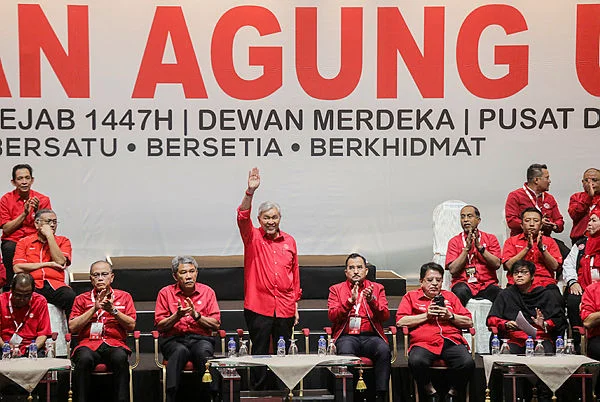
Move projects Umno as party willing to adopt more inclusive, magnanimous approach: Academic
PETALING JAYA: Analysts are divided over the effectiveness of Umno’s “Rumah Bangsa” agenda, with some viewing it as a successful consolidation strategy while others are questioning its long-term viability amid leadership rivalries among Malay-based parties.
Universiti Malaya political analyst Mohammad Tawfik Yaakub said Umno’s recent move to readmit several high-profile leaders reflects a deliberate strategy to strengthen the party ahead of the next general election.
“I see this so-called ‘political amnesty’ by Umno as part of a broader effort to reinforce the party. The return of influential figures such as Datuk Seri Hishammuddin Hussein, Khairy Jamaluddin, Tan Sri Syed Hamid Albar and others signals that the agenda is gaining traction.”
He added that the move projects Umno as a party willing to adopt a more inclusive and magnanimous approach, in contrast to its rivals.
“It shows Umno is taking a different path, being open and big-hearted, at a time when other parties are still embroiled in internal disputes, power struggles and fragmentation, including Bersatu.
“Even within the PN coalition, there are ongoing disagreements over leadership and seat allocations.”
However, Pacific Research Centre of Malaysia principle adviser Oh Ei Sun offered a more cautious assessment, saying the concept behind “Rumah Bangsa” is not new and faces structural challenges.
“You see, race-based parties have, from time to time, floated the idea of forming a broad umbrella to unite their respective communities, bringing together major personalities and parties under one platform.”
He added that similar initiatives have been proposed in the past, including during the tenure of incarcerated former prime minister Datuk Seri Najib Razak, who extended cooperation overtures to PAS.
“After 2018, especially during Tan Sri Muhyiddin Yassin’s administration, there were also efforts to align Umno and PAS, alongside other Malay-based parties. So, in essence, the ‘Rumah Bangsa’ or ‘umbrella’ concept is not something entirely new.”
While acknowledging that the return of former Umno leaders could strengthen the party’s hand, Oh emphasised that a more fundamental issue remains unresolved: leadership.
“The key question is: even if all the Malay-based parties come together, who will ultimately lead? Will it be Umno, PAS or Bersatu? More specifically, will it be the Umno president, the PAS president or the Bersatu president?” he asked.
Oh also pointed to emerging dynamics within the political landscape, including the possibility of new alignments led by figures such as former opposition leader Datuk Seri Hamzah Zainudin.
“These are critical questions that need to be addressed. But in reality, they are very difficult to resolve because everyone wants to lead.
“While there is consensus on unity in principle, each leader prefers unity on their own terms.”
He added that the concept appears to mirror an “Umno-plus” framework, positioning Umno as the central or “mothership” entity.
“But the question remains whether parties such as Bersatu and PAS would agree to such an arrangement. That is still uncertain.”
The agenda was mooted by party president Datuk Seri Dr Ahmad Zahid Hamidi during the last Umno annual general assembly in January.



