




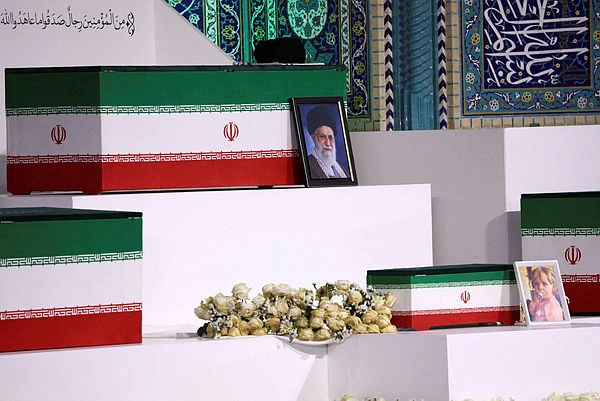
Iranians explain why they will not attend the late supreme leader’s funeral, citing safety, economic hardship and propaganda concerns.
PARIS: Iranians interviewed by AFP from Paris explain why they won’t be attending late supreme leader Ali Khamenei’s funeral, with some fearing for their safety and others not wishing to take part in a lavish ceremony while the Iranian economy suffers.
In the capital Tehran, residents reported fewer people than usual were out and about, with shops closed and roads leading out of the city packed, suggesting many did not want to take part in the ceremonies.
The multi-day funeral of the man venerated by many Shias, killed in US-Israeli strikes at the start of the Middle East war in late February, is taking place against the backdrop of a fragile US-Iran truce, and six months after major anti-government protests rocked the country.
‘Putting lives at risk’
Effat is a 67-year-old housewife in the northeast city of Mashhad: “My concern is that poor organisation could put people’s lives at risk. I also worry about the possibility of violence or a terrorist attack intended to gain international attention. When those kinds of tragic things happen, the authorities quickly blame foreign actors like Israel, or the opposition, before the facts are clearly established. I just hope everyone who attends returns home safely.”
Tehran emptying out
Azadeh, 43, is a translator in the capital Tehran: “From what I can see, many people in Tehran are actually leaving the city and escaping the messy, crowded city and ceremony. The city is unusually quiet. I don’t know who is supposed to make up the ’15 million’ attendees they’re talking about. People are saying government employees and even schoolchildren are being bused in from other cities to Tehran on Saturday. What worries me most is the safety of those kids. I just hope they don’t get crushed in the crowd.”
Overwhelmed by the atmosphere
Saeid, 29, is a tech worker in Tehran: “Despite the intense heat, the roads leading out of Tehran are packed. Many Tehran residents have already headed north, and I’m leaving too because staying in the city has become really difficult. The atmosphere feels tense. Many streets are closed, nighttime checkpoints are back, and the city is filled with security personnel and large numbers of people in conservative religious attire. It feels unsettling and I can’t bear this. My guess is they may be able to gather around four or five million supporters, and then the state media will probably claim that 20 million people attended.”
‘Where is this money coming from?’
Ali, 49, lives in Tonekabon on the shores of the Caspian Sea: “The government says it has planned food, drinks, accommodation, and other services for 15 million attendees. My question is: where did that money come from? In just the past few days, the price of bread and some basic food items has reportedly increased by as much as 30 percent. People are the ones already paying for it.”
Propaganda honouring ‘dictator’
Kaveh, 38, is a visual artist in Tehran: “This ceremony brings nothing to ordinary people except frustration. None of these so-called facilities, temporary tents, portable toilets, emergency internet, fast logistics, catering, or food supply, were ever properly provided for people in Iran during real crises like earthquakes or floods. Yet now, in a devastated post-war economy, they are spending the same people’s money on an extravagant and expensive ceremony for a dictator. This is nothing but another theft from the public’s pocket and propaganda for themselves.”
‘Two different bubbles’
Elnaz is a 32-year-old painter in Tehran: “For people like us, those who have ordinary lives, aren’t religious, and have no ties to the government, whether Khamenei was alive or not didn’t really change our daily lives, so it’s hard to see why this ceremony would matter to us. For years, it has felt like ordinary people and government supporters have been living in two completely different bubbles while being in the same country. This ceremony is no different from other state or religious events that attract only a minority of Iranian society.”



