




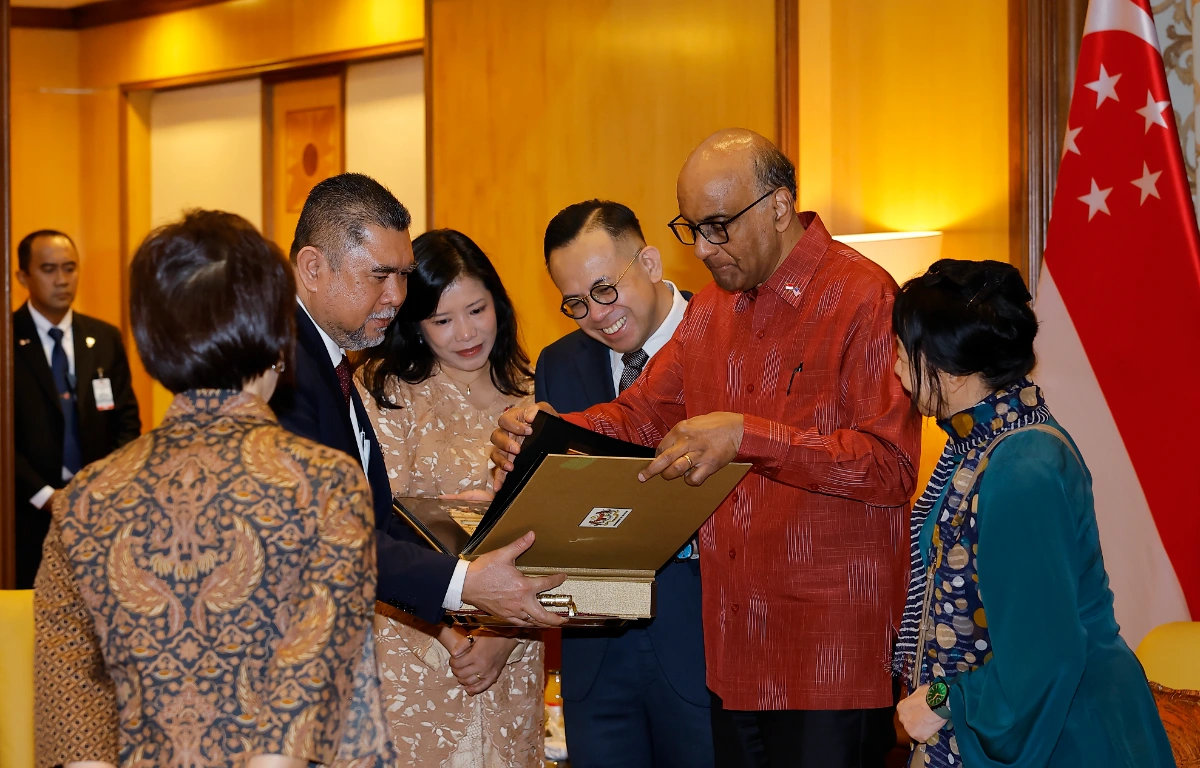
Singapore President Tharman Shanmugaratnam’s state visit to Malaysia underscores that a shared proverb can strengthen bilateral ties beyond pure economics.
THERE is a Malay phrase, “Jiran sepakat membawa berkat”, that roughly translates to “neighbours in agreement bring blessings”.
Singapore President Tharman Shanmugaratnam chose to close his recent state visit to Malaysia with that phrase, and it is worth asking why a head of state would reach for a local proverb rather than a diplomatic communique to sum up a relationship as complicated as this one.
Tharman’s four-day state visit, from July 12 to 15, was his first to Malaysia since taking office in 2023, and it followed His Majesty Sultan Ibrahim’s own state visit to Singapore in 2024.
He was welcomed at Istana Negara with full state honours and received by Prime Minister Datuk Seri Anwar Ibrahim, the kind of ceremony reserved for relationships that matter.
But what stood out was not the pageantry; it was the president’s insistence, in an interview ahead of the trip, that Singapore and Malaysia’s bond must never be reduced to a purely transactional one, even as the two countries deepen record levels of trade and investment.
That is a striking thing to hear from the leader of a country often associated with hard-nosed economic pragmatism.
And the numbers are, admittedly, impressive. Bilateral trade between January and May this year grew by roughly 14.5%, compared with the same period last year, and Singapore remains Malaysia’s largest trading partner in the region.
The Johor-Singapore Special Economic Zone and the Rapid Transit System Link connecting Johor Bahru and Woodlands are moving from paper to concrete, promising to turn the world’s busiest land border crossing into something closer to a daily commute than an ordeal.
Yet, Tharman kept returning to a different measure of success: people.
He noted that roughly 120,000 Singaporeans currently live and work across Malaysia and framed their everyday presence as the glue that keeps the formal partnership resilient when politics gets complicated.
He spoke of villagers in Kedah’s rice fields who showed him extraordinary warmth decades ago and of Malaysian food that Singaporeans have long claimed as their own comfort dishes too, laksa chief among them. This is worth sitting with because it reframes what a healthy bilateral relationship actually requires.
Malaysia and Singapore have never fully agreed on everything, from water arrangements to airspace to land reclamation, and they are unlikely to in the near future.
But Tharman’s own words were telling: It is precisely by addressing disagreements directly, rather than papering over them, that trust gets built between neighbours over time. That is a more mature model of diplomacy than the alternative, where minor disputes are left to fester until they explode into something bigger.
There is also a regional lesson here, one that extends beyond these two countries. At a moment when global trade is fracturing and geopolitical rivalries are hardening elsewhere, Malaysia and Singapore have kept choosing dialogue, restraint and respect for each other’s sovereignty.
Their cooperation on Asean’s Digital Economy Framework Agreement, expected to be signed later this year, and their joint bet on the Johor-Singapore Special Economic Zone, show two mid-sized nations deciding that pooling strengths beats guarding turf.
None of this erases the harder conversations still ahead, over labour mobility, wage gaps or how evenly the gains from deeper integration will be shared. Good neighbours do not pretend those questions do not exist.
But if this state visit demonstrated anything, it is that Malaysia and Singapore have built something increasingly rare in today’s world: a relationship confident enough to disagree without breaking and close enough that a shared proverb can still say more than a joint statement ever could.
Nevhan Phrassantha Naidu Puspakaran
Graduate in International Relations (Diplomacy and International Security)
National Defence University of Malaysia



