




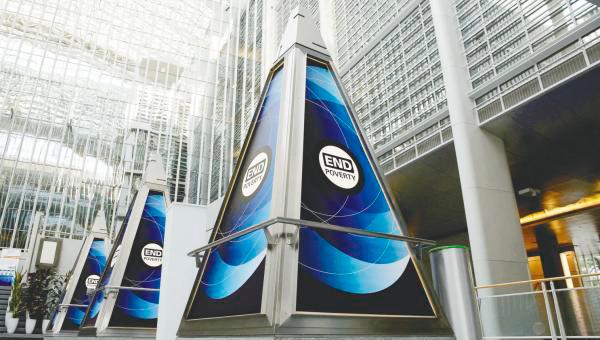
THE World Bank insists commercial finance is necessary for achieving economic recovery and the Sustainable Development Goals (SDGs), but does little to ensure profit-hungry commercial finance serves the public interest.
By failing to address pressing challenges within their purview, the second-ever Bretton Woods institutions’ (BWIs) annual meetings on the African continent, in Marrakech in October 2023, set the developing world even further back.
The International Monetary and Financial Committee, which oversees the International Monetary Fund, could not agree, by consensus, on the usual end-of-meeting ministerial communique for “geopolitical” reasons. The Development Committee, which governs the World Bank Group, fared little better.
New World Bank playbook
Little was achieved on crucial outstanding issues of governance reform and sovereign debt. Implicitly acknowledging past failure, World Bank Governors endorsed a “new vision to create a world free of poverty on a livable planet”.
After all, even the World Bank now acknowledges recent increases in global poverty have been the worst since the World War II as economic stagnation, debt distress and inflation spread across the developing world.
The Bank’s new Evolution Roadmap proposes a just energy transition plan to mobilise private capital to scale up, secure and deploy climate finance.
This is mainly for mitigation, rather than adaptation, let alone losses and damages.
The blueprint wants international financial institutions to help developing country governments de-risk private investments.
For Muchhala, this reflects “the failure of the Bank’s wealthy shareholders to help ensure a more equitable multilateral system that is truly fit for purpose to meet the challenges of the 21st century”.
Blending finance for private profits
The strategy proposes “de-risking” foreign investment with various types of “blended finance” – such as co-financing, loan guarantees, political risk insurance or public equity co-investments – as well as complementary legal and other reforms.
The Bank and its allies have been promoting “blended finance” for development, the environment and global warming since before the 2008 global financial crisis.
Their main recommendation has been to induce profit-seeking private capital to fill growing financing gaps.
Undoubtedly, most poor developing countries have limited public resources to make needed social and environmental, including climate investments.
In such arrangements, public funds are used to de-risk or otherwise subsidise commercial finance, ostensibly to serve public policy priorities.
However, private commercial involvement in public services and infrastructure is costly and risky for the public sector and citizens, by deploying limited public resources for private gain.
Civil society and other critics have already expressed grave concerns about the new roadmap.
The World Bank Group also set up a Private Sector Investment Lab to scale up private finance in developing economies.
It claims to be creating a “business-enabling environment that unleashes private financing”.
Billions to trillions
The World Bank’s “billions to trillions” slogan has been the pretext for privileging commercial finance as supposedly necessary to achieve the SDGs.
But it has done little to ensure that such profit-seeking private investments will help achieve the SDGs or otherwise serve the public purpose.
The Bank does not consider that profit-seeking private investments expecting attractive returns may not serve the public interest and priorities. Nor do they necessarily support desirable transformations.
Worse, their economic, social and environmental consequences may be for the worse.
The privatisation of previously public social services and infrastructure has worsened development and distribution.
Unequal access to public services – increasingly linked to affordability and ability to pay – threatens hundreds of millions.
Such blended finance arrangements have also contributed to the debt explosion in the Global South – exacerbating, rather than alleviating developmental, environmental and humanitarian crises.
Debt distress spreading
Developing countries are in their worst-ever debt crises, with debt service obligations higher than ever before. Current debt-to-GDP ratios are more than twice those of low-income countries before the 1996 HIPCs’ (heavily indebted poor countries) debt relief came into effect, and even higher than for Latin American nations before the 1989 Brady plan.
Unlike the 1980s’ sovereign debt crises, market finance is now more important.
Much more government debt from commercial sources involves relying on bond markets, rather than commercial bank borrowings.
With official credit much less important, commercial finance has become much more important compared to the 1980s.
Unlike official creditors, most private creditors typically refuse to participate in debt restructuring negotiations, making resolution impossible.
Debt servicing costs equal the combined expenditure for education, health, social protection and climate.
In Africa, debt servicing has risen by half. Debt service levels of the 139 World Bank borrowers are higher than during the HIPCs and Latin American debt crises peaks.
Debt service is absorbing 38% of budget revenue and 30% of spending on average by developing country governments.
In Africa, the levels are much higher, at 54% of revenue and 40% of spending!
The BWIs’ joint debt sustainability framework insists debt-distressed economies must have lower debt-to-GDP ratios than other countries, limiting this LICs’ external ratio to 30% or 40%.
This BWI policy effectively penalises the poorer and more vulnerable nations.
In 38 countries with over a billion people, loan conditionalities during 2020-22 resulted in regressive tax reforms and public spending cuts.
Less expenditure has hit fuel or electricity subsidies and public wage bills, deepening economic stagnation.
Despite severe debt distress in many developing countries, no meaningful debt relief has been available for most.
The most recent debt restructuring deals have left debt service levels averaging at least 48% of revenue over the next three to five years.
Debt distress limits government spending capacity, desperately needed to address social and environmental crises.
Hence, overcoming stagnation and achieving the SDGs will require much more debt cancellation, relief and borrowing cost cuts. – IPS



