




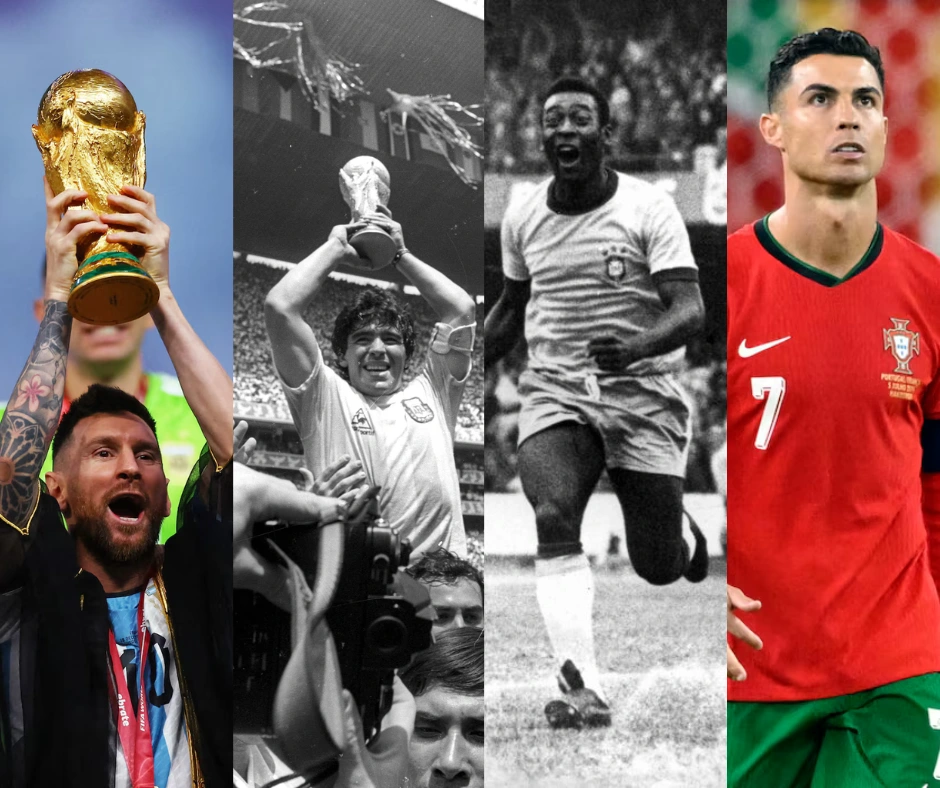
Lionel Messi and Cristiano Ronaldo set new World Cup records, but the GOAT debate ignores football’s romantic soul.
THIS could very well be the definitive story waiting to be written, or perhaps, more accurately, the exhausting parable that will be endlessly narrated for weeks, maybe months, maybe even generations to come.
However long it takes, this has been an ongoing, relentless psychological war.
Following a historic week at the 2026 World Cup, the footballing universe has fractured once again along its predictable fault lines. Over in Dallas, Lionel Messi struck a clinical brace against Austria to claim 18 total tournament goals, eclipsing Miroslav Klose’s long-standing record of 16 to become the all-time leading scorer in World Cup history.
Not to be outshone, Cristiano Ronaldo immediately responded in Group K, slamming home two goals against Uzbekistan to become the first human being to score in six entirely different World Cups.
Naturally, their congregations of faithful internet trolls went on another rampage on social media to determine, yet again, who is the true and final greatest.
If you ask me, this has turned out to be a fascinating sickness. We’ve turned the world’s most beautiful game into a highly rigid corporate spreadsheet.
If you suggest to a modern football fan that a player is a genius, they don’t look at his touch, but they look up his expected assists. It’s akin to staring at Leonardo Da Vincci’s Mona Lisa, and saying, “Yeah, it’s nice, but how many grams of paint did he use? What’s his brushstroke efficiency per minute?” You’ve completely missed the point of the game.
In light of this, I must explicitly take back what I wrote about Ronaldo in my previous chapter.
After watching him ruthlessly carve open Uzbekistan to claim his sixth historic tournament milestone, the reality is undeniable: the man remains one of the absolute greatest of all time.
The durability of his excellence is a monument to human willpower. But why does the modern world insist that metrics are the only way to validate CR7, Messi, or anyone else for that matter.
To try and comprehend this repetitive madness, I decided to conduct my own grassroots research, sampling the collective wisdom of the ordinary folk around me.
The older consensus remains beautifully, hilariously stubborn: Pele is the greatest of all time. Why? Because, as a couple of purists told me: “He made the world fall in love with football”. Another insisted, “He opened the world to what football could actually be, even his misses were so skilfully done!”
Everyone in the world wants to get into this conversation.
Being someone who was born in the 1980s, we all grew up with someone who allegedly played for some historical local side.
My late Godfather, for instance, proudly claimed until his final days that he turned out for the Kluang Chinese Football Club. There is absolutely no archive or database on earth to verify this, rendering it just as beautifully unprovable as the myth of Arthur Friedenreich’s legendary tally of over 1,000 goals. But my Godfather remained fiercely convinced that Pele was the supreme deity because his logic was rooted in physical suffering.
I totally understand the comparison, because back then, the leather balls were heavy enough to cause concussions, the pitches were soft, wet and muddy. A brutal two-footed tackle was routinely dismissed with a casual wave of the referee’s hand, the same gesture the referee gave when Messi allegedly handled the ball when Argentina faced Netherlands in the 2022 world cup.
The subscribers of Messi-ism and Cristiano-ity may argue that if the two legends played back then, their talent is transcendent that they’d still be at the absolute top. For me, that is something arguable. However, the aesthetic contrast between the two modern giants is entirely self-evident.
Ronaldo is biomechanically engineered, a product of pure, unadulterated human will, sprinting in perfectly straight lines, and jumping higher than the laws of physics should allow. He is a predator of space. Messi is a glitch in reality.
He operates in the tightest space, shifting his center of gravity to drop a shoulder so subtly that defenders fall over without him ever touching the ball. Ronaldo demands your awe; Messi begs your disbelief.
While I profoundly disagree with both of them being the greatest of all time, I also understand that this is the beautiful, entirely unquantifiable nature of footballing opinion.
In my humble opinion, when you watch the footage of the game’s historic past, the modern obsession with statistics begins to look shallow.
How do Messi and Ronaldo truly look when lined up next to the romantic ghosts of the past?
My former Sports Editor, Navjeet Singh, just like his close friend, the late Raj Kumar Soman, who was the Photo Chief, offered a completely different gospel.
They firmly believe Diego Armando Maradona is the greatest to ever lace a pair of boots, simply because, as veteran newsroom person, they love a flawed genius.
If any impact, measured by my data, is the only metric we are allowed to measure greatness by, then surely we should be calculating exactly how many grams of substance Diego Maradona ingested before dragging Argentina to a World Cup triumph. That is a real impact. That is heavy lifting.
Ultimately, this data-driven debate completely ignores the human element.
Pele won three World Cups, but because he spent his peak years in South America, the football-data-obsessed modern critic claims he never tested himself in Europe.
Maradona was fundamentally a chaotic, unpredictable force of nature, yet he still single handedly engineered a World Cup for Argentina through sheer genius.
George Best was arguably the most naturally gifted genius to ever emerge from the Manchester United academy. A rockstar who treated elite defenders like temporary inconveniences before completely disappearing into the Belfast night, yet because he carried the passport of Northern Ireland, he never stepped foot on a World Cup pitch.
Johan Cruyff didn’t just play the game, this man fundamentally invented the modern spatial architecture of it, shifting the tectonic plates of tactical thought forever. Yet, because he failed to win a World Cup final, are we to foolishly claim he isn’t the best? Even Ronaldo Nazario played a massive portion of his career with one good knee, yet he still managed to win two World Cups and completely tear the continent of Europe to shreds, and who are we to say he’s is not the best ever?
In the early 2000s, Zinedine Zidane did not need to score forty goals a season when he moved across the pitch like a dancer in slow motion. Ronaldinho played the game with a permanent smile, treating the highest pressure environments on earth like a casual kickabout on the beach in Copacabana, inventing tricks that felt like pure witchcraft.
And if we are talking about the sheer, unadulterated romance of the game, how do they compare to our very own Supermokh, Mokhtar Dahari?
Long before the multi-million dollar deals sanitised the sport, Supermokh ran at the English defense in 1978 to score that iconic equaliser against Bobby Robson’s team, it wasn’t about data tracking. It was about raw, unfiltered national pride.
It is wonderful that we are having this conversation, but we must ask ourselves what it actually means.
If we strip away the romance, the character flaws, the nights I spent with my dad arguing why he hates Manchester United and Sir Alex Ferguson and the group WhatsApp debate on football, just to worship the spreadsheet and calculator, we haven’t found the GOAT. We’ve just forgotten how to love the game.



