




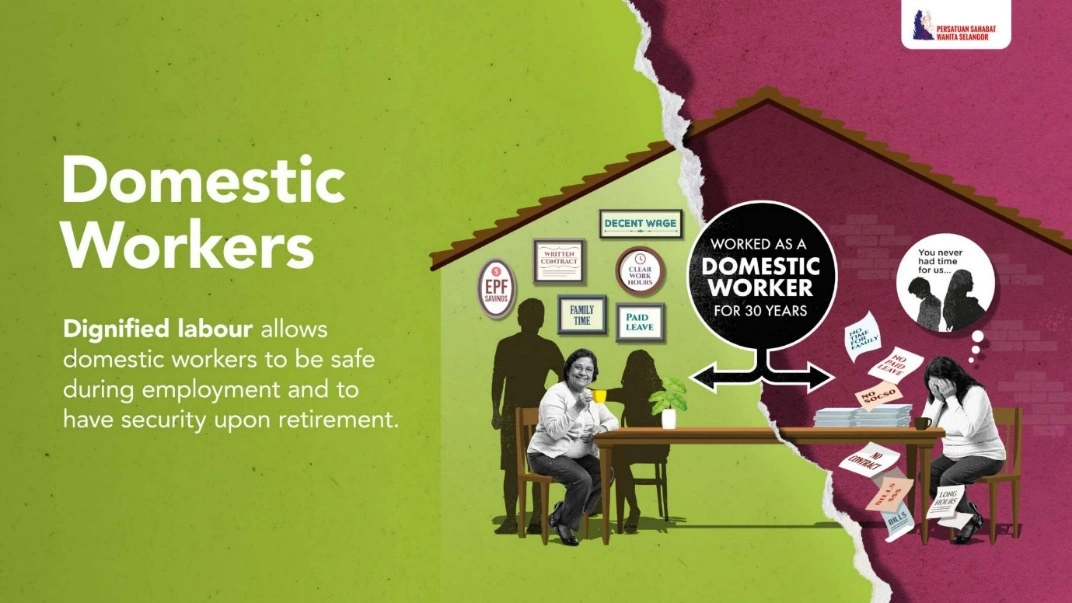
Older Malaysian domestic workers face retirement poverty due to legal exclusions from labour protections and savings schemes.
WHILE Malaysia determinedly pursues the goal of a “high-income” nation by 2028, a quiet phenomenon is unfolding in Malaysian homes.
This phenomenon is linked to the rapidly ageing population in Malaysia and its impact on a most vulnerable, low-income group of women whose working lives operate outside the protection of the Employment Act 1955.
The middle-class dream in Malaysia of a married couple pursuing their careers is made possible by a silent engine: marginalised, low-income women working as domestic workers. Yet, when these women grow old, the system remains oblivious to their living in poverty. This is not an accident; it is a phenomenon created by our laws that disregard the lives of the most vulnerable.
For decades, the government has treated housework and caregiving as not “real” work, explicitly leaving domestic workers out of the main protections of the Employment Act 1955.
As a result of this exclusion in the law, employers are not legally required to give local domestic workers set working hours, mandatory rest days, medical benefits or even a formal notice of termination.
While the nature of the work is every bit as demanding and backbreaking as any manual labour, there is a tendency to refer to domestic work as “flexible” work. As a result, women domestic workers are completely unprotected from various forms of abuse.
Childhood deprivations
A qualitative study undertaken by Sahabat Wanita (PSWS) profiling older Indian Malaysian women (aged between 40 and 60 years old, born in the 1980s and 1960s) with domestic work experience in the Klang Valley reveals that for many Indian Malaysian women starting out in this sector was never a free choice; it was a necessity born of systemic failures that began in their childhood.
Denied basic protections and facing deprivations, many dropped out of school as young as 12 to provide for impoverished families.
It is necessary to raise concerns about Malaysian laws that appear to have facilitated this denial of protections for such children. While Malaysia ratified the Convention on the Rights of the Child in 1995, which defines a child as a person under the age of 18, the country’s Children and Young Person’s (Employment) Act 1966 explicitly allows minors under 18 to be legally hired as “domestic servants”.
While the Employment Act of 1955 did recognise domestic work as “real worker”, in the 2022 amendment, the government wiped the archaic word “servant” from sections of the Employment Act in 2022, they have failed to remove this same word denoting system of servitude from the Children and Young Person’s (Employment) Act 1966.
While internationally Malaysia promises to protect children, laws like this still legally allow minors under 18 to be hired as “domestic servants”.
Women interviewed in this study recalled being sent to work full-time at just 12 or 16 years old (in the 1970s and 1990s), enduring long, exhausting hours and harsh treatment at the whim of their employers.
So painful were those years that even in their twilight years in the present, informants spoke with pain of the domestic abuse and humiliations they experienced as children in their families.
Ageing without savings
Informants spoke of decades of toil without relief or protection in their efforts to survive. For many, their daily struggles to survive brought little long-term security.
This is apparent as informants got older. Since they are not recognised as regular workers, employers do not have to contribute to their retirement savings. While the government noted that a person needs at least RM270,000 to retire securely, these women have little or nothing to secure their lives as they age.
While many informants strive to continue working as they age, health concerns loom large. Trying to balance the necessity for work with the reality of physical decline was a repeated concern in many interviews.
Years of heavy lifting, scrubbing and breathing in harsh cleaning chemicals have taken a brutal physical toll. Several of them suffer from torn muscles, frozen shoulders and severe asthma. Yet, they do not have the luxury of taking time to heal. The lack of savings means that they are forced to keep working until their bodies completely fail them.
One 62-year-old Indian Malaysian worker shared her anxiety: “I think about my health and how I have barely any savings… how much worse could it get when I’m older? I can’t depend on my children because they have their own families to care for. So I just think about earning money somehow to save for myself.”
For these women, working through the pain isn’t just about buying food; it is about survival and self-respect. In a world that judges worth by income, having no savings means a loss of dignity, even in family circles.
Another 47-year-old part-time worker explained the painful reality: “I think about it a lot because I don’t want people to say I’m sitting at home, living off others. If I don’t have my own money, even my husband and children will not respect me. I have experienced that too much… you must have money or else people really look down on you.”
Irony of our economy
The irony is that Malaysia’s economy depends on the unacknowledged labour of domestic workers. They are indispensable in a country where the growing demands for affordable public daycare centres and elderly care facilities are not adequately provided for.
Many homes, families and individuals are completely dependent on the services and often unseen contributions of domestic workers.
Domestic workers mind the children and care for the elderly of the middle class, freeing others to go out and boost the nation’s GDP while they themselves are denied basic labour rights.
To address social inequalities, the recent government initiatives have sought to provide some relief. However, these often appear to have failed to grasp the depth of problems that domestic workers are confronted with.
Recent government initiatives like “voluntary” retirement saving schemes are almost an affront.
A woman who is barely making enough to survive day-to-day cannot “voluntarily” save her way out of systemic poverty. While voluntary contribution schemes to the Employees Provident Fund and Socso sound like progressive steps, these are not always realistic initiatives for those whose resources are severely limited.
To make matters worse, existing welfare support schemes and others recently introduced are not always understood or accessible to many workers. Informants of the study spoke of being confronted by a confusing maze of bureaucracy when they did try to seek help.
This is a problem that has been highlighted by a World Bank report in 2026 that noted the problems with accessing social assistance schemes in Malaysia because they were spread across 26 different ministries.
Furthermore, the push to move all government services online effectively locks out older women who do not own smartphones or know how to navigate complex websites.
Real progress means legal dignity
If Malaysia is to claim its much anticipated “high-income” status with genuine pride, it must end this historical discrimination.
The Human Resources Ministry must change the Employment Act to fully recognise and protect domestic workers. Fair wages, safe working conditions, rest days, social security and proper training must be guaranteed by law and not left to the goodwill of individual employers. In doing so, the contributions of domestic workers can be recognised for what it truly is: a skilled, vital pillar of our economy. Becoming a wealthy nation on paper means nothing if the women cleaning our floors and raising our children are left unprotected.
True national progress is not measured by economic rankings and income thresholds; it is measured by how the country treats the people who hold homes and families together.
To read the complete study detailing the interviews with Malaysian domestic workers, visit Persatuan Sahabat Wanita Selangor website.



